Data Governance · Supplier Onboarding

Supplier Product Data Onboarding Framework for Manufacturers and Distributors

Supplier product data onboarding breaks down at the field level, not the file level. Three pieces fix it: a data contract that defines what “acceptable” means, a field dictionary that assigns an owner and a check rule to every attribute, and a workflow that keeps submission, validation, and approval separate.
Ceejay S Teku September 2, 2026
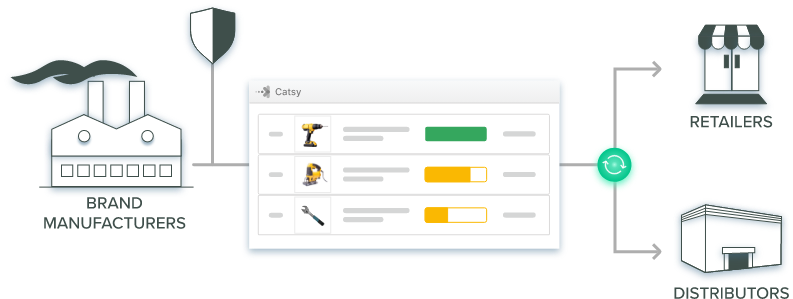
Catsy PIM, DAM, and GDSN connecting brand manufacturers with retailers and distributors through secure product data exchange
The short answer

Supplier product data onboarding works when three things are in place. A data contract tells suppliers exactly which fields, formats, values, files, and ID numbers you require. A field dictionary gives every field an owner, a source, a check rule, and a destination. And a four-step workflow keeps sending, checking, fixing, and approving apart, so one bad field cannot stall a whole submission.

Supplier product data onboarding breaks down at the field level, not the file level. A supplier can send exactly what you asked for, and the data can still be unusable. Why? Because “send us your product data” was never a clear enough request.

This article walks through a simple framework with three parts. First, a data contract that spells out what “acceptable” really means. Second, a field dictionary that assigns clear ownership to every piece of data. Third, a workflow that keeps submission, checking, and approval as separate steps.

Together, these turn a new supplier’s data into something channel-ready on a set schedule, instead of whenever someone finds time to clean it up. It is one piece of the wider discipline covered in our guide to manufacturing product data management.

In this article, you’ll learn:
Why supplier files are rarely ready to use, even when the supplier tried to follow your format
How to build a supplier data contract covering required fields, formats, accepted values, files, and ID numbers
How to build a field dictionary that assigns an owner, a source, and a check rule to every piece of data
Why sending, checking, fixing, and approving need to be four separate steps, not one blended process
Which numbers actually show whether supplier onboarding is getting better over time
Catsy PIM for manufacturers centralizing supplier product data into one governed catalog

Why Supplier Files Are Rarely Ready to Use

A supplier’s product data was built for their own systems, not yours. This shows up constantly for manufacturers who build finished goods from bought-in parts, where one product can depend on data from several suppliers at once.

Their item list matches their own business software. Their photos were organized for their catalog, not your store’s rules. None of that means the supplier did a bad job. It is a mismatch, and it shows up the same four ways almost every time.

What goes wrongWhat it looks like in practice
Formats clashOne supplier sends weight in pounds. The next sends kilograms. A third leaves the unit off entirely and expects you to guess.
ID numbers get inventedA GTIN is meant to be one unique number for a product across the whole supply chain, replaced when certain things change, such as the brand name or a certification mark on the pack. Reuse an old GTIN after a real product change and every system trusting that number breaks quietly.
Marketing detail gets skippedTitles, descriptions, feature bullets, and search keywords are the layer suppliers leave out. It matters most to you and least to them.
Photos arrive unnamedFiles are named however the supplier organizes their own folders. Nothing tells you which product, which angle, or which channel a shot is for.

You cannot fix any of this by asking suppliers to try harder next time. You fix it by replacing a vague request with a specific one. The cost of not doing so lands downstream, which is why accurate product information matters so much to B2B sales.

Build a Supplier Data Contract Before the First File Arrives

A supplier data contract is a written answer to one question: what do you actually need from us? It has five parts, and all five need to exist before you onboard a single supplier, not discovered one gap at a time after something breaks.

Contract partWhat it specifiesWhy it matters
Required fieldsThe exact field names that must be filled before a product is accepted at all: title, short description, category, weight, dimensions, and whatever else your catalog needs.“Product info” is not a specification. Field names are.
FormatsThe unit, structure, or pattern each field must follow. Weight in a set unit. Dates in a set format. Categories that match yours, not the supplier’s, which is where a governed product taxonomy does the work.A filled-in field in the wrong format still fails downstream.
Accepted valuesFor any field that is not free text, the exact list or range it must fall within.A material field that takes “Aluminum” but rejects “Alum.” and “ALU” is not being fussy. It is stopping five spellings of one fact from fragmenting your catalog.
FilesImage size, file naming rules, and which documents (spec sheets, certificates, manuals) are required or optional per product type.These need the same handling as any other digital asset, not a loose folder nobody has sorted.
ID numbersWhich system you require (GTIN, your own SKU, or both), and the rule for when a supplier needs a new one rather than reusing an old one.GS1’s Global Location Number works the same way for trading partners and locations. An ID only stays useful while everyone assigns it by the same rule. The same discipline governs product classification codes like UNSPSC and ETIM.
Secure GDSN product data exchange between brands, manufacturers, retailers, and distributors through Catsy PIM and DAM

Give this contract to a supplier before their first submission, not after their first rejection. A supplier who knows the rule in advance has a real chance of meeting it. A supplier who learns it from a bounced file learns it the expensive way, and so do you.

Build a Field Dictionary With Owner, Source, Rule, and Output

The data contract tells a supplier what to send. A field dictionary tells your own team what to do with it once it lands. Every field in the contract needs four things written down beside it.

Dictionary entryWhat it recordsThe test
OwnerThe specific person or role responsible for that field being correct.Not “the data team.” If a category is wrong, one named person should know it is theirs to fix.
SourceWhere the correct value comes from: the supplier’s submission, an internal enrichment step, or a system of record like your ERP. Our guide to how ERP, PIM, and DAM form a single source of truth covers how those hand-offs should work.If two sources can both claim to be right for one field, you do not have a contract. You have an argument waiting to happen. The same logic governs attribute ownership inside your own catalog.
Check ruleThe specific automated test that decides whether a value passes.Not “looks about right,” but something a computer runs: in a numeric range, matches an accepted list, fits a required pattern.
Where it goesWhich system actually consumes this field once approved.If a field is in the dictionary but nothing downstream uses it, cut it rather than maintain it.

A field dictionary also turns “supplier data quality” from a gut feeling into a number. Once every field has an owner and a check rule, “how good is this supplier’s data” becomes a question with an answer. That is what product data governance rests on. You cannot enforce a standard you cannot check, which is the argument behind using a PIM to make and keep your data clean.

Keep Sending, Checking, Fixing, and Approving Separate

Most supplier onboarding breaks because these four steps get blended into one messy cleanup phase. When they are treated as one step, a single bad field can stall an entire submission with no end in sight. Nobody has drawn the line between where cleanup ends and approval starts.

StepIts only jobWhat good looks like
1. SendingCapture exactly what arrived, before anyone touches it.A portal, template, or direct feed, with the raw submission preserved.
2. CheckingTest every field against its dictionary rule.A clear result per field: pass, or fail with a specific named reason. “This doesn’t look right” is not a check. It is work you are putting off.
3. FixingRoute failed fields to whoever can correct them.The specific field and the exact rule it failed, not a generic rejection of the whole file. One round trip instead of three.
4. ApprovingA named reviewer signs off.A deliberate checkpoint once every required field passes, not something that happens by default because nobody objected.
[TO FILL: describe this image for alt text before publishing]

Keeping these apart is also what shows where a managed approval workflow earns its place. Not as a rubber stamp at the end, but as the gate between “checks passed” and “this is live in the catalog.”

Track Three Numbers by Supplier

A framework nobody measures slides back into ad hoc cleanup within a few months. Three numbers, tracked separately per supplier, keep it honest.

MetricWhat it measuresWhat a bad reading tells you
First-pass acceptance rateThe share of a supplier’s submitted fields that pass checks with no fix needed.A low number is a signal to reopen the onboarding conversation with that supplier, not to keep patching their files forever.
Unresolved problemsHow many flagged fields are sitting unresolved, and how long they have been sitting.A growing backlog for one supplier is an early warning, long before it becomes a missed launch date.
Time to readyHow long from first submission to a product approved for publication.The number that really shows whether the framework works. A high field-level pass rate means little if a product line still takes six weeks.

Track these per supplier, not as one catalog-wide average. An average hides the single supplier costing your team ten hours a week among nine others whose data is fine. A short time-to-ready also speeds up sending products to each sales channel once approved, and it compounds: our guide to the impact of PIM on supply chain efficiency makes the case that supply chain problems usually start with product data rather than logistics.

Where This Fits With Other Supplier and Governance Work

This framework is deliberately about the small, practical pieces: the contract, the dictionary, and the workflow tying them together. That is different from the broader relationship case for working closely with suppliers, which Catsy’s guide to why manufacturers need a vendor portal covers in more depth. That guide explains why a shared intake channel helps the supplier relationship itself, not just your own cleanup workload.

The same groundwork is what Catsy’s supplier onboarding tools are built around. For distributors handling feeds from dozens of suppliers, a field dictionary is what keeps that work from becoming a full-time job. It matters most when data arrives from different business systems, spreadsheets, and channel portals at once, a problem covered further in our guide to how a PIM helps distributors manage SKU data.

Once incoming data is checked against clear rules instead of eyeballed one by one, the same product information management system that enforces the contract can push approved records straight out to every sales channel, with no manual handoff in between. For the full picture of how these pieces connect, see our complete product data management guide for manufacturers.

Manufacturer product data hub distributing approved records from a central PIM to connected sales channels

The Compliance Case Is Arriving Too

Getting supplier data right at intake is becoming a regulatory matter, not just an operational one. Under the EU’s Ecodesign for Sustainable Products Regulation, importers must check a product’s compliance paperwork before placing it on the EU market, and must not place it if they have reason to believe it does not meet the rules.

Digital Product Passport: the real timeline

No Digital Product Passport requirement is actually in force during 2026. The sequence runs:

2026 — first ESPR product-specific delegated act expected, covering iron and steel
February 2027 — the EU battery passport becomes the first binding DPP mandate, for EV, light transport, and industrial batteries over 2 kWh
Late 2027 onward — textiles, then furniture and electronics later in the decade

Adoption of a delegated act is not the same as a rule applying. Build to the dates for your own product groups, and confirm them as each act is published.

The direction of travel is clear enough to act on now. A field that has been checked, and can be traced back to a specific supplier submission, is no longer just a cleaner catalog. It is increasingly the proof a distributor needs to show where a compliance claim actually came from.

Key Takeaways

01. Supplier files are not unusable because suppliers were careless. They are unusable because “send us your product data” was never a specific enough request.
02. A supplier data contract needs five parts: required fields, formats, accepted values, files, and ID numbers, handed over before the first submission.
03. A field dictionary gives every attribute an owner, a source, a check rule, and a destination, which turns data quality into something you measure rather than guess at.
04. Sending, checking, fixing, and approving are four separate steps. Blending them into one cleanup phase is what makes onboarding stall.
05. Track first-pass acceptance, unresolved problems, and time-to-ready per supplier. A catalog-wide average hides your worst performer.
06. Compliance pressure is building. No Digital Product Passport rule binds in 2026, but the battery passport applies from February 2027, and traceable supplier data is what backs a compliance claim.
Catsy PIM + DAM

Start With a Contract, Not a Guess

If new suppliers still send data in whatever format they happen to use, the fix is not asking them to try harder. It is giving them a clear contract to follow, and giving your own team a field dictionary to check it against. Book a demo to see how Catsy enforces both, or browse the PIM and DAM resource center for more.

FAQs

It’s the process of turning a supplier’s raw product data into a checked, ready-to-use record inside your own systems. Done well, it’s a repeatable process with clear rules, not a one-off cleanup job for every new supplier.

Five things: the required fields for a product to be accepted, the format each field must follow, the accepted values for fields that aren’t free text, the file requirements for images and documents, and the ID number rules for GTINs or your own SKUs.

sually because the template named a field but didn’t say what format it needed, what values it accepted, or what rule it had to pass. A field can be technically filled in and still fail later if “weight” doesn’t say what unit, or “material” accepts any spelling at all.

The contract tells the supplier what to send. The field dictionary tells your own team what to do with it once it arrives, including who owns each field, where its correct value comes from, and what rule decides if it passes.

Send the specific field that failed, along with the specific rule it failed, back to whoever can fix it. Don’t bounce the whole submission back to the supplier with a generic rejection. This lets most problems get fixed in one round trip instead of several.

SHARE