

One global product truth — from a failed PIM and fragmented continents to 99% data completeness in 11 weeks
Dynabrade, a Clarence, New York-based manufacturer of premium pneumatic abrasive power tools sold in over 90 countries, had a product data problem that was stalling their digital growth: a legacy PIM abandoned after two years, product data split across a USA ERP, European Excel masters, and shared network drives, and a global website relaunch delayed for 16 months. After deploying Catsy PIM + DAM as their single source of truth across two continents, Dynabrade achieved 99% data completeness (up from 61%), eliminated all distributor feed errors, cut data preparation time by more than 50%, and launched their new global B2B website — all within 11 weeks, with a combined digital team of just three people.
Founded in 1969 and based in Clarence, New York, Dynabrade is a well-known name in the manufacturing sector. They make portable pneumatic abrasive power tools and surface finishing solutions, and their product data supports more than 1,100 tools across categories like die grinders, sanders, drills, and robotic automation systems.
Dynabrade serves a wide range of industries, including automotive, aerospace, metalworking, and wind energy. Managing product data and technical specifications at this scale means handling complex product data across many use cases and requirements.
Their products are sold through a global network that reaches more than 90 countries and multiple sales channels. To support that reach, they rely on accurate data, consistent product data, and strong product information management PIM practices to keep product information aligned across regions.
The company is also ISO 9001:2015 certified, which means data accuracy, regulatory compliance, and data quality are critical to how they manage product information and maintain a consistent customer experience worldwide.
The Dynabrade Group operates through several strategic brands and subsidiaries:
Dynabrade's first attempt at a modern PIM system, launched in 2017, was quietly abandoned after two years without ever gaining real adoption. Rather than starting fresh, the result was even more fragmentation. Product data ended up spread across the USA ERP systems, European Excel masters, and shared network drives, with no clear ownership and no data management or governance in place to keep everything aligned.
The downstream consequences were significant and recurring:
The core issue was structural. Product data was spread across multiple systems running in parallel across two continents, with no governance, no data validation, and no shared data model. Because of that, every digital initiative, whether it was a website update, distributor feeds, or new product launches, required manual reconciliation before it could move forward.
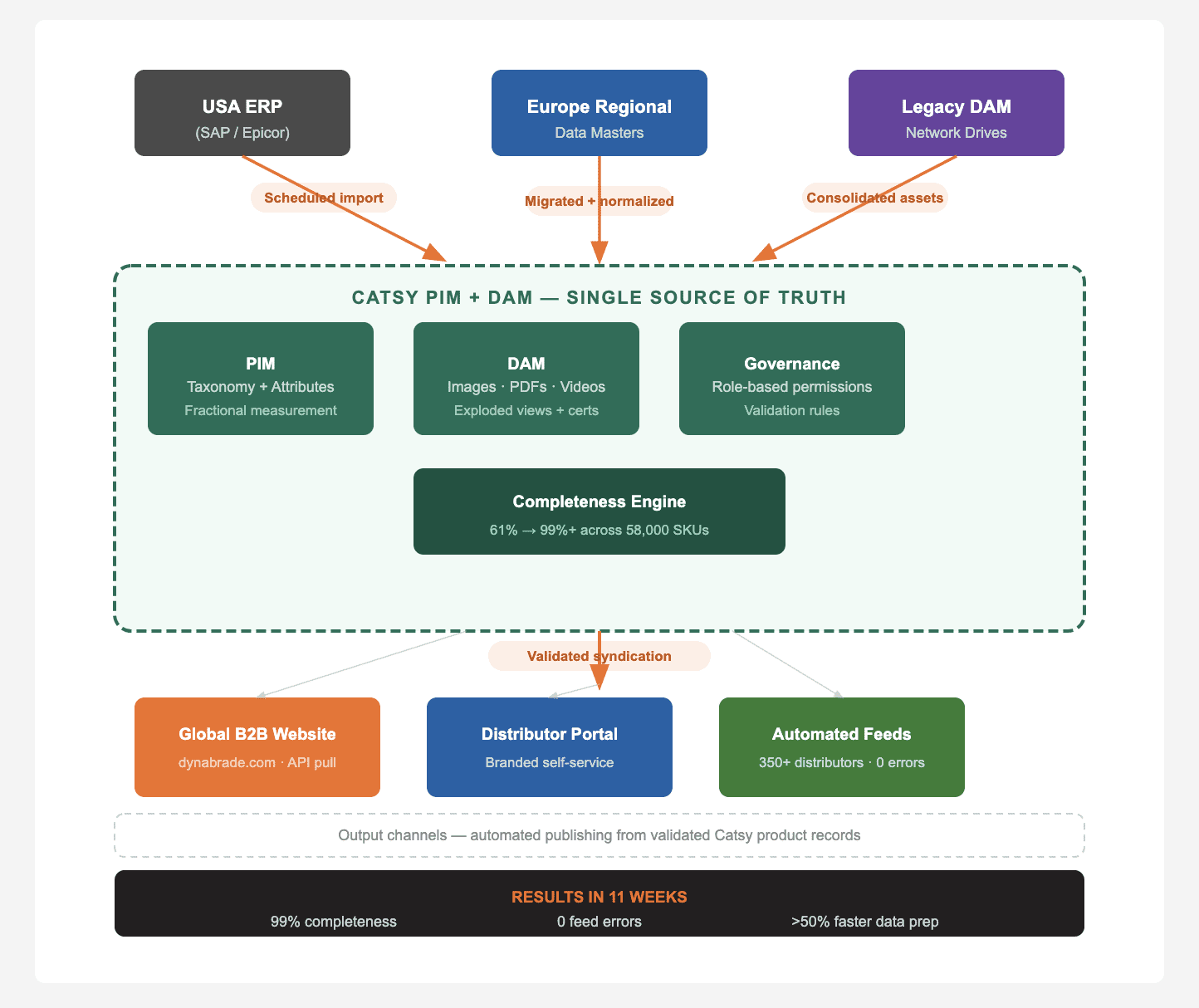
Dynabrade came into the project with three clear goals. They needed a single source of truth for product data shared across the USA and Europe, a new global B2B website built on structured product information, and a way to replace manual distributor workflows with automated, validated feeds. The plan followed three phases:
This phase focused on building the base. That included taxonomy design, attribute modeling, ERP systems integration, and migrating legacy product data. Cleaned up product data through deduplication and normalization across regions to improve data quality and data accuracy.
Next came control and structure. Role-based access was set up to separate USA and Europe permissions. Data validation rules added to protect data quality and ensure consistent product data. Measurement data structured to support both metric and standard formats, including fractional values. Digital asset management was also consolidated to support centralized product data management.
The final phase focused on distribution. The global B2B website was connected through API integration. Distributor channels were configured, and automated feed generation replaced manual processes. A completeness engine was activated to ensure product data met required standards before going live across sales channels.
Success was clearly defined from the start. The goal was near-complete product data coverage across all 58,000 SKUs, no more USA-Europe conflicts, zero distributor feed errors, and a full website launch without manual data preparation.
Dynabrade chose Catsy because it brought PIM and DAM together into a single platform. That meant no more dealing with the integration issues that caused problems in their previous PIM system. It also came with built-in channel mapping, so they didn't need custom development to support different sales channels.
The setup was simple to use. A single spreadsheet-style interface lets both American and European teams manage product data in a single place. They could work with the same product information, digital assets, and product specifications without needing extra training or switching between systems.
Catsy's implementation team started by setting up taxonomy, attribute groups, and import structures before moving any product data. That way, product records came in clean and organized, instead of needing cleanup later. Their setup also included extended templates built for industrial use, which handled Dynabrade's technical specifications, such as RPM, CFM, air consumption, sound level, weight, and regulatory certifications. Managing product specifications this way helps ensure product data is accurate, complete, and consistent across teams, supporting both operational efficiency and the customer experience.
Normalization and automated data validation were major parts of the process. These steps helped maintain accurate data, support regulatory compliance, and ensure all product information met industry standards. With centralized product data management in place, data validation became automatic, and product specifications stayed consistent across the business.
Dynabrade's catalog includes many products with fractional dimensions, like 11⅝ in or ½ in. To handle that, Catsy extended its measurement data type to store, validate, and normalize those values consistently. That means product data stays accurate without extra manual work.
Now, Dynabrade can import fraction-based dimensions directly, without needing to clean them up first. The system automatically handles data validation, ensuring product specifications remain consistent across the website, sales channels, and compliance documentation.
Metric and standard units are managed in one place and converted automatically when needed. This keeps product data aligned, improves data accuracy, and supports a consistent customer experience across multiple channels.
All regional image libraries, exploded-view diagrams, certification PDFs, and video assets were brought into a single digital asset management system. This created a centralized repository for digital assets, so everything is easier to find, manage, and keep up to date.
Role-based permissions were set up so the USA and European teams can work in the same system without stepping on each other's work. Each group has the appropriate level of access and control, helping protect product data and digital assets while improving data management.
This setup finally put an end to the back-and-forth overwrites between regions and made it much easier to manage product data and digital assets across multiple channels.
Each distributor channel is set up just once in the PIM system. Each has its own SKU naming rules, image requirements, and tech specs. This all makes managing complex data product catalogs much easier, and it helps keep product data accurate across multiple sales channels.
With centralized product data management in place, Catsy can generate and update feeds automatically. This eliminates the need for manual work in Excel, which previously caused errors during quarterly updates. Now, the product information flows right from the system. That improves data accuracy and overall operational efficiency.
The website connects to the PIM system through an API, so it always pulls the latest validated product data. In practice, the live site serves as a single source of truth with no extra steps.
Catsy also supports supplier data as a part of a broader product data management setup. Teams can work more closely with partners while keeping all of the product data consistent. Product info is automatically formatted and shared across websites and mobile apps. This speeds time-to-market and improves how data is delivered everywhere it needs to go.
Custom data validation rules were set up to catch issues such as unit mismatches, invalid value ranges, conflicting attributes, and missing compliance documentation before any product data is sent to a sales channel. This helps protect data accuracy and keeps bad data from spreading across systems.
The completeness engine gives real-time visibility into product data, showing which records are ready to go and which still need work. That makes managing product data much easier and helps teams stay on track without guessing.
Keeping consistent product data and high-quality product data is critical for building trust. A strong PIM system improves data accuracy by helping eliminate data silos and making sure every sales channel delivers reliable, consistent product information.
"Catsy makes it possible to have all our data centralized in one place, which allows us to easily share information with customers and update our website."— Marketing Specialist, Dynabrade
Governance has to be built into the PIM system from the start, not added later. Dynabrade's earlier product information management PIM effort failed because there was no clear ownership of product data across regions. By integrating role-based permissions into the PIM system, they created a true single source of truth and eliminated overwrite issues without relying on manual rules or processes.
Industrial products need industrial data models. Standard PIM software is usually designed for simple product catalogs rather than complex product data. Dynabrade needed support for technical specifications like RPM, CFM, air consumption, sound levels, and fractional values. Choosing the right PIM solution that could handle this without custom work made managing product data much easier and helped drive adoption.
Data migration quality sets the pace for the whole project. Dynabrade focused on cleaning and structuring product data before moving it into the system. By normalizing taxonomy, attributes, and measurement data early, they avoided delays and improved data quality. This approach to centralized product data management helped them complete the full rollout in 11 weeks.
Reliable syndication depends on strong data validation. Distributor feed errors did not go away just because formatting improved. They disappeared because the PIM system enforced data validation and completeness before product data reached any sales channels. Catching issues early improves data accuracy, supports regulatory compliance, and makes the whole process more efficient.
A small team can handle large-scale product data with the right setup. Dynabrade showed that a lean team can manage complex product catalogs across multiple sales channels when the PIM system handles governance, validation, and formatting. This kind of setup helps improve operational efficiency and shows that the value of a PIM solution is not just time saved, but also the headcount you do not have to add.
Dynabrade replaced a failed legacy system, unified two continents, and launched a global website in 11 weeks, with a team of three. If fragmented product data is slowing your digital initiatives, Catsy can help you move faster than you think.
Request a demo →| Workflow area | Before Catsy | After Catsy |
|---|---|---|
| Product data source | Split across USA ERP, European Excel, and shared network drives | Single validated product record in Catsy, accessible to both regions |
| Regional collaboration | Daily USA–Europe attribute overwrite conflicts, no governance | Role-based permissions enforce ownership; conflicts eliminated |
| Data completeness | 61% — incomplete records blocked publishing and syndication | 99%+ — completeness engine flags gaps before they reach channels |
| Distributor catalog updates | Manual Excel manipulation each quarter; 25–35 errors per cycle | Automated channel feeds configured once; zero feed errors |
| Website product data | Relaunch stalled 16 months; no clean data pipeline to site | Live B2B website pulls via Catsy API; always in sync |
| Measurement handling | Fractional values formatted manually; frequent inconsistencies | Fractional dimensions validated and auto-converted; no manual prep |
| Digital asset management | Scattered regional image libraries and documentation folders | All assets consolidated in Catsy DAM; linked to product records |
| Team size | 5-person digital team managing fragmented systems | 3-person team managing 58,000 SKUs across two continents |