

Master Fluid Solutions operates in the manufacturing sector, producing metalworking fluids, coolants, and industrial lubricants across more than 4,000 active SKUs. Their product data supports a B2B website, Affiliated Distributors, and a broad network of sales channels, making centralized product data management essential to keep everything aligned.
For years, managing product data relied on a custom internal database understood by only one developer. That setup made managing complex product data slow, risky, and difficult to scale. Heavy manual data entry led to data inconsistencies across multiple systems, making it harder to maintain accurate data and consistent product data across multiple sales channels. As a result, operational efficiency declined and the risk of errors continued to grow.
To fix this, Masterfluids implemented a robust PIM+DAM system from Catsy, combining product information management PIM with digital asset management DAM and seamless integration with their Epicor ERP systems. This product information management system replaced the legacy database with a centralized product data hub built for data validation, structured product data, and centralized product data management.
The impact was immediate. Data accuracy and data quality improved across all sales channels, while time to market accelerated significantly. Updates to technical specifications and compliance documentation like Safety Data Sheets dropped from six to eight weeks to under four hours. Distributor self-serve adoption reached 87 percent, and automated workflows helped improve operational efficiency across the organization.
Masterfluids now manages complex product data with higher data accuracy, improved data quality, and a scalable foundation for continued growth.
Masterfluids manufactures and distributes a broad catalog of metalworking fluids — including cutting and grinding coolants, straight oils, cleaners, corrosion inhibitors, and fluid management systems — under its globally recognized product families. With operations spanning North America and international markets, the company serves precision manufacturers, industrial distributors, and OEM supply chains.
The digital team is intentionally lean, operating with a single person responsible for product data, website publishing, and distributor content management across the full 4,000+ SKU catalog. Their technology stack at the time of implementation included Epicor for ERP and a heavily customized internal database for product content. Managing product data across multiple systems presented significant challenges, especially when handling complex data such as detailed technical specifications, hierarchical product relationships, and regulatory documentation. This complexity highlighted the need for a robust product information management strategy to enable manufacturers like Masterfluids to scale, adapt to market demands, and ensure data accuracy and operational efficiency.
Over a decade of custom development created an internal database that once worked well, but had started to become a problem. The system depended on one developer's knowledge, which made even simple updates risky. As the product data grew and the distributor network expanded, those small issues turned into bigger operational problems that affected revenue, regulatory compliance, and customer relationships.
Masterfluids went into the evaluation process with a clear plan. They needed to replace their fragile internal database with a structured, easy-to-manage PIM system. They also wanted a centralized database for managing complex product data, a single source of truth aligned with their ERP systems, and a way to automate distributor data delivery so teams could stop relying on manual exports. Success was measured by faster time to market, quicker update times, higher distributor self-serve adoption, and less internal effort needed to manage product data.
Epicor ERP integration configured and validated. Legacy internal database migrated to Catsy with field-level validation applied to all historical product records.
Team training completed. First 20,000 SKUs published live on the B2B website via real-time Catsy syndication. Attribute schemas validated against channel requirements.
Affiliated Distributors (AD) syndication activated. Top 50 distributor feeds configured and live with schema-matched CSV/XML output replacing manual exports.
Full catalog rollout completed. On-demand self-serve portal enabled for all distributors, providing real-time access to current product data without manual requests.
Masterfluids selected Catsy PIM and DAM, a robust product information management system and a strong PIM for manufacturing, because it already supported industrial distributor structures and offered native bi-directional integration with Epicor. Catsy's integration capabilities made it easy to connect ERP systems and other existing systems, so product data stayed consistent across platforms and data silos were eliminated. By integrating multiple systems, the team improved real-time sync and overall operational efficiency. Instead of building a custom connection, they were able to configure everything and validate the data flow within the first three weeks.
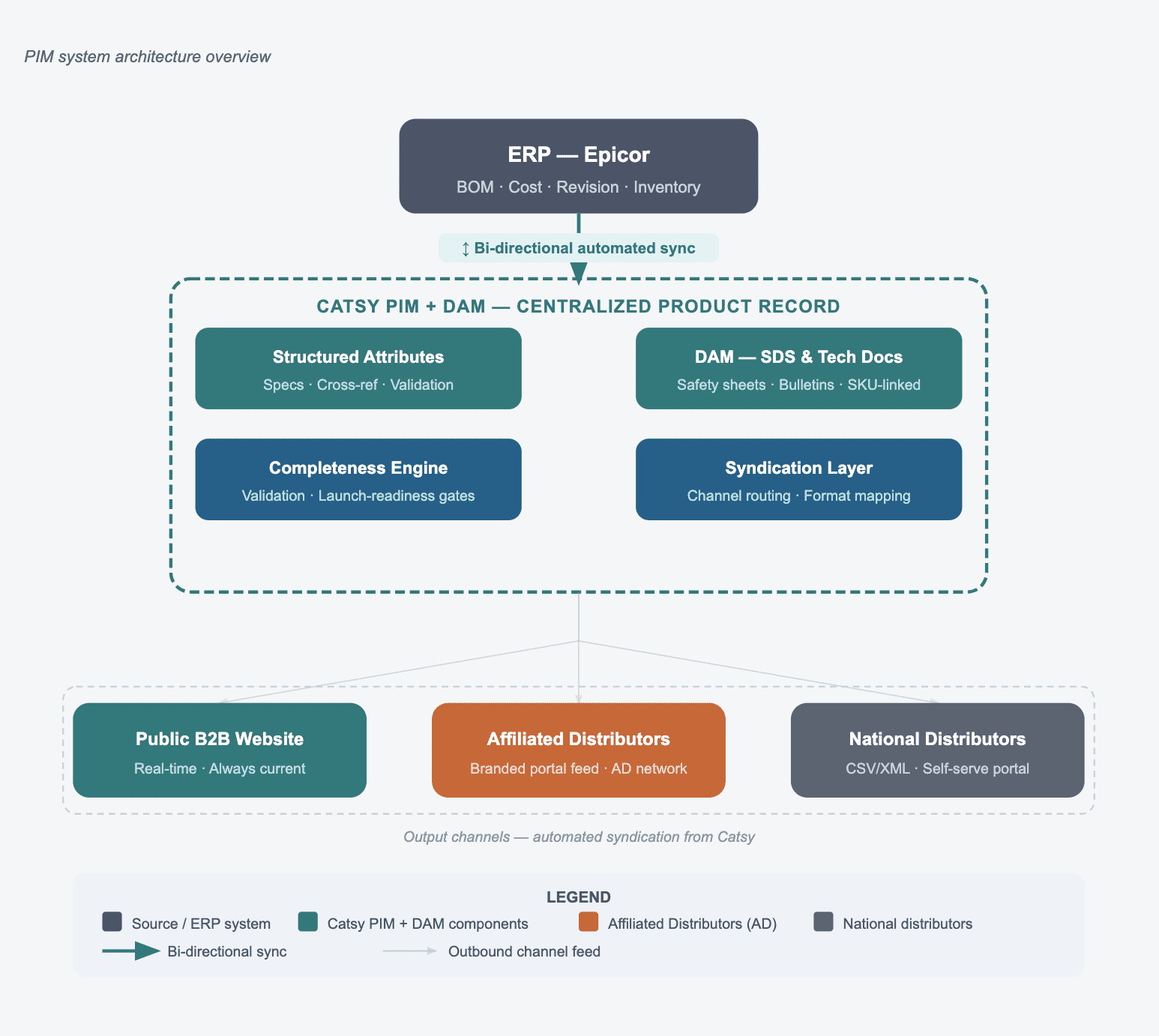
The setup separates transactional data in the ERP from structured product data managed in the PIM system. Things like BOM, costing, revision history, and inventory stay in Epicor, while product details live in Catsy. The two systems stay aligned through automated sync, so when something is updated in Epicor, it flows into the PIM system and out to every connected sales channel without manual work.
Safety Data Sheets and technical documentation were moved into Catsy digital asset management and linked directly to each SKU. This change removed the need to send documents by email and reduced compliance risk. When a file is updated, every channel that uses that product data reflects the change automatically.
A data validation layer was also added to enforce completeness before anything could be published. This helped improve data quality and gave the team confidence to move faster. They no longer had to rely on manual checks, which had previously slowed down every product launch.
Distributor feeds were set up to match each channel's requirements. CSV and XML outputs were created for national distributors, and a branded portal was built for the AD network. This replaced the manual export process completely. With centralized product data management, the PIM system now handles formatting, localization, and distribution automatically, making it easier to manage product data and support multiple sales channels without extra effort.
Accurate data and consistent product data are critical for B2B ecommerce. Customers need reliable product data and detailed product information across all sales channels, and when that's in place, it directly improves customer experience. With centralized product data management using Catsy DAM and PIM, Masterfluids was able to improve operational efficiency and give internal and external users access to up to date and accurate data. Better product data and enriched product information also helped reduce return rates, since customers had the right details before making a purchase. The robust PIM solution also improved sales efficiency by automating workflows, reducing time to market, and making sure everyone had what they needed without manual steps.
"We finally retired the internal database that had become difficult to maintain. Catsy pulls structured data from our ERP and distributes it consistently across our website, AD, and national distributors."— Mark, Marketing Manager, Masterfluids
Separate transactional data from product content early. ERP systems are built for costing, revision control, and inventory, not for structured product data or the attribute schemas needed for sales channels and ecommerce. When teams try to manage everything in one place, it usually creates problems over time. Masterfluids showed how separating systems, while keeping them aligned through integration, supports managing complex product data like technical specifications, regulatory compliance, and hierarchical structures, and improves operational efficiency.
Documentation compliance is really a product data problem. When SDS sheets and technical documentation sit outside the product record, they turn into manual work. A PIM system that connects with digital asset management makes it easier to manage complex product data and link compliance documentation directly to SKUs. With stronger data modeling and better product data management, teams can handle product hierarchies and variants more accurately and stay aligned with regulatory compliance requirements.
Completeness checks protect data quality and team confidence. One of the biggest hidden issues with legacy systems is not just updating product data, but making sure it is correct before publishing. Automated data validation helps improve data accuracy and prevents bad data from entering the system. Strong data governance, where each product attribute has ownership and rules, helps maintain consistent product data and reduces data inconsistencies.
Self-serve distributor access creates real value. When distributors can access centralized product data on demand, it improves relationships and reduces back-and-forth requests. That means teams spend less time answering questions and more time focusing on growth. A strong product information management strategy supports product lifecycle management and helps manufacturers stay flexible as they adapt to new market trends and digital transformation.
A phased rollout reduces risk and keeps things moving. Masterfluids rolled out their PIM system in phases, validating each step before expanding. This approach works especially well in the manufacturing sector, where data accuracy affects safety, compliance, and daily operations. PIM software supports managing technical data, compliance documentation, and traceability at the SKU level, helping manufacturers meet regulatory requirements across markets.
Masterfluids turned a fragile, single-developer database into a scalable, validated PIM system in under 12 weeks, and they did it without adding headcount. They moved to centralized product data management, improved data accuracy, and built a system they could actually trust.
If your team is still managing product data with manual exports, scattered documentation, and no real confidence in data consistency, there's a better way. A strong PIM solution like Catsy can help you eliminate data silos, improve operational efficiency, and make managing product data a whole lot easier.
Request a demo| Workflow area | Before Catsy | After Catsy |
|---|---|---|
| Spec / SDS update cycle | 6–8 weeks, manual coordination | Under 4 hours, automated propagation |
| Distributor feeds | Hand-built CSV exports, frequent errors | Schema-matched automated CSV/XML feeds |
| SDS distribution | Emailed on request, compliance risk | Linked to SKU, auto-updated across channels |
| New product launch cycle | 10–14 weeks, data trust issues | 3–4 weeks, completeness gates enforced |
| Manual export labor | ~3 FTE equivalent per week | ~4 hours per week |
| Distributor self-serve | 0% — all data requested manually | 87% self-serve via portal |
| ERP–content alignment | Manual reconciliation across multiple files | Bi-directional Epicor sync, always aligned |
| Data completeness | Manual checks before every publish | Automated completeness engine with publish gates |

505 N La Salle Drive, Suite 300
Chicago, IL 60654
(312) 212-0086