Key Takeaways
A PIM product hierarchy works only when every attribute has exactly one owner: the parent, the SKU, the channel, or the relationship. That ownership has to be enforced, not just assumed. Most catalog inconsistency doesn’t come from bad data entry. It comes from the same fact living in two places at once with no rule for which one wins. Get attribute ownership right, and updates cascade automatically; get it wrong, and every product launch turns into a manual reconciliation project.
Why “Just Add It to Every SKU” Breaks Down at Scale
Most catalogs don’t start broken. They start with a spreadsheet, a handful of SKUs, and every field filled in by hand because the SKU is the only level available. That approach works for the first hundred products. It doesn’t scale to the next thousand.
As a product family grows with multiple models, variants, and orderable SKUs, shared data gets entered again and again. Brand name, certification, warranty term, and safety rating may be copied across hundreds of SKUs. Each duplicate creates another chance for a typo, an outdated value, or a missing field.
This is where duplication becomes drift, not just redundancy:
This is the exact governance failure described in Catsy’s own guidance on PIM implementation projects: when every team can edit every field, no team is actually accountable for any of them, and the catalog degrades the same way regardless of how good the original data entry was.
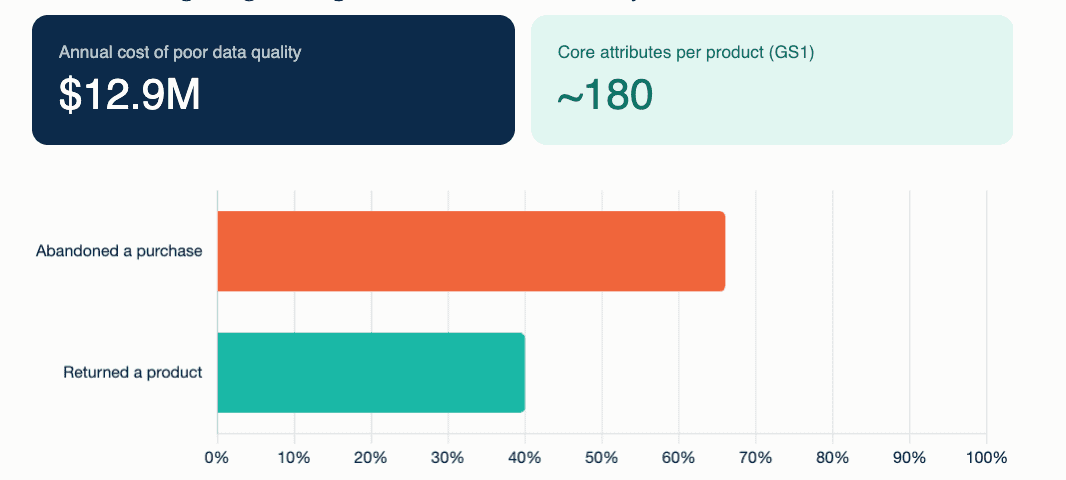
The scale of this problem is easy to underestimate. Working with GS1, the Consumer Goods Forum identified roughly 180 foundational attributes as critical just to verify, list, move, and sell a single product, and that’s before a business layers in its own custom specifications, compliance fields, or marketing attributes. A catalog with even a modest number of product families can easily be managing several hundred distinct attributes in practice.
The financial exposure is real: poor data quality costs the average organization an estimated $12.9 million a year, according to Gartner research from 2020, a figure that predates the current AI-driven surge in catalog complexity and, if anything, understates the current stakes. And the consequence isn’t just internal cleanup cost. In Akeneo’s 2025 global shopper survey, 66% of consumers said they’d abandoned a purchase over missing or inaccurate product information, and 40% said they’d returned a product in the past year because the listed data was wrong. Attribute drift that starts as an internal data-hygiene problem ends up as a returns and conversion problem.
The Four-Part Ownership Test
The fix isn’t “centralize everything.” Some attributes genuinely differ by SKU, and forcing them upward just breaks the catalog a different way. The fix is a deliberate test applied to every attribute, once, before it’s ever entered.
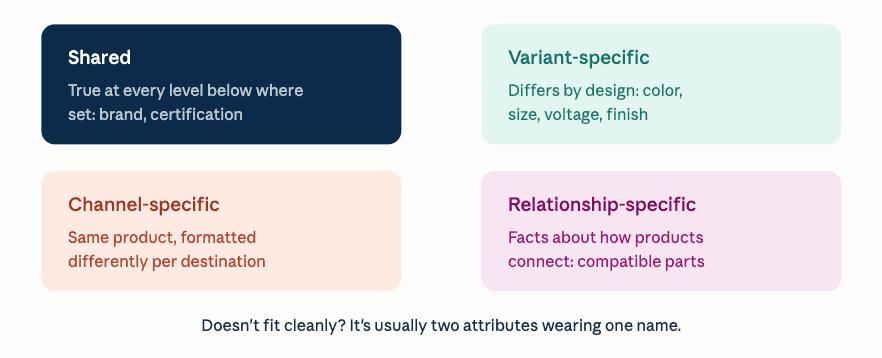
Ask which of these four categories the attribute belongs to:

Every attribute maps to exactly one of these four categories. When a field doesn’t fit cleanly, that’s usually a sign it’s actually two attributes wearing one name: a “certification” field that mixes a shared base certification with a channel-specific regional variant is a common example.
Mapping Ownership Across a Real Product Hierarchy
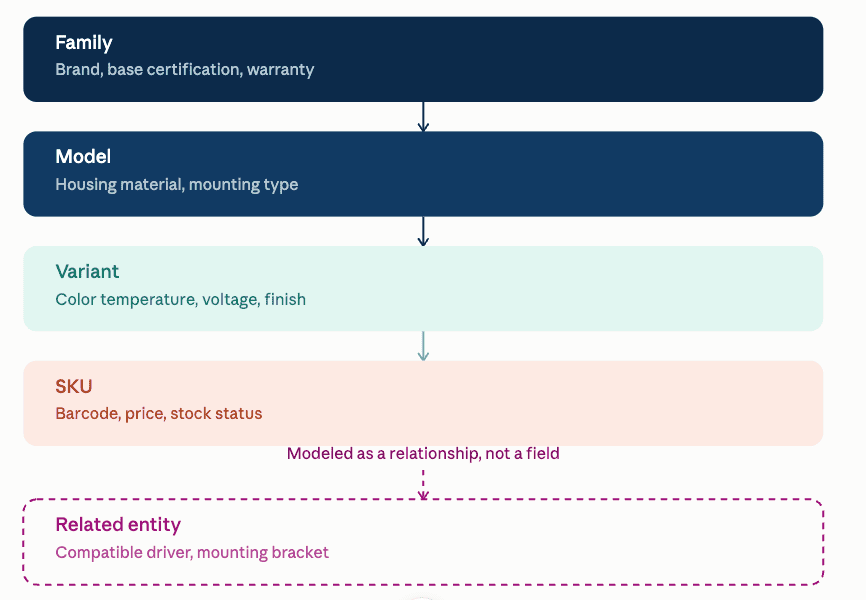
The test is easiest to see against a concrete hierarchy. Take a specification-grade lighting manufacturer’s product line, a pattern documented in a real Catsy customer implementation, where a multi-level hierarchy carried hundreds of attributes split across family and SKU levels, alongside relational data like driver compatibility that had previously lived in spreadsheets.
Notice what happens at each boundary. The base certification lives at the family level because it’s true for the entire series; re-entering it at every SKU multiplies the chance of an inconsistent value with zero benefit. Color temperature and voltage live at the variant level because they’re the entire reason the variant exists as a distinct SKU; pushing them upward would collapse variants that are genuinely different products. The compatible driver isn’t an attribute of the fixture at all; it’s a relationship to a separate catalog entry, and treating it as a free-text field is exactly the pattern that turns into an unmaintainable spreadsheet-based compatibility matrix over time. Getting the underlying data model right, including variant relationships and custom attribute types, is what determines whether a hierarchy like this scales cleanly or collapses back into spreadsheet-style firefighting.
This is also where channel requirements get layered in without disturbing the base hierarchy. A distributor may need a different title format or a regional compliance mark than the direct-to-consumer channel. That’s a channel-level override sitting on top of the base attribute, not a reason to duplicate the base data.
How Inheritance and Overrides Actually Work
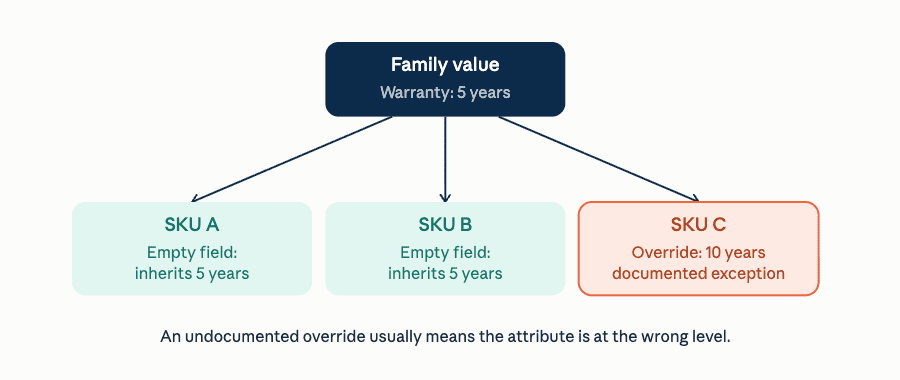
Attribute inheritance makes your product hierarchy work in practice. An attribute set at the family level automatically flows down to every model, variant, and SKU beneath it. For example, update the family-level warranty term once, and every SKU in that family reflects the change automatically.
The practical mechanics, consistent across the PIM platforms that support hierarchy-level data, work roughly like this:
Exception handling deserves its own rule, not an afterthought: every override should carry a reason, an owner, and (where the platform supports it) an expiration or review date, so a legitimate one-off doesn’t quietly become the new undocumented standard.
A 30-Day Attribute Ownership Cleanup Plan
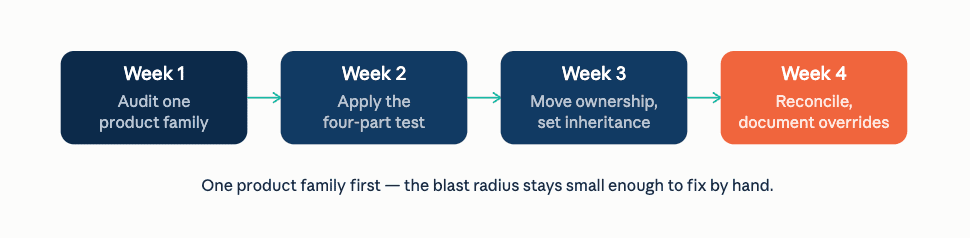
Fixing ownership catalog-wide in one pass isn’t realistic. Fixing it for one product line in 30 days is.
Running this cleanup against a single family before rolling it out catalog-wide surfaces most of the edge cases (mixed field types, channel conflicts, orphaned relationship data) while the blast radius is still small enough to fix by hand. If the audit reveals your current system can’t enforce hierarchy-level ownership at all (no inheritance, no override tracking, no structured relationships), that’s usually a platform limitation, not a process failure, and worth weighing when comparing PIM platforms built for complex catalogs.
Where Attribute Ownership Fits Into Broader PIM Governance
Attribute ownership is a field-level decision, but it doesn’t exist in isolation. It’s one piece of the larger PIM governance framework that also covers access control, approval workflows, and compliance, and it depends on the same underlying principle: when everyone owns the data, nobody owns the data. Assigning attribute-level ownership is what makes broader product data governance enforceable instead of aspirational, because it gives every field a single accountable home rather than leaving ownership implicit.
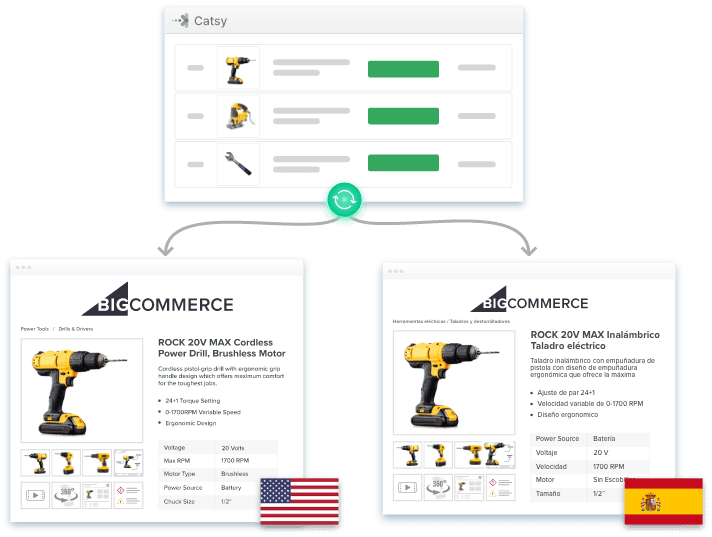
This matters more, not less, as catalogs grow. A product information management system built to enforce hierarchy-level attribute rules, rather than relying on team discipline to maintain them, is what lets a family-level update actually reach every SKU beneath it without anyone chasing it down record by record.
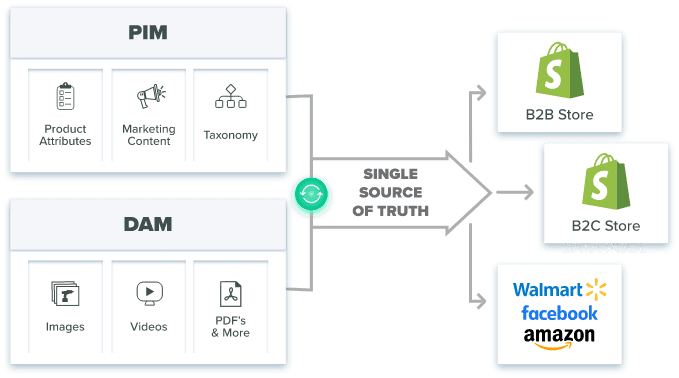
For manufacturers managing complex, multi-variant SKUs and technical spec sheets, that enforcement is the difference between a hierarchy that scales and one that quietly reverts to spreadsheet logic under pressure. The same structural discipline extends naturally into digital asset management, where images, spec sheets, and certifications need the same family-vs-SKU ownership logic as text attributes. A driver spec sheet, for instance, belongs to the driver’s own product record, not copy-pasted onto every fixture that happens to use it.
Well-modeled attribute ownership also pays off downstream. Clean, correctly inherited attributes are the raw material that product experience management depends on: a PXM layer can only personalize or contextualize product content that’s already accurate and consistent underneath it.
Catsy’s PIM is built around this kind of hierarchy-aware attribute management, enforcing which attributes belong at which level of a family, model, variant, and SKU structure, with custom attribute management and role-based governance layered on top so ownership rules are enforced by the platform, not just documented in a wiki that nobody checks before entering data.
See How Catsy Models Complex Product Relationships
If your catalog has grown past the point where SKU-level-only data entry is sustainable (multiple product families, hundreds of attributes, and relationships between products that spreadsheets can’t reliably track), the underlying issue is usually the data model, not the team’s discipline. Catsy’s PIM enforces attribute ownership at every level of a product hierarchy, from shared family attributes down to SKU-specific variants and structured product relationships, so updates cascade automatically instead of requiring manual reconciliation across hundreds of records.
Request a demo to see how Catsy models family, variant, and relationship-level attribute ownership for catalogs like yours, or browse Catsy’s PIM and DAM resource center for more implementation guidance.