How PIM Acts as a Harness to Keep AI From Ruining Your Product Data
Uncontrolled AI can damage product data. See how a PIM system limits AI agents with roles, human approval, and tool restrictions.
Table of Contents
AI can read a catalog with thousands of SKUs faster than any team. That speed is the appeal, but it is also the risk. An agent with open access to product information management data can rewrite a specification, change an attribute, or publish an unchecked claim just as quickly as it can fix a typo.
But there are four failures worth watching for: inaccurate specifications, unauthorized attribute changes, inconsistent descriptions, and product claims nobody verified. Each of this starts as one record and then travels to every channel that receives it.
Key Terms to Know
What uncontrolled AI does to a catalog
Attributes are the weak spot, and in a B2B catalog a wrong thread size or voltage rating means the wrong part in the cart.
Take this as an example: ShoppingBench is an academic benchmark from Alibaba researchers, which put 17 language agents through shopping tasks, and the best one succeeded on fewer than half of them. In 60 failed runs from that agent, the largest share traced back to missing or mismatched product attributes. In one case, the agent recommended a black sandal after finding no match for the requested color. The test was a simulation with 2025-era models, so exact numbers will move. Gartner’s 2024 survey found that 63% of organizations either lack the data management practices AI needs or are unsure they have them.
The costs land on the channels you sell through and on the customers who buy. Here are more examples of the same problem:
None of this needs a malicious agent. Open Worldwide Application Security Project (OWASP) calls the underlying flaw excessive agency, which lets damaging actions happen whatever causes the model to malfunction. Usually, it boils down to these three root causes: there’s too much functionality, too many permissions, and too much autonomy.
These three map to the three controls below.
The harness that keeps AI in bounds
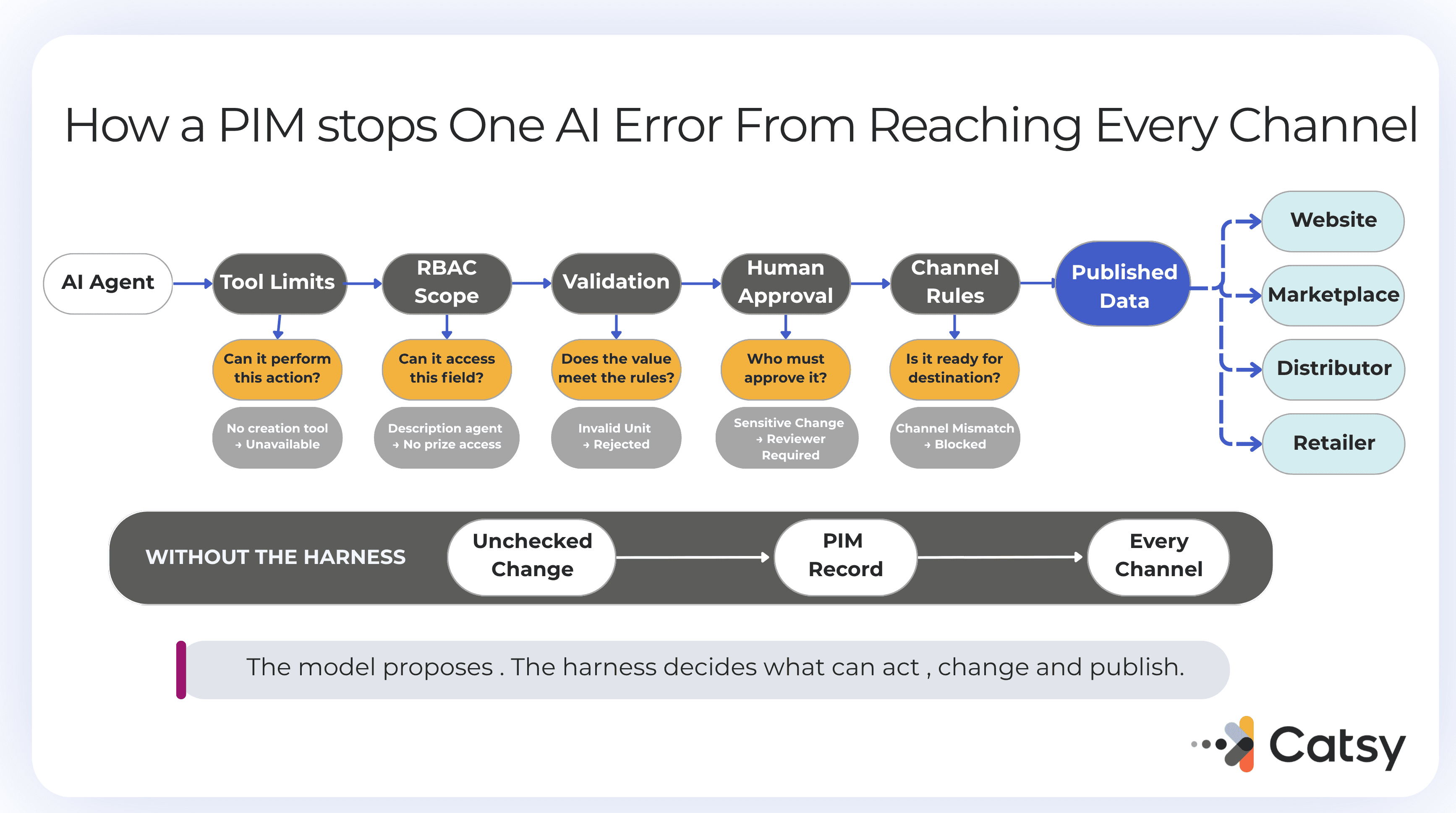
Engineers call the controls around a model a harness, and LangChain sums it up as “Agent = Model + Harness”. A connection alone is not a control. The Model Context Protocol (MCP), an open standard that links AI tools to outside systems, says it cannot enforce consent rules by itself and tells implementers to build authorization flows into their applications.
A PIM system (see what a PIM is) is a natural home for those controls. It already holds the approved product record and the rules for changing it.
Give each agent a role and keep it in its lane
Role-based access control (RBAC) ties permitted actions to roles instead of individual identities. NIST describes a role as a collection of access authorizations that reflects the permissions needed to perform a defined function. For AI, that means each agent gets its own role with a narrow scope.
Take a distributor of industrial pumps, as an illustration. A description agent may read technical specifications and write to the description field. It may not change prices, and it may not touch certifications or other regulatory fields. Catsy’s own guide makes the same point about a classification helper, which has no business accessing pricing.
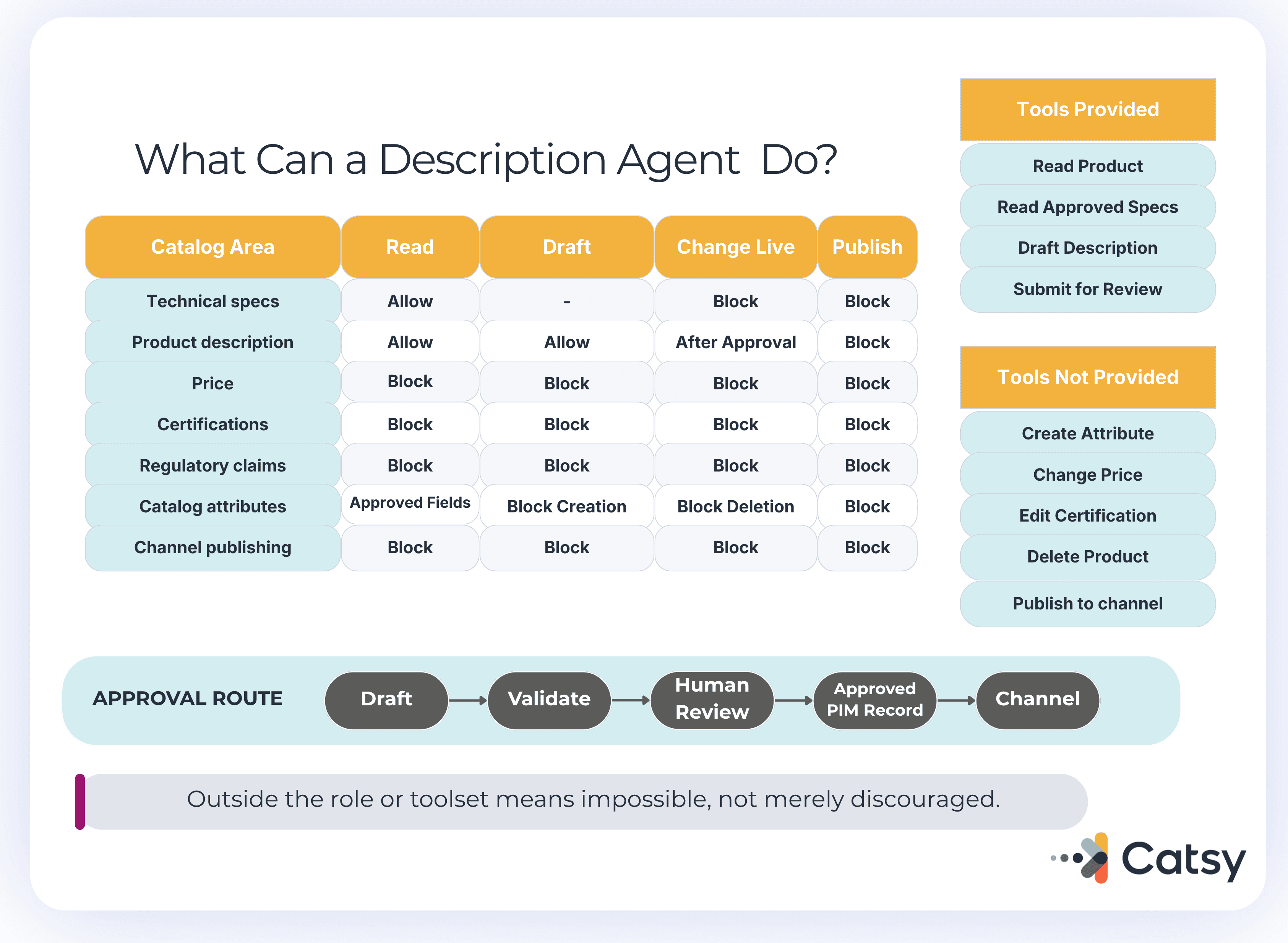
The limit has to be enforced by the system, not requested from the model. OWASP recommends implementing authorization in downstream systems rather than relying on the model to decide what is allowed. An agent that uses a product database for recommendations might need only read access to a products table, with no ability to insert, update, or delete.
Keep a person in charge of what gets published
Human-in-the-loop means a person must approve an action before it takes effect. OWASP recommends this for high-impact actions. In product data, AI can draft descriptions, classify products, and enrich attributes from images and specs. A qualified employee approves the work before publication.
Risk should set the strictness. A unit format fix that passes validation can move quickly. However, higher-risk changes need closer review.
For example, a chemical distributor may use AI to standardize package sizes across its catalog, but any change to a hazard warning or Safety Data Sheet should require approval from a product safety specialist.
OSHA (Occupational Safety and Health Administration) requires chemical manufacturers, importers, and distributors to communicate accurate hazard information through labels and safety data sheets. If the change affects many products, a second compliance reviewer should approve it before publication.
Hand agents only the tools they need
A tool is an action an agent is allowed to call, such as reading a product or updating a field. OWASP advises limiting agents to the minimum tools necessary and avoiding open-ended ones. MCP says hosts must obtain explicit user consent before invoking any tool.
The practical result is simple. An agent can do only what its tools and permissions allow. If it has no tool for creating attributes, it cannot create them, so the structure of the catalog stays intact.
Where Catsy fits
Catsy is an integrated PIM and DAM platform, and several of these controls are part of how it works. Its PIM lists advanced user permissions for internal teams and external partners, and its data governance tools cover ownership, validation, and role-based rights. Approval workflows route content to reviewers, and automated checks validate required fields, image specs, and compliance markers before a product goes live. According to Catsy’s AI governance guide, these controls apply whether a person or a model wrote the content.
For AI access, Catsy offers an MCP server that connects AI systems to its PIM and DAM data. Its comparison of MCP and API connections helps choose the right link for each job, and its guide to product data quality standards covers writing the rules agents must meet. Rules also matter downstream, since channel templates shape data for each destination.
Start narrow
Pick one agent and one task. Give it read access, a scoped write permission for a single field, and an approval step before anything publishes. Watch the corrections and rejections for a few weeks, then widen its scope only if the numbers hold. To see these controls on your own catalog, request a demo.
Request a DemoKey Takeaways