
Product Data Management: The Complete Guide for Manufacturers
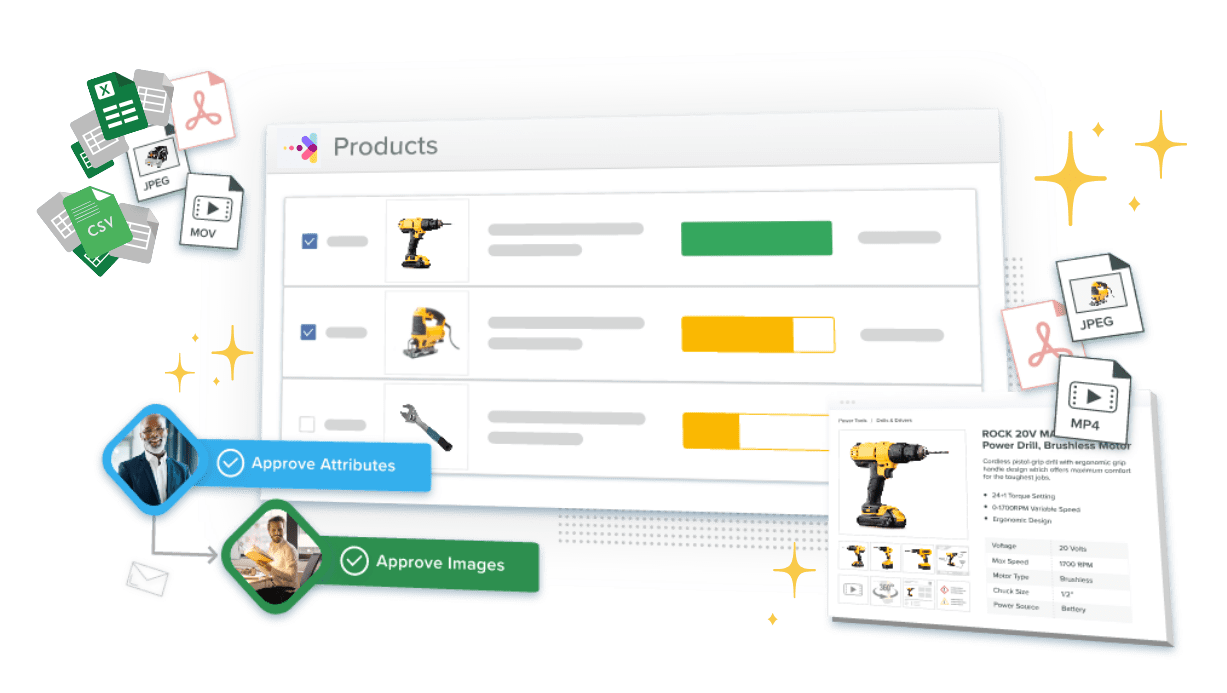
There are two completely different disciplines called "product data management." One governs engineering design files. The other governs the commercial content that determines whether a product is findable, accurate, and buyable across every channel. Here's how they work — and why manufacturers need both.
Search for "product data management" and most of what you find describes engineering software. PTC Windchill, Autodesk Vault, and Dassault ENOVIA dominate results for this term. They are serious, purpose-built systems used by R&D teams to manage CAD files, bills of materials, and engineering change orders. They are also not what most eCommerce managers, product managers, and channel operations teams are actually looking for when they search that phrase.
If your team is responsible for product descriptions, marketplace listings, digital assets, and content across multiple sales channels, you are dealing with commercial product data management. The relevant software category is PIM (Product Information Management). This guide covers both disciplines, because understanding the distinction between them is what separates the right technology investment from a very expensive mistake.
That number holds even at companies with solid engineering PDM environments. The reason is simple: engineering PDM stops at the factory floor. The commercial data problem starts the moment a product is ready to sell, and almost no manufacturer has it fully solved.
What Is Product Data Management?
Product data management is the discipline of organizing, governing, and maintaining structured product information across a product's full lifecycle, from engineering specifications through commercial content. The challenge, and the source of most confusion in this space, is that "product data" means something fundamentally different depending on who is asking.
For an engineering team, product data is CAD files, bills of materials, engineering change orders, tolerances, material specifications, and design revisions. For a marketing or eCommerce team, it is product attributes, descriptions, images, certifications, and the channel-specific content that makes a product findable and buyable. These two worlds require different management approaches, which is why two distinct categories of software have evolved to serve them. Engineering PDM manages the design and manufacturing phase. Commercial PDM (what the software industry calls PIM, or Product Information Management) manages the commercial content lifecycle.
The key positioning principle for everything that follows: PDM for engineering, PIM for the customer.
Regardless of which type a team is running, any effective product data management system performs five core functions:
Bringing product data into a governed repository from its sources: engineering systems, ERP, supplier data sheets, and manual entry. The quality of ingestion determines what the rest of the system has to work with.
Maintaining a structured, versioned record of every product, so teams always work from the current approved version and every prior state is recoverable. Version control is the foundation of change accountability.
Governing who can view, edit, and approve which records. In commercial PDM, this typically means marketing owns descriptions, engineering approves technical specs, and channel managers control distribution settings.
Moving product records through defined review stages before they reach channels. No product goes live without the appropriate sign-off, whether that is a legal review, an engineering spec confirmation, or a marketing quality check.
Publishing or syndicating product data to the systems and channels that consume it: websites, marketplaces, distributor portals, print catalogs, and every other touchpoint where the product needs to appear.
These five functions describe the operating architecture of any product data management system. Engineering PDM and commercial PDM differ in what data they manage and who uses them, not in the underlying functions both systems perform.
Engineering PDM vs. Commercial PDM: Two Systems, One Name
The same term covering two fundamentally different disciplines is not just a vocabulary inconvenience. It creates real strategic risk. When a manufacturing leadership team hears "we need better product data management," some people in the room think of design systems and change control. Others think of content operations and channel consistency. Without shared language, companies invest in the wrong category or assume an existing investment covers a gap it does not address.
Engineering PDM is the system of record for everything created during product design. PTC Windchill, Autodesk Vault, and Dassault ENOVIA have built strong reputations here. They serve aerospace, automotive, and industrial manufacturers who need precise control over design change processes and multi-level BOM management. If your team manages CAD assemblies and engineering change approvals, one of these tools is likely the right fit.
Commercial PDM handles what happens after the design is approved. When a product moves from engineering sign-off to commercial readiness, an entirely different set of questions takes over: How is this product described to a buyer? What images represent it accurately? Which attributes are required for each channel? What certifications need to accompany distributor data sheets? These questions belong to marketing, eCommerce, and product management teams. They need a system built around content completeness and channel distribution, not file versioning and design change control.
This is where the gap that most manufacturers actually face lives. Engineering PDM is well-established and well-served. The commercial half is not. Turning an approved engineering design into accurate, complete, channel-ready product content at scale is where spreadsheets persist, data quality breaks down, and omnichannel consistency fails. The two systems are complementary, not competitive. Engineering PDM manages the product through design. Commercial PDM takes it to market.
PDM vs. PIM vs. PLM vs. MDM vs. ERP: Clearing Up the Landscape
With two types of PDM established as distinct disciplines, the next challenge is mapping them against the broader landscape of enterprise product systems. Manufacturers frequently encounter PDM, PIM, PLM, MDM, and ERP in the same procurement conversations, and without a clear map of responsibilities, technology selection becomes expensive guesswork.
Each system manages a distinct layer of the product data ecosystem:
| System | Primary Focus | Primary Users | Data Managed |
|---|---|---|---|
| Engineering PDM | Design and engineering lifecycle | R&D, engineering | CAD files, BOMs, ECOs, design revisions |
| PLM | Full product lifecycle orchestration | Engineering, supply chain, compliance | Program-level lifecycle data, compliance, service records |
| MDM | Enterprise master record governance | IT, data governance | Core identifiers, entity relationships, cross-system reference data |
| PIM | Commercial product content | Marketing, eCommerce | Attributes, descriptions, images, channel content |
| ERP | Operational transactions | Finance, supply chain | Inventory, pricing, orders, invoicing |
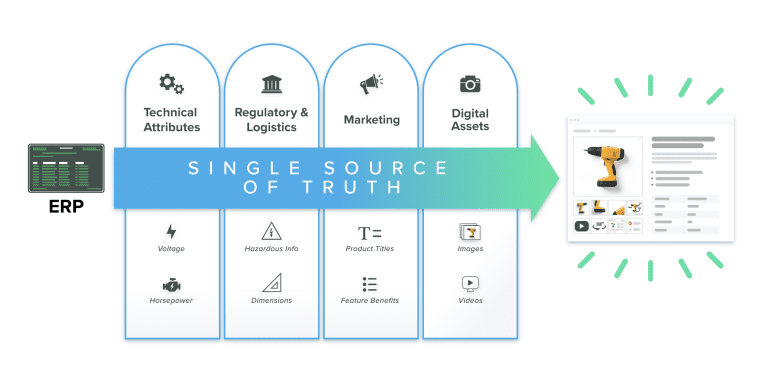
The handoff points between these systems matter as much as the systems themselves. ERP is the source of truth for pricing and inventory: when a price changes, the ERP updates, and that change flows to PIM for commercial channels. Engineering PDM holds approved product specifications: when an engineering change order is closed, approved specs flow to PIM where they become commercial attribute data. PIM enriches those specs with descriptions, images, and channel-specific formatting, then distributes the complete record downstream. No system duplicates what the others do. Each manages an adjacent, complementary layer.
MDM (Master Data Management) governs the enterprise master records for core business entities, including customers, suppliers, locations, and products, ensuring consistency across all enterprise systems. MDM manages core product identifiers (SKU, GTIN, internal part numbers) and the structural relationships that link records across ERP, supply chain, and commerce platforms. MDM cares about the product record as an enterprise entity. PIM manages the rich commercial content layer (descriptions, images, attribute values, channel-specific copy) that MDM doesn't govern. See our guide on PIM vs MDM for the full breakdown.
Where PLM fits. PLM (Product Lifecycle Management) is the strategic layer above engineering PDM. It extends from design concept through manufacturing, service, and product retirement, coordinating engineering, manufacturing, supply chain, and compliance teams around a shared view of the product's entire life. Engineering PDM is the file-level implementation; PLM is the program-level orchestration. Large manufacturers typically have PLM governing the engineering lifecycle and PIM governing the commercial content lifecycle, with PLM serving as the authoritative source for technical specifications. See our guide on PIM vs PLM for a detailed comparison, and PIM vs ERP for how the operational and commercial data layers connect.
Why Manufacturers Need Both PDM and PIM
This is the strategic core of the product data management conversation. Manufacturers who have invested in engineering PDM often assume their product data problem is solved. It isn't, because engineering PDM stops at the factory floor. The commercial data problem starts the moment a product is ready to sell, and the tools that govern design files were never built to govern channel content.
According to Hexagon and Forrester's March 2024 research, 98% of manufacturers face data quality issues that stifle innovation and time to market, and that number holds even at companies with mature engineering PDM environments. The commercial gap is predictable. Four failure modes appear reliably when manufacturers lack a governed commercial PDM layer.
Engineering specs don't translate to channel content. CAD dimensions and tolerance specs are not Amazon bullet points. Someone has to transform technical data into commercial content, and without a governed system for that transformation, it happens in spreadsheets, inconsistently, with no version history. Each new product introduction repeats the same manual effort.
Product launches lag behind engineering completion. When commercial content isn't managed in a governed system, content creation becomes the go-to-market bottleneck. Products are ready to ship weeks before they are ready to list. That gap costs revenue and slows the return on new product development investment.
Channel data diverges at scale. Without a single source of commercial truth, product descriptions on the website differ from distributor data sheets, which differ from marketplace listings. Buyers who encounter different specifications in different places lose confidence in the product and in the brand. As catalog size grows, the divergence compounds and becomes harder to audit.
Regulatory and certification data goes unmanaged. SDS sheets, compliance certifications, and regional regulatory documents need to travel with product content to distributors and compliance-driven channels. Engineering PDM holds these files. Without an integration to the commercial layer, they don't reach the channels that need them, creating compliance gaps and driving listing rejections.
Retailers and distributors using centralized PIM systems have reported saving 80+ hours per month on manual data management tasks that previously required individual channel-by-channel updates.2 That is time returned to content quality, new product onboarding, and channel expansion rather than re-entry of data a governed system should distribute automatically.
Data Governance and Metadata Management in Product Data Systems
Understanding why both systems are needed is one thing. Making them work reliably over time is another, and that is what governance is for.
Data governance is the system of rules, ownership assignments, and enforcement mechanisms that keep product data trustworthy across every downstream system and over the full life of the catalog. Without it, even a well-implemented product data management environment degrades: teams make ad hoc edits, new products get entered without following established formats, and no one can determine which version of a product record is the authoritative one. Good governance prevents that drift from the start.
A mature product data governance framework addresses six distinct elements.
Ownership frameworks define who is responsible for every product attribute, at the attribute level rather than just the product record level. Marketing owns long descriptions. Engineering owns dimensions and material specifications. Channel managers own distribution settings. Without that specificity, ownership disputes stall every product launch, and data quality degrades wherever responsibility is unclear.
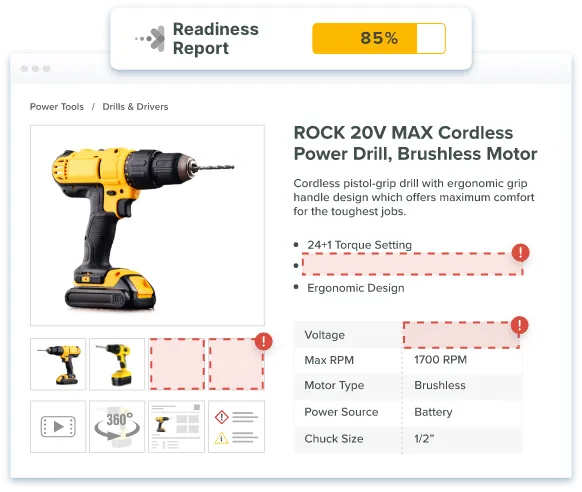
Validation rules and completeness scoring are how policy becomes enforcement. Rules flag missing required attributes, format violations, and out-of-range values before data reaches channels. Completeness scoring gives teams a quantitative measure of channel readiness: a product at 40% completeness for Amazon's requirements is not ready to list, regardless of what the launch schedule says.
Change history and audit trails log every modification to a product record: who changed it, when, and what the previous value was. Audit trails are required for regulatory compliance in many industries and essential for diagnosing channel errors after the fact. Without them, tracing when a corrupted product record was introduced becomes archaeology.
Attribute schema governance controls the definition of what attributes exist, their data types, valid values, and allowed formats. A "color" field that accepts free text produces 47 variants of "red" across a large catalog. A governed attribute schema produces one: "Red." Schema governance ensures the product data model evolves in a controlled way rather than accumulating inconsistencies as new product categories are added.
Taxonomy governance maintains the product category hierarchy: how categories are structured, which attributes are inherited from parent categories, and how product families are organized. Taxonomy drift, where category structures diverge between systems, is one of the most common sources of channel data inconsistency and one of the hardest to clean up after the fact.
Localization metadata tracks language variants, regional regulatory attributes, and market-specific content at the attribute level rather than the product level. A product sold across twelve markets may have twelve valid descriptions, and governance ensures each variant is versioned and deployed to the correct channel. Without localization metadata management, a description update in English goes live in all markets while translated versions lag behind.
The scale of this governance challenge is driving broad adoption. ISG Research (formerly Ventana Research) projects that PIM adoption in one-third of enterprises will energize a new focus on product value across the supply chain through 2026, a signal that commercial product data governance has crossed from operational nicety to strategic investment.3
AI Applications in Product Data Systems
With governance established as the foundation, AI is best understood as an accelerant for the work that governance enables. It reduces the labor cost of data quality operations, speeds up content creation, and catches errors that rule-based validation misses. What it does not do is replace governance. A product data environment without a governed attribute schema, validated training data, and human review workflows will find that AI amplifies existing inconsistencies at speed rather than resolving them. The governance infrastructure from the previous section is what makes AI applications reliable.
Implementation Roadmap: Deploying a Product Data Management System
Most product data management implementation failures happen not because the technology is inadequate, but because teams configure a system before they know what they need it to enforce. Technology decisions made before a governance framework is in place produce systems built around the wrong data model, and Phase 2 inevitably becomes a restructuring project. The sequence below avoids that pattern by establishing the governance foundation first.
Before selecting or configuring any system, inventory the current state of your product data. How many SKUs does your catalog contain? Where does product data currently live: ERP, engineering PDM, spreadsheets, a legacy PIM? What attributes exist across your product categories, and which products have complete data versus missing fields? The output is a data quality baseline and a prioritized list of gaps to address before launch. This phase also establishes what "channel-ready" means for each primary channel, since completeness requirements differ significantly between Amazon, a B2B distributor, and a print catalog.
Before any system is configured, establish the governed list of attributes, their data types, valid values, and ownership assignments. Build the taxonomy structure: category hierarchy, product families, attribute inheritance rules. This work requires input from engineering (which technical attributes matter), marketing (which attributes buyers use to make decisions), and IT (how attributes need to map to other systems). The output is a governed attribute schema and taxonomy signed off by all three stakeholders. Systems built on agreed schemas require far less rework than systems built on assumptions made during configuration.
With the attribute schema and taxonomy defined, map them into the PIM. Set up validation rules and completeness scoring thresholds per channel. Configure role-based access and approval workflows that reflect the ownership assignments from Phase 2. See our guide on PIM and ERP integration for how to structure the operational data connections at this stage. The output is a configured system with enforced governance rules ready to receive product data from its sources.
Connect the data sources that feed the PIM: engineering PDM for technical specifications, ERP for pricing and inventory, and DAM for images and digital assets. Then connect the distribution targets: website product detail pages, marketplace channels, distributor portals, and any other downstream system. The output is a connected architecture with validated data flows in both directions.
Run the first full product batch through the system, from ingestion through enrichment, validation, and syndication. Review channel feedback, resolve validation failures, and establish the ongoing governance cadence: who reviews completeness scores and at what frequency, how channel specification changes are incorporated, and what the new product onboarding process looks like going forward.
The commercial product data management channels that Catsy connects at Phase 5 and beyond:
Print catalogs deserve explicit mention. Despite the digital focus of most channel discussions, many industrial manufacturers and distributors still produce print catalogs as a key sales tool for field teams and procurement departments. Managing print catalog content alongside digital channels from the same source record, via InDesign integration, means a specification update does not require a separate round of edits to a document living outside the governed system.
Key Takeaways
Frequently Asked Questions
What is the difference between product data management and PIM?
Product data management (PDM) is the broad discipline of governing product information across its lifecycle; PIM (Product Information Management) is the commercial implementation of that discipline: the software system that manages product attributes, descriptions, images, and channel-ready content for marketing and eCommerce teams. Engineering PDM manages CAD files and design revisions for R&D teams; PIM manages commercial content for marketing and sales channels. The two systems are complementary: engineering PDM handles the product before launch; PIM handles it after, distributing governed content to every distribution channel.
What is the difference between PDM and MDM?
PDM manages product-specific data: attributes, specifications, descriptions, and images. MDM (Master Data Management) governs enterprise-wide master records, including customer IDs, supplier records, location data, and the product identifiers that link records across ERP, supply chain, and commerce systems. MDM is broader and more IT-centric; PDM is domain-specific to the product record. In a mature data architecture, MDM provides the golden record identifiers that PDM and PIM use as keys to link product data across systems.
Who uses product data management software?
Engineering PDM is used by R&D, product design, and engineering teams managing CAD files, BOMs, and design revisions. Commercial PDM (PIM) is used by marketing, eCommerce, product management, and sales operations teams managing channel-ready product content. In large manufacturers, both systems coexist and serve different users: engineering PDM governs the design lifecycle; PIM governs the commercial lifecycle. In mid-market companies, one or two people may own the entire commercial product data management function. In enterprise organizations, it spans a cross-functional team across product, marketing, and operations.
How does product data management improve omnichannel consistency?
Product data management improves omnichannel consistency by establishing a single governed source of truth for product content and distributing from that source to every channel. Without governed PDM, product descriptions diverge as teams make local edits across separate systems: the website says one thing, the distributor data sheet says another, and the marketplace listing reflects an older product version. A PIM ensures every channel draws from the same validated record, so a specification update made once propagates to every connected channel automatically.
What is engineering PDM vs. commercial PDM?
Engineering PDM manages the technical product record: CAD files, bills of materials, engineering change orders, tolerances, and design revisions, for R&D and engineering teams using tools like PTC Windchill, Autodesk Vault, and Dassault ENOVIA. Commercial PDM manages the market-facing product record: attributes, descriptions, images, certifications, and channel content, for marketing and eCommerce teams using PIM platforms. The handoff between them happens at product launch: engineering approves the design, and commercial PDM takes it to market. Both are required in a complete manufacturer's product data ecosystem.
How does PIM connect to an engineering PDM system?
PIM connects to engineering PDM through a structured integration that pulls approved product specifications (dimensions, materials, tolerances, certifications) from the engineering record and maps them to commercial attributes in the PIM. This integration eliminates manual re-entry of engineering data and ensures commercial content reflects the approved specification. The integration is typically triggered by engineering change order (ECO) approval, so updates in the engineering PDM propagate to the PIM automatically rather than requiring a separate data transfer step.
Catsy operates as the commercial layer that connects to engineering PDM systems, receiving approved specs, transforming them into channel-ready content, and syndicating across every distribution channel without manual re-entry. The integration closes the handoff gap where commercial teams would otherwise transcribe data the engineering record already contains.4
Conclusion
Product data management spans two distinct disciplines, two distinct systems, and two distinct phases of the product lifecycle. PDM for engineering. PIM for the customer. Manufacturers who close the gap between the two don't just improve data quality. They accelerate time to market, reduce listing rejections, and maintain the kind of omnichannel consistency that builds real buyer confidence at scale.
If you're evaluating product information management options for the first time, our PIM hub is the right place to start. If you're ready to see what a governed, channel-connected commercial product data management system looks like in practice, book a Catsy demo below.
Centralize Your Commercial Product Data with Catsy
Catsy's purpose-built PIM + DAM platform is the commercial product data management solution for manufacturers, distributors, and multi-channel brands. Centralize, enrich, govern, and syndicate from one source of truth to every channel your buyers shop.
Book a Demo
