Best PIM Tools for Omnichannel Retail: Navigating the Digital Commerce Waters
Discover the best PIM tools for omnichannel retail. Compare enterprise, mid-market, and specialized Product Information Management software to scale your sales.
Table of Contents
Key Terms to Know
Expand the glossary for this article
Agentic commerce: Shopping in which AI agents search, compare, and sometimes buy products for a person.
API (application programming interface): A connection that lets two software systems share data automatically.
Attribute: Any single detail you track about a product, such as size, material, or wattage.
Completeness score: A measure of how much of a product record is filled in, compared with what a channel requires.
Digital Asset Management (DAM): Software that stores, organizes, and versions files such as product photos, videos, and manuals.
Digital Product Passport (DPP): An EU digital record of a product’s details, such as materials and sustainability information.
Model Context Protocol (MCP): A standard way for AI tools to connect to a system and read its live data.
Product data syndication: Sending product data to each sales channel automatically, in the format that channel expects.
Product Information Management (PIM): Software that centralizes, enriches, and distributes product data to every sales channel.
Product Lifecycle Management (PLM): Software that tracks a product from design through development, before it is ready to sell.
Shoppers expect the price, size chart, and photos to match on your website, app, stores, social media, and marketplaces. When details differ, they leave or send the item back. Most retailers fix this with a product information management (PIM) system.
This guide compares the best PIM tools for omnichannel retail, the features worth testing, and what AI shopping assistants need from your product data.
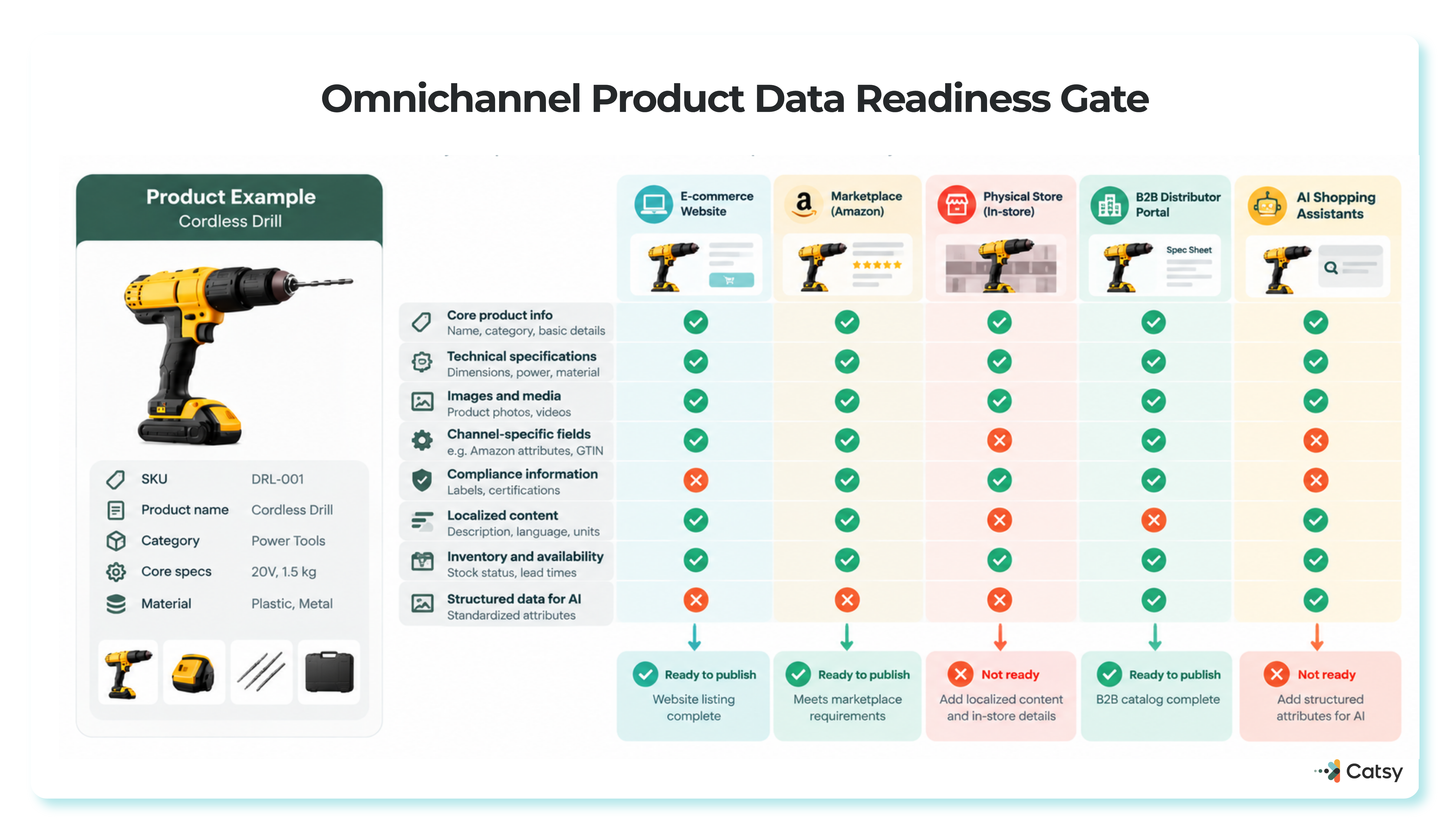
The same product record, checked channel by channel — core info, specs, images, compliance, and AI-ready structured data — before anything goes live.
One Product Record, Many Places to Sell
A PIM is a central database for product names, descriptions, prices, specs, and media links. Your team updates a product once, and the PIM sends the right version to every channel. Catsy’s product information management (PIM) system works this way, and this explanation of what PIM is covers the basics.
The channel list keeps growing. AI assistants inside ChatGPT, Google AI Mode, and Gemini now pull product details from structured feeds, so omnichannel retail data management must keep channels consistent and keep data readable by machines. A PIM for omnichannel retail keeps one database behind all of these channels.
What Inaccurate Product Data Costs
In 2017, a Salsify survey of 1,000 consumers found that 87% of shoppers considered accurate, rich, and complete product content very important when deciding what to buy.
Salsify’s 2026 Consumer Research report surveyed 2,712 shoppers in the US, UK, and Canada in October 2025. It found:
- Returns: 45% had returned an online purchase because the product information was incorrect or misleading. Among millennials, the figure was 56%.
- Abandoned purchases: Up to 45% of Gen Z shoppers and 43% of millennials abandon a purchase when product details do not match across sites.
- Cross-checking: 54% check two to three channels before buying a mid-range item.
Adobe Analytics reported that traffic to retail sites from generative AI tools rose 693.4% year over year during the 2025 holiday season (November and December), based on its analysis of US retail sites. Those shoppers have often read an AI summary first, so any mismatch on your page costs trust.
Where a PIM Pays Off
The case for a comprehensive PIM solution for retailers rests on three gains. Most figures below come from retailers and vendors, not independent studies, so test them against your own numbers.
- Less manual work. A well-run PIM can cut manual update time by up to 80 percent, and many retailers report ROI of 200 to 400 percent within the first three years.
- More consistent experiences. Some retailers with comprehensive PIM systems report conversion improvements of 15 to 25 percent across digital channels.
- Faster launches. Teams can work on the same product at the same time, which can cut time to market by 40 to 60 percent.
In its February 2025 deal announcement, Centric Software said Contentserv users had reported a 30% reduction in time to market, 70% faster catalog creation, and 75% more accurate product information.
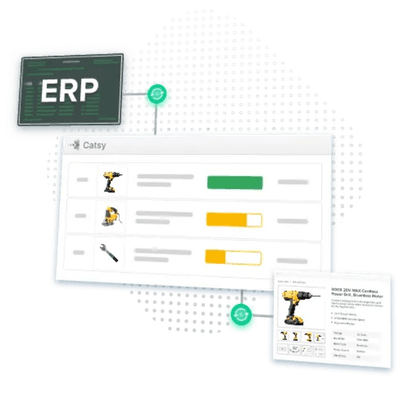
ERP data feeds into Catsy PIM, which completes each record and syncs it out to a finished listing.
Make Catsy DAM and PIM software an extension of your team.
Features to Test Before You Buy
Test each of these PIM software features with your own catalog.
Data model. The PIM should handle simple products and products with many variants. Look for hierarchical catalogs, unlimited custom attributes, validation rules, duplicate detection, and completeness scoring. Learn how to set product data quality standards for each channel.
Publishing. Good product data syndication formats content for each channel automatically. Ask about marketplace connectors, APIs, and update speed.
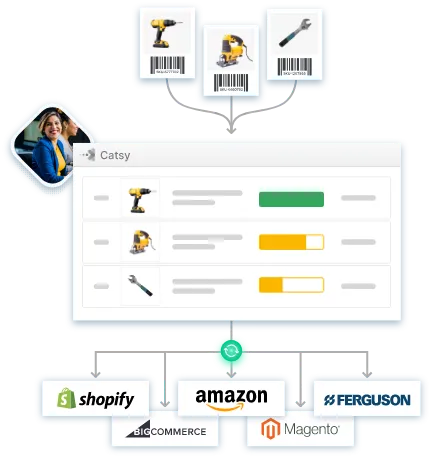
Normalize once in Catsy, then publish out to Shopify, Amazon, Ferguson, BigCommerce, and Magento in the format each one expects.
Media. Your PIM should include DAM or connect well with one. Look for version control, links between files and variants, and automatic resizing, such as asset transformation for channel-specific image sizes. This breakdown of PIM vs. DAM explains where each system fits.
Workflow. Role-based access, approvals, and audit trails keep contributors organized. See how PIM and DAM workflows handle approvals.
AI readiness. AI agents read structured data, not page design. Two standards matter:
- OpenAI: In September 2025, OpenAI introduced the Agentic Commerce Protocol, co-developed with Stripe. Its product feed specification describes how merchants supply structured catalog data.
- Google: In January 2026, Google announced the Universal Commerce Protocol, co-developed with Shopify, Etsy, Wayfair, Target, and Walmart.
Ask about complete attributes, fast-updating feeds, and the same approval checks for AI-written copy as for human copy (see how PIM acts as a harness for AI). Some platforms offer an MCP server; Catsy, for example, has an MCP server for its DAM and PIM data.
The Leading Platforms, Compared
Each platform suits a different retailer. For a broader cross-industry list, see the 7 best PIM software solutions in 2026.
| Platform | Good fit for | Recent change |
|---|---|---|
| Akeneo | Enterprise: large, global catalogs | Agentic Ziggy (July 2026) |
| Salsify | Enterprise: brands selling through many retailers | Agentic commerce positioning (2026) |
| Catsy | Mid-market: product data and media in one place | AI copy, tagging, MCP server |
| Pimcore | Mid-market: strong in-house technical teams | POCL license (2025.1) |
| Inriver | Specialist: manufacturing and B2B | n/a |
| Syndigo | Specialist: large partner networks | Acquired 1WorldSync (September 2025) |
| Centric | Specialist: fashion and apparel | Agreed to acquire Contentserv (February 2025) |
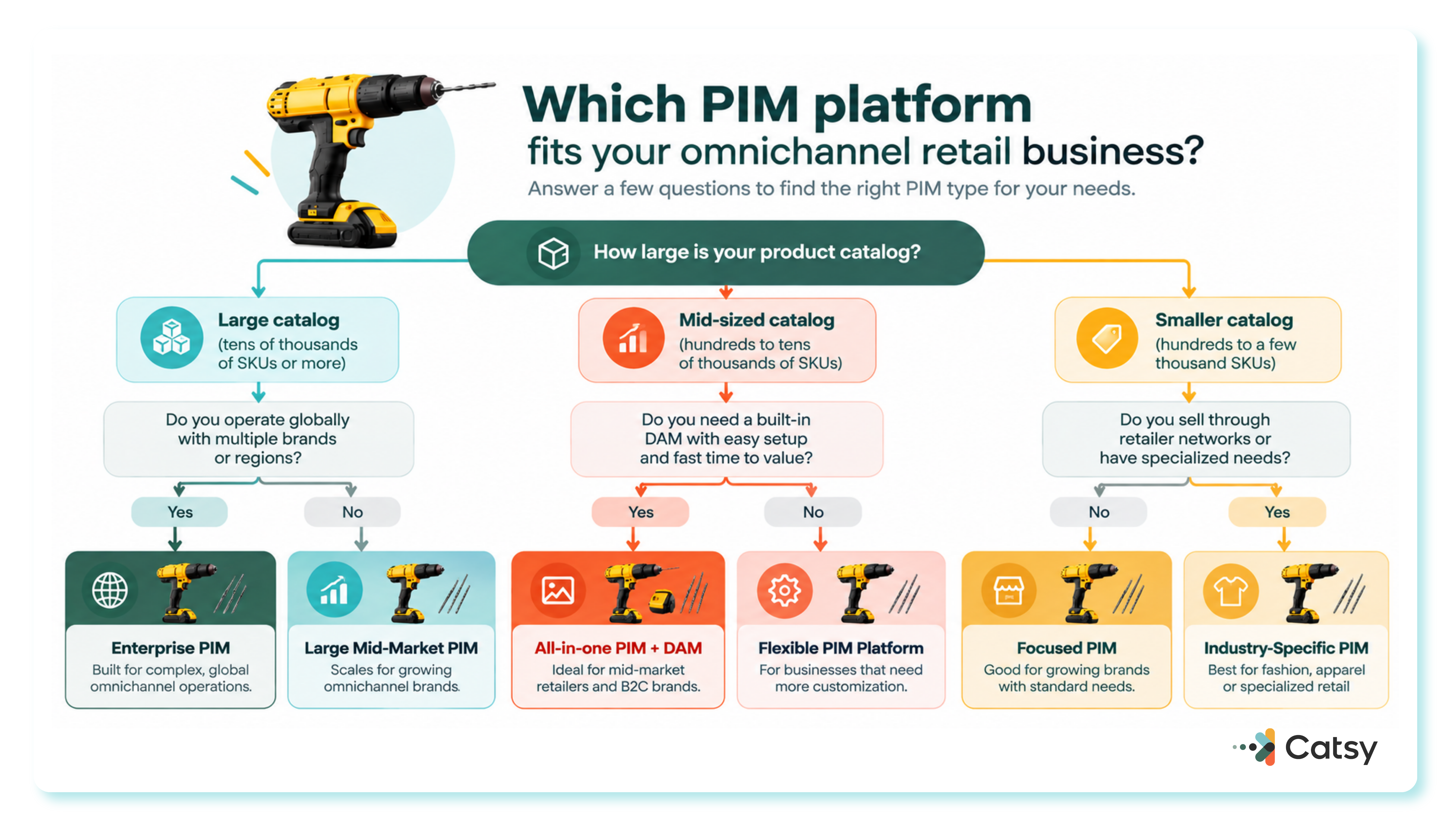
Catalog size and needs decide the platform type: enterprise, mid-market, all-in-one PIM+DAM, or a focused industry specialist.
Akeneo is API-first and handles complex catalogs. Its Product Cloud added AI Discovery Optimisation in summer 2025, a partnership with Stripe’s Agentic Commerce Suite in January 2026, and Agentic Ziggy, its AI operational layer, in July 2026.
Salsify sells Product Experience Management (PXM): PIM plus analytics, marketplace connectors, supplier tools (SXM), a GDSN data pool, and digital shelf analytics. In 2026, it extended that positioning to agentic commerce.
Catsy pairs PIM with built-in digital asset management. It:
- links each asset to the right variant and sends each channel the correct file format
- blocks incomplete products through data governance rules
- adds role-based permissions, audit trails with rollback, and AI-written copy and automatic asset tagging
Pimcore offers deep customization for strong technical teams. Since Platform 2025.1, its free Community Edition uses the Pimcore Open Core License (POCL) instead of GPLv3. The source code is still available, but free use is limited to companies with annual revenue under €5 million (Pimcore also cites EUR/USD 5 million), and hosted offerings need a commercial license. Read about SaaS vs. open-source PIM before assuming Pimcore is free.
Inriver focuses on manufacturing and B2B product relationships.
Syndigo specializes in content syndication. In September 2025, it acquired 1WorldSync, creating a company valued at more than $3.5 billion. 1WorldSync, a GDSN data pool provider, brought its PowerReviews tools. Syndigo says its network spans more than 3,500 retailers.
Centric suits fashion, with tools for seasonal collections and size matrices, but its core product is PLM, not PIM. In February 2025, Centric Software agreed to acquire Contentserv, a PIM and PXM provider, for an enterprise value of €220 million. Fashion teams can also compare Catsy’s PIM for fashion.
Still choosing a platform type? The PIM platform comparison guide compares the categories.
Rolling Out a PIM in Phases
Audit first. Map every system that holds product data and check it for completeness and accuracy.
Price the full cost. Total cost of ownership covers the license, implementation, onboarding time, and maintenance. The PIM cost guide explains what drives pricing.
Ask sharp demo questions. Is DAM included? How does the platform support AI-ready feeds? Get roadmaps and terms in writing.
Migrate in phases. Clean your data, start with a small product set, and expand once the process works. Read about PIM implementation myths to set realistic expectations.
After launch, set governance rules and data owners, track response times and time to market, document how to add SKUs, and test integrations regularly. This guide to managing product data at scale helps as the catalog grows.
Trends Shaping PIM in 2026
IMARC Group valued the PIM market at $15.7 billion in 2025 and expects $34.7 billion by 2034. Other firms’ estimates vary widely.
AI agents as shoppers. McKinsey’s October 2025 analysis estimates that agentic commerce could drive $900 billion to $1 trillion in US B2C retail revenue by 2030, and $3 trillion to $5 trillion globally. Both figures cover goods only. Your product feed becomes your shelf.
Trust is still low: Salsify found that 22% of shoppers use AI to research products, but only 14% trust its recommendations enough to rely on them regularly.
If you sell on Shopify, see what AI agents read through Shopify MCP. Multi-store merchants can compare the best PIM for Shopify Plus.
AI inside the PIM. Akeneo, Salsify, and Catsy now offer AI that writes descriptions, pulls details from images, and flags unusual data. Next come agents that handle multi-step tasks with human approval. See AI without hype: crew-assisted workflows.
Compliance data. The European Commission launched the Digital Product Passport Registry on July 20, 2026. The first deadline is February 18, 2027, for certain large batteries. The Registry also supports textiles, steel and aluminum, tires, furniture, and ICT products.
Immersive content. AR and VR adoption is slow: Salsify reported that virtual try-ons decreased 9%. Store 3D files as managed assets for now.
Keep your content on course with Catsy.
Follow Catsy on LinkedIn. [TO FILL: exact YouTube and X/Twitter handles for Catsy could not be independently confirmed during this pass]
Key Takeaways
See your catalog synced across every channel
Catsy pairs PIM with built-in DAM, AI-ready feeds, and an MCP server, so your product data stays consistent wherever shoppers find it. Book a free demo.