Integration Architecture · AI & PIM

PIM MCP vs API: Which Product-Data Connection Fits Your Workflow

MCP and APIs solve different product-data problems. A decision framework for choosing the right connection for each PIM workflow.
Ceejay S Teku September 4, 2026
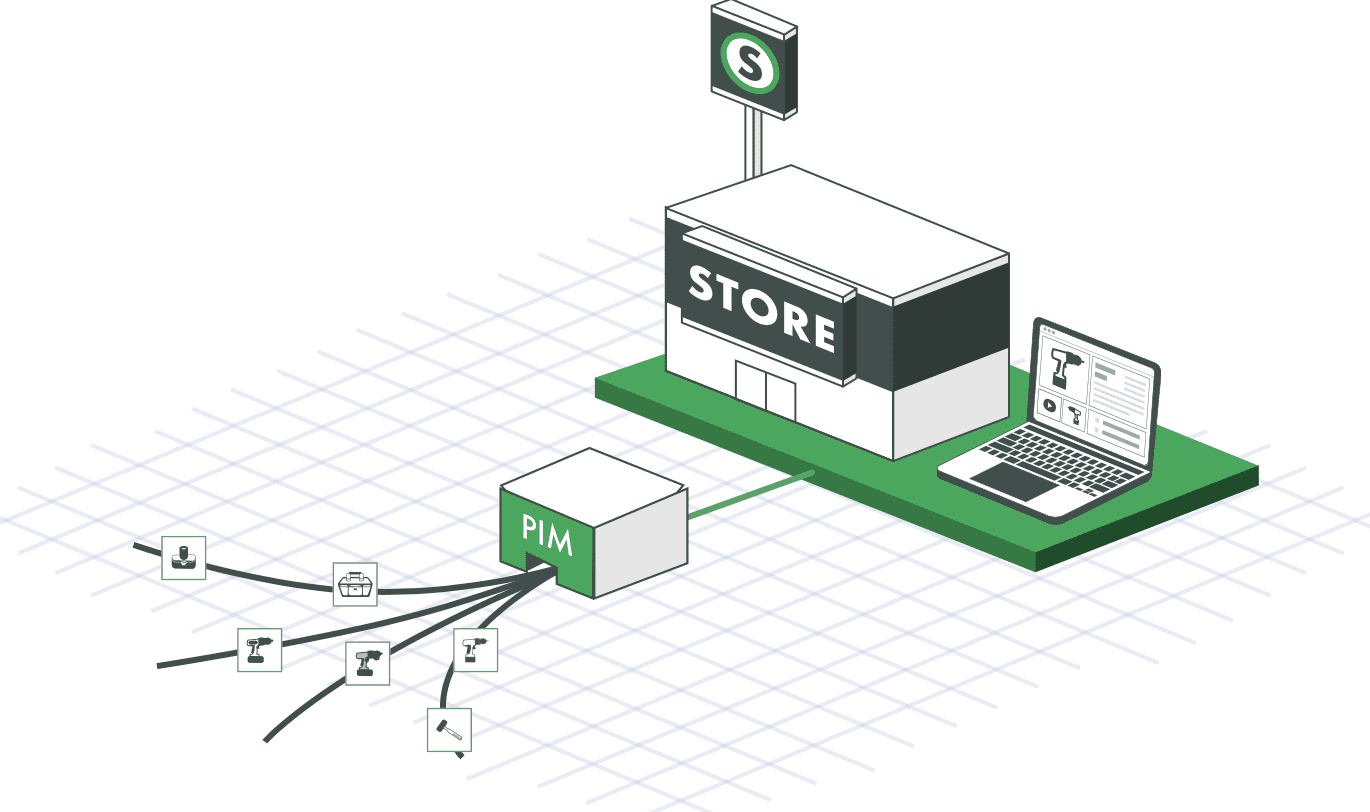
Catsy PIM connecting to ERP and channels through simple, governed API syndication
The short answer

Pick the connection by the workflow, not the technology. Human questions and judgment-driven agent tasks suit MCP. Fixed, high-volume, scheduled data movement suits a traditional API. Most mature product-data architectures run both: the API as the deterministic backbone, MCP layered above it for the reasoning work.

PIM MCP vs API is the wrong fight.

Model Context Protocol and traditional APIs answer to different callers. They solve different problems. Ask which one is better and you get a useless answer. Ask what the workflow has to do, and the choice usually makes itself in about thirty seconds.

Most teams end up needing both anyway.

In this article, you’ll learn:
Why the right starting question is “what kind of workflow is this,” not “which technology is newer”
How MCP and APIs differ across the six dimensions that affect a real integration decision
Three concrete cases: a readiness query, a distributor feed sync, and a reviewable content draft
Where a single system legitimately needs an API and an MCP connection at once
What Dynabrade’s 350-distributor rollout says about doing this in the right order
How this fits alongside the governance work in Catsy’s MCP implementation checklist

Start With the Workflow, Not the Protocol

The fastest way to get this wrong is to pick a protocol before deciding what the workflow has to do.

Four patterns cover most real cases. Two of them involve a model making judgment calls. Somebody asks a plain-English question and wants a real answer, not a raw data dump. Something like “which SKUs in this line are missing a required spec?” Or a model has to pick its next tool mid-conversation, based on what the last call sent back. Neither is a fixed sequence of steps. Both are reasoning problems, and MCP was built for those.

The other two involve no judgment at all. Two systems trade product data through a fixed contract: same endpoint, same payload shape, same call every time. Or a large batch of records moves on a schedule, with no per-record decisions to make. That second one is a throughput problem, not a reasoning problem. Throughput problems want an API.

Judgment points to MCP. Predictability points to an API. Everything below is just detail on why.

MCP and APIs Compared Across Six Dimensions

Once the workflow type is clear, six dimensions explain why the two behave differently in practice. Not just on paper.

DimensionTraditional APIMCP
Primary userA developer writing code against a fixed contractAn AI model deciding what to call, and when
Interaction patternA predetermined sequence of callsThe model discovers and selects tools at runtime
Context handlingEach call is self-contained; the caller supplies every piece of context explicitlyCapabilities are negotiated once per connection, and the model reasons across several calls inside that session
RepeatabilityIdentical input, identical behaviour, every timeTool selection can vary between calls, because the model is reasoning rather than executing a script
GovernanceAccess control lives at the endpoint: auth tokens, scopes, rate limitsThe implementer builds it. The protocol does not enforce consent, review, or logging on your behalf
Change managementA breaking change means coordinated updates across every consumer of that endpointA new tool can be added and discovered without a coordinated release, though behaviour still needs testing

The context-handling row deserves a footnote. It is where the “stateful versus stateless” shorthand misleads people.

MCP messages are self-contained. The spec requires all client-server messages to follow JSON-RPC 2.0. That is the same base format sitting under a lot of ordinary API tooling. So what persists is not the wire format. It is the session, which the spec handles under lifecycle management, plus whatever the model has worked out along the way. The difference is real. It just lives a layer above the message.

Three Decision Examples

Dimensions are easier to apply against cases you recognize. These three come up constantly in PIM work.

A readiness query

A product manager needs to know which SKUs in a line are missing a required certification before a launch date. There is no fixed report format here. The fields shift by product category, especially for manufacturers running regulated or technical catalogs. Scale is what makes it hard. Dynabrade carries 58,000 SKUs across more than 1,100 tools, sold into 90-plus countries. Nobody audits that by hand before a launch date. An agent can reason across the readiness rules and hand back a real answer instead of a canned report. MCP.

Chart showing increased SKU coverage for retailers using a PIM system
A readiness query asks which SKUs are complete enough to launch — the kind of open-ended question an MCP connection handles better than a fixed report.

A distributor feed sync

Your PIM pushes updated pricing and inventory to Grainger or Fastenal every night. On a schedule, in a format the receiving system already agreed to accept. No judgment involved. It has to run the same way every time, at volume, with failure handling you can predict.

Here, predictability is not a preference. It is a requirement. Catsy’s walkthrough of the industrial tech stack puts the stakes plainly:

“For industrial brands, accuracy is non-negotiable. Incorrect dimensions, part numbers, or certifications can lead to frustrated distributors and lost sales.”

Catsy, 2025 Tech Stack for Industrial Brands: Why PIM + DAM Software are Essential

The same video makes the point that gets lost when teams treat every connection as interchangeable:

“Each of these distributors has their own product data requirements. Submitting incorrect or incomplete data can lead to delays, lost opportunities, and strained relationships.”

Catsy, 2025 Tech Stack for Industrial Brands
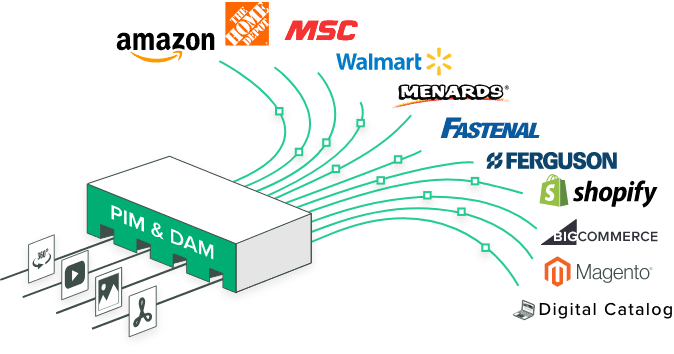
Catsy PIM distributing product data out to multiple sales channels and distributor destinations
Every distributor destination is its own fixed contract. That is exactly the shape an API handles well.

Dynabrade, a pneumatic tool manufacturer, syndicates to more than 350 distributors across 90 countries. Its product data sat in a US ERP, European spreadsheets, and shared drives, and the two regions overwrote each other. After 11 weeks on a governed PIM and automated feeds:

25–35 → 0Distributor feed errors per quarterly cycle
61% → 99%Product data completeness
>50%Reduction in data preparation time

Grainger, Fastenal, Ferguson, and AD each want something different. A fixed contract per destination keeps that manageable. Hand it to an agent that reasons its way through every record and you have made a solved problem unpredictable again. API.

A reviewable content draft

Catsy PIM and DAM speeding up product listing creation and time to market
Drafting a listing is a reasoning task. Publishing it stays a governed, human-approved step.

A team wants an agent to draft a product comparison from approved attribute data, with a human signing off before anything publishes. That is the pattern behind Catsy’s MCP integration with HubSpot. It sits between the other two. The drafting gains from MCP reasoning over context. But the attribute data underneath should already arrive through a governed API connection, and the publish step stays a separate human action. Both.

Where a Single Workflow Needs Both

That third example is not an edge case. It is what a mature integration usually looks like.

The API stays the backbone. Inventory levels, price updates, bulk attribute syncs: all of it keeps moving through a fixed contract you can test and monitor. Predictability at volume is exactly what those jobs need. MCP sits above that layer. It handles the parts that gain from a model reasoning over product data the API has already delivered.

Treat it as either-or and you tend to make one of two mistakes.

The first is forcing a high-volume nightly sync through an agent that has to think about every record. Slow, unpredictable, and pointless. The second is squeezing a judgment-driven question through a fixed contract. It cannot adapt to anything it was not built to answer.

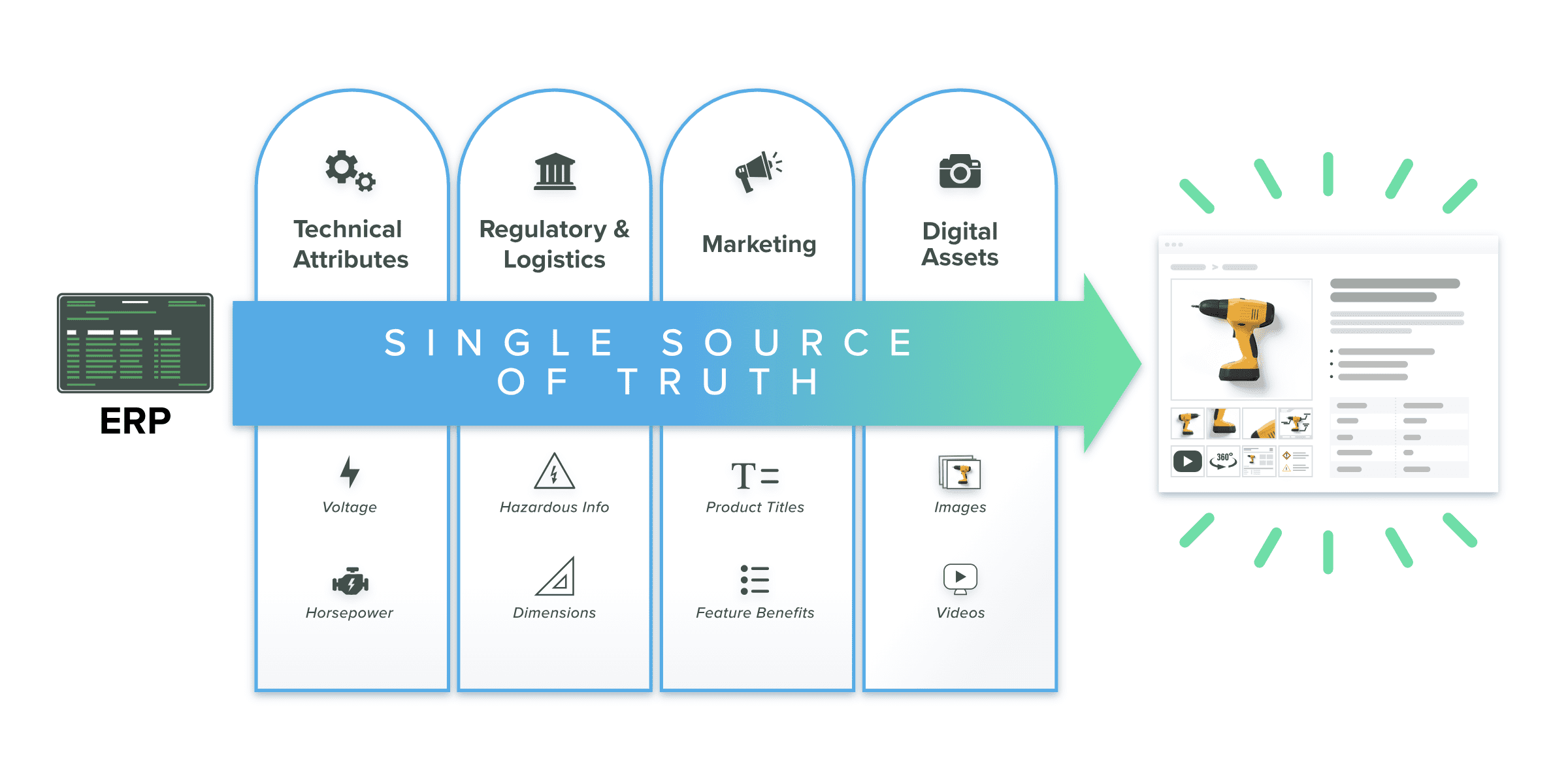
Diagram of a PIM as single source of truth, moving product data from ERP through to the product detail page and eliminating data silos
Both connection types read from the same place. That shared source is what makes either one trustworthy.

Neither connection rescues bad source data, though. An agent reasoning over unchecked attributes gives you a confident wrong answer. An API sends that same wrong attribute to twelve destinations on schedule. Governed PIM data underneath both layers is what makes either one worth connecting.

Dynabrade’s numbers show the size of that gap. Its catalog went from 61% complete to 99%. At 61%, roughly two attributes in five are missing or wrong. An agent asked a readiness question against that data will answer confidently and be wrong four times out of ten, and no protocol choice fixes it.

“Catsy makes it possible to have all our data centralized in one place, which allows us to easily share information with customers and update our website.”

Marketing Specialist, Dynabrade — Catsy case study

Centralization is the precondition. The protocol question comes after it.

Where This Fits Alongside the MCP Implementation Checklist

Catsy’s PIM MCP implementation checklist starts where this article stops. It assumes MCP is already the right call, then walks through access scope, human review, logging, and escalation.

This is the step before that. Is MCP even the right tool here, or would an API do the same job more predictably?

The same split applies to Catsy’s Shopify MCP coverage. It takes an agent-facing storefront workflow as given rather than arguing for it. Worth reading once you have decided. Less useful while you are still deciding.

Unified PIM and DAM platform managing product attributes and digital assets in one system
A unified PIM and DAM is the backbone both an API and an MCP layer connect back to.

Underneath both sits one question: how does a workflow actually reach the product information management system behind it? A fixed, high-volume sync stays fast and testable through that PIM’s own API layer. That is the backbone an MCP layer should sit on, not replace.

Key Takeaways

01. Judgment points to MCP. Predictability points to an API. Decide the workflow type first and the technology choice follows.
02. Six dimensions separate them: primary user, interaction pattern, context handling, repeatability, governance, and change management.
03. MCP messages are self-contained JSON-RPC 2.0 requests, per the spec. What persists is the session and the model’s reasoning, not a different wire format.
04. A readiness query fits MCP. A nightly Grainger or Fastenal feed fits an API. A reviewable content draft usually needs both.
05. Governance is the sharpest difference. An API enforces access at the endpoint. MCP leaves consent, review, and logging to whoever builds it.
06. Neither connection rescues bad source data. Validated attributes underneath are what make either one trustworthy.
07. Dynabrade shows the payoff in order: centralize first, then connect. Feed errors fell from 25–35 a quarter to zero, and data completeness rose from 61% to 99%.
Catsy PIM + DAM

See Both Connections Running Side by Side

Catsy supports API and MCP connections against the same governed product data. A nightly distributor feed and an agent answering a readiness question draw from one validated PIM. Request a demo, or browse the PIM and DAM resource center.

FAQs

No. MCP is often built on top of existing APIs rather than replacing them. A deterministic, high-volume integration, like syncing inventory to a retailer’s system, is usually better served by a traditional API, while MCP fits tasks that genuinely benefit from a model reasoning over context.

When the task involves a human-language question with a synthesized answer, or an agentic task where a model needs to decide which tool to call based on what earlier steps returned. Fixed, predictable, high-volume data movement is usually better served by an API.

It’s more precise than that binary suggests. MCP’s individual protocol messages are self-contained JSON-RPC requests, similar in structure to many API calls. What persists across an MCP workflow is the negotiated session and the model’s own reasoning across multiple calls, not a fundamentally different message format.

Yes, and this is common in practice. A typical pattern uses an API for the deterministic system-of-record connection, like syncing attributes or inventory, with MCP layered on top for the human or agent interaction that reasons over that already-synced data.

A nightly retailer-feed sync that pushes pricing and inventory in a fixed format on a fixed schedule. There’s no judgment involved and no benefit to a model reasoning about it. A deterministic API integration handles this more predictably and at greater scale.

SHARE