
As digital commerce keeps evolving, more businesses are asking the same question: what is the best PIM with AI agents? Product data lives everywhere — across e-commerce platforms, marketplaces, ERP systems, and new sales channels that seem to appear overnight. Keeping product information accurate and consistent across multiple channels is no longer something your teams can manage by hand.
This is where modern product information management (PIM) systems step in. The best PIM software actively improves your product data using automation and intelligent workflows. When AI agents are built into a PIM platform, product data management becomes faster and far more scalable. Rather than reacting to data problems, businesses can stay ahead of them.
Understanding AI Agents in Product Information Management
Traditional PIM systems were built to centralize product data. They act as a single place to store product descriptions, technical specifications, digital assets, and other core product information. That alone brings big benefits — teams can centralize product data, reduce duplication, and improve data accuracy across multiple sales channels.
The problem is that traditional PIM software still relies heavily on manual effort. Someone has to clean the data, validate it, update product content, and manage workflows. As product catalogs grow and businesses expand into multiple regions and languages, that work becomes overwhelming.
AI agents change how PIM systems work. Instead of waiting for humans to fix issues, AI agents actively monitor product data and take action. They can validate data quality and detect errors, then suggest corrections automatically. They can generate product descriptions and translate content into multiple languages. All of your product information stays up to date across all sales channels.
Key Features That Define the Best AI-Powered PIM
Not all PIM solutions are created equal. The best PIM software with AI agents includes a clear set of core features designed to support scale, speed, and accuracy.
Digital Asset Management in AI-Driven PIM Systems
Digital asset management plays a major role in product data management today. Product images and digital assets are just as important as product descriptions and technical specifications. If assets are outdated or mismatched, customer trust drops quickly.
In AI-driven PIM systems, digital asset management is fully integrated into the centralized platform. AI tools automatically tag product images, link them to the correct products, and validate that they meet quality standards. A unified platform that combines PIM and DAM gives teams a single source of truth.

How AI Agents Transform Product Data Management
Onboarding speed. AI-powered PIM solutions can ingest supplier data, extract product attributes, and validate technical specifications automatically. What once took weeks can now happen in days or hours.
Product content creation. AI agents generate product descriptions tailored to different sales channels and regions. Content can be localized into multiple languages while maintaining consistent product data and brand voice.
Continuous optimization. Instead of waiting for quarterly reviews, the system uses digital shelf analytics and performance insights to improve product content in real time.
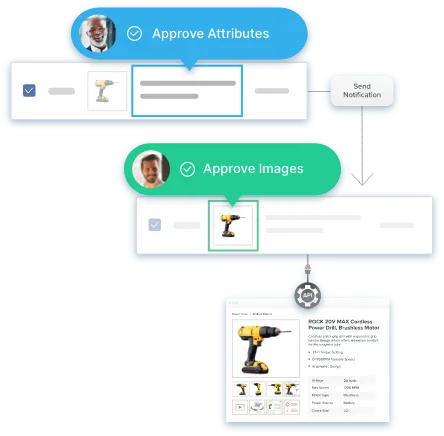
Workflow management. AI agents help manage version control, track approvals, and enforce data validation rules. Problems are caught early, and improvements happen continuously.
Agentic Commerce and the Future of Product Discovery
Agentic commerce is changing how products are discovered and purchased. AI shopping assistants can now search product catalogs, compare options, and complete purchases on behalf of users. These systems rely on structured, accurate product data to function.
For businesses, this means product information management systems must be ready for machine consumption, not just human browsing. Product data must be complete, consistent, and machine readable. Missing attributes or outdated information can cause products to be skipped entirely by AI agents.
The best PIM with AI agents supports agentic commerce by providing structured product data, API access, and real-time updates. As more consumers rely on AI assistants, businesses that invest early in AI-ready PIM systems will have a clear advantage.
Choosing the Right PIM Solution for Your Business
Start by defining your business needs. Consider your product catalogs, number of sales channels, and regions you support. A PIM software comparison is essential — look closely at AI capabilities, not just feature lists. Ask how AI agents are actually used to improve data quality, product workflows, and operational efficiency.
Integration is another key factor. The best PIM software offers seamless integrations with ERP systems, ecommerce platforms, and third-party tools. Usability matters too — a user-friendly interface reduces the steep learning curve that often comes with enterprise software.
