Industrial Marketing Content Strategy: The Technical Buyer’s Playbook
Learn how to turn engineering specs into industrial marketing content technical buyers actually use, from persona mapping to PIM+DAM syndication for CAD files, compliance sheets, and dealer feeds.
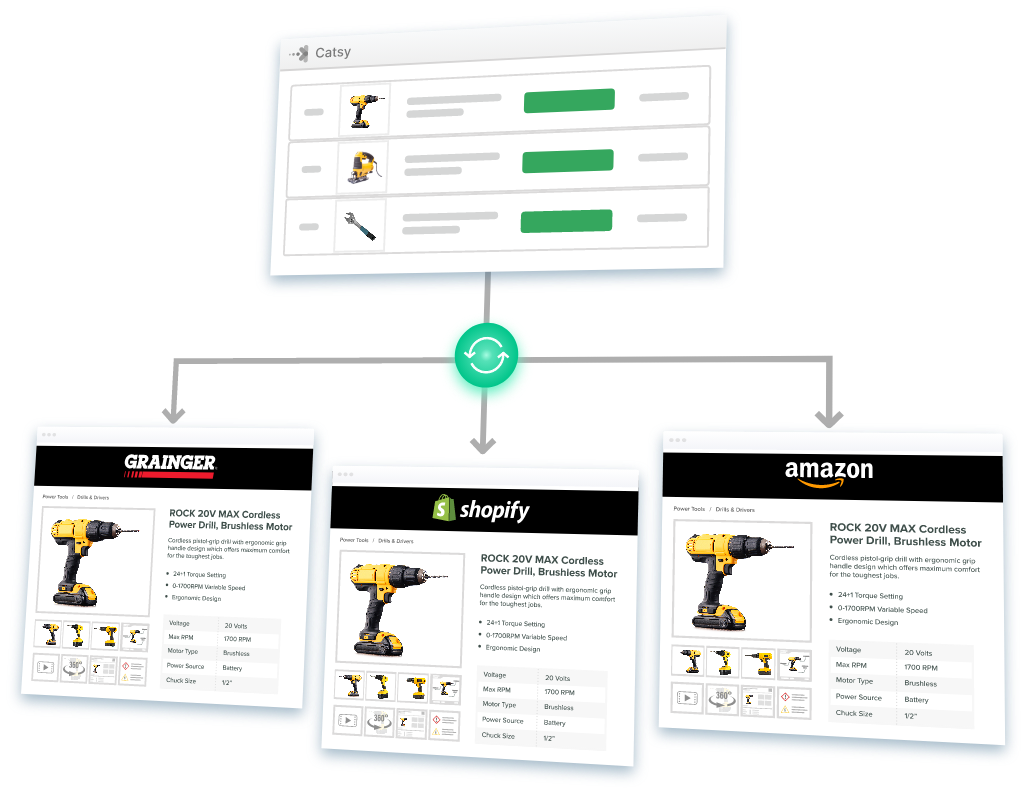
Table of Contents
Direct answer: Industrial marketing content works differently from standard B2B marketing. Your product data is the content. Engineers, procurement staff, and plant operations officers need structured, spec-dense assets. They don’t need editorial articles. A unified PIM plus DAM system automates that content. CAD models, drawings, compliance sheets, and catalog taxonomy sync from one source. That source feeds your storefront, distributor portals, and marketplaces at once.
What Is the Difference Between a PIM, a DAM, and a CMS?
A Product Information Management (PIM) system holds your structured product data: names, specs, pricing, and attributes. A Digital Asset Management (DAM) system holds your media: images, CAD files, videos, and PDFs. A content management system (CMS), like the platform running your blog, publishes pages built from text and design, not governed product records. Manufacturers often reach for CMS-style tools such as HubSpot or Notion to organize marketing content, but a spec sheet or CAD file isn’t blog content. It’s product data. Treating it that way, inside a PIM and DAM built for technical catalogs, is what keeps it accurate as your catalog grows.
Why Are Traditional Spec Sheets Limiting Your Growth?
Spec sheets limit growth because they assume every buyer thinks like an engineer, and most don’t. Picture a 47-page tech spec for an industrial pump. Engineering accounted for every detail of torque, materials, and performance. The product is genuinely better than competitors. The marketing materials still fall flat, because the sheet answers “what is this” and skips “why should I buy it.”
Product quality isn’t the problem. Communicating that quality to the buyer is. Content Marketing Institute’s manufacturing research shows how wide this gap runs. Among manufacturing marketers, only 20% call their content strategy very effective. 67% call it only moderately effective. The top reasons: content isn’t tied to the customer journey (47%), isn’t data-driven (46%), and lacks clear goals (40%). That’s the same gap this section describes, now with real numbers behind it.
| Why Spec-Only Content Fails | What the Buyer Actually Needs |
|---|---|
| Engineering docs assume every reader thinks like an engineer. | ROI and implementation ease, spelled out, not implied. |
| Static PDFs don’t fit digital-first, mobile buying habits. | Searchable, interactive content that works on a phone. |
| Generic templates make differentiated products look identical. | Content that shows what’s actually different, and why it matters. |
A typical industrial purchase now runs through more people than one spec sheet can satisfy. Forrester’s most recent buying research counts 13 internal stakeholders and 9 external influencers in the average B2B purchase decision. Content built for one role rarely satisfies the other twelve.
What Does It Cost You When Technical Content Doesn’t Convert?
Ineffective content costs manufacturers real revenue. 2026 research puts a hard number on that drag. Storyblok, working with FT Longitude, surveyed 550 senior leaders at billion-dollar-plus companies. They call it “content debt”: content that’s outdated or poorly structured. It’s costing enterprises $4.63 trillion globally. The average company carries nearly 6% of annual revenue at risk. For a mid-market manufacturer, the problem looks smaller but familiar. A spec sheet nobody updated after a product revision. A PDF that no longer matches your current catalog.
A governed product data management system attacks that lost time directly. Reps stop hunting for the current spec sheet or certificate, because every channel pulls from the same source. That’s the practical fix to the content-debt problem: content that updates once and syndicates everywhere doesn’t accumulate debt the way scattered PDFs do.
What Content Solutions Should You Test First?
Start with a low-cost pilot, not a full platform migration. Smart manufacturers begin content transformation with a targeted pilot that proves ROI before they invest in a comprehensive system. A focused pilot also builds internal confidence before you touch your whole catalog.
| Solution Category | Example Tools | What It Solves |
|---|---|---|
| Content Audit & Prioritization | SEMrush Content Audit, HubSpot Content Strategy | Shows which existing materials already convert, so you fix the highest-impact gaps first. |
| Template-Based Content Systems | Notion, a dedicated industrial PIM | Lets you create content systematically without a large upfront technical investment. |
| Interactive Content Platforms | Outgrow, SnapApp, custom configurators | Turns static specs into an experience that captures lead data while it demonstrates value. |
Pick your three highest-value product lines and map a buyer journey for each one. That focused scope lets you refine your process before you scale it across the full catalog.
How Do Smaller Industrial Brands Get Faster ROI?
Smaller manufacturers move faster on content. Fewer approval layers, not more budget, is why. McKinsey’s small-business research backs this up. In several sectors, including professional and administrative services, medium-size businesses with 50 to 499 employees match or beat companies over 500 employees. Enterprise content rollouts typically take 12 to 18 months. A focused mid-market pilot can finish a full test cycle much faster.
| Phase | Weeks | Focus |
|---|---|---|
| Audit | 1-2 | Audit existing content, set priorities, clean your product data. |
| Build | 3-4 | Develop templates and produce your baseline content. |
| Test | 5-6 | Test and optimize based on real performance data. |
| Scale | 7-8 | Roll the proven approach out to more product lines. |
A smaller organization also keeps engineering, marketing, and sales talking directly to each other. That direct line prevents the disconnects that show up in larger companies, where those three teams rarely sit in the same room.
How Do You Future-Proof Your Content Infrastructure?
Build your infrastructure to adapt. Don’t try to predict every trend. Industrial buyers want digital-first, self-service research now. Forrester’s 2026 research confirms the shift is underway. Generative AI is changing how buyers discover and evaluate products. Buyers still want human validation before they spend budget.
- AI-powered content personalization based on buyer behavior
- Augmented reality product visualization tied to live specifications
- Interactive configuration tools that generate custom proposals automatically
- Multi-channel distribution built for every buyer touchpoint
Younger buyers are entering industrial purchasing now. They want video, interactive comparisons, and mobile access. They still want full technical depth too. Build infrastructure that flexes. A one-time redesign won’t keep up with expectations that keep shifting.
Is Your Product Data Actually Your Content?
Yes, for an industrial buyer, your product data is your content. A CAD file lets an engineer drop your part into an assembly. A compliance certificate lets an officer clear your product for a plant floor. Neither reads like a blog post, but both do a content asset’s job: they move a buyer toward a decision.
| Asset Type | What It Enables |
|---|---|
| 3D CAD & BIM models | Engineers drop parts directly into design assemblies, no file request needed. |
| Dimensional drawings & tolerance specs | Procurement validates against exact data, not a rounded estimate. |
| Compliance & safety certifications | ISO, RoHS, and REACH documents download instantly instead of by email request. |
| Structured attribute taxonomies | ETIM or UNSPSC classification makes your catalog searchable the way distributors expect. |
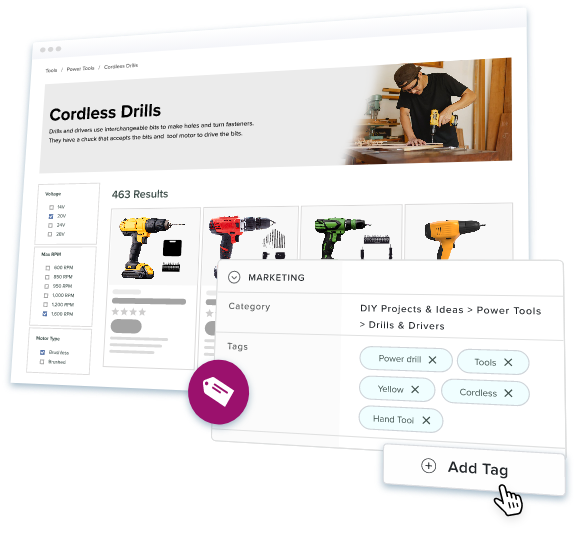
This is why a combined PIM and DAM system matters more for manufacturers than for most other B2B categories. The content and the product data are the same file.
What Does a Unified PIM+DAM Engine Look Like?
A unified engine keeps every technical asset accurate everywhere it’s published. That includes your own site, and every channel beyond it. Engineering PLM and ERP systems feed a central PIM and DAM hub. That hub enriches and validates the data. It manages the assets too. Then it transforms everything into the format each channel needs: your storefront, a distributor portal, or a marketplace feed.
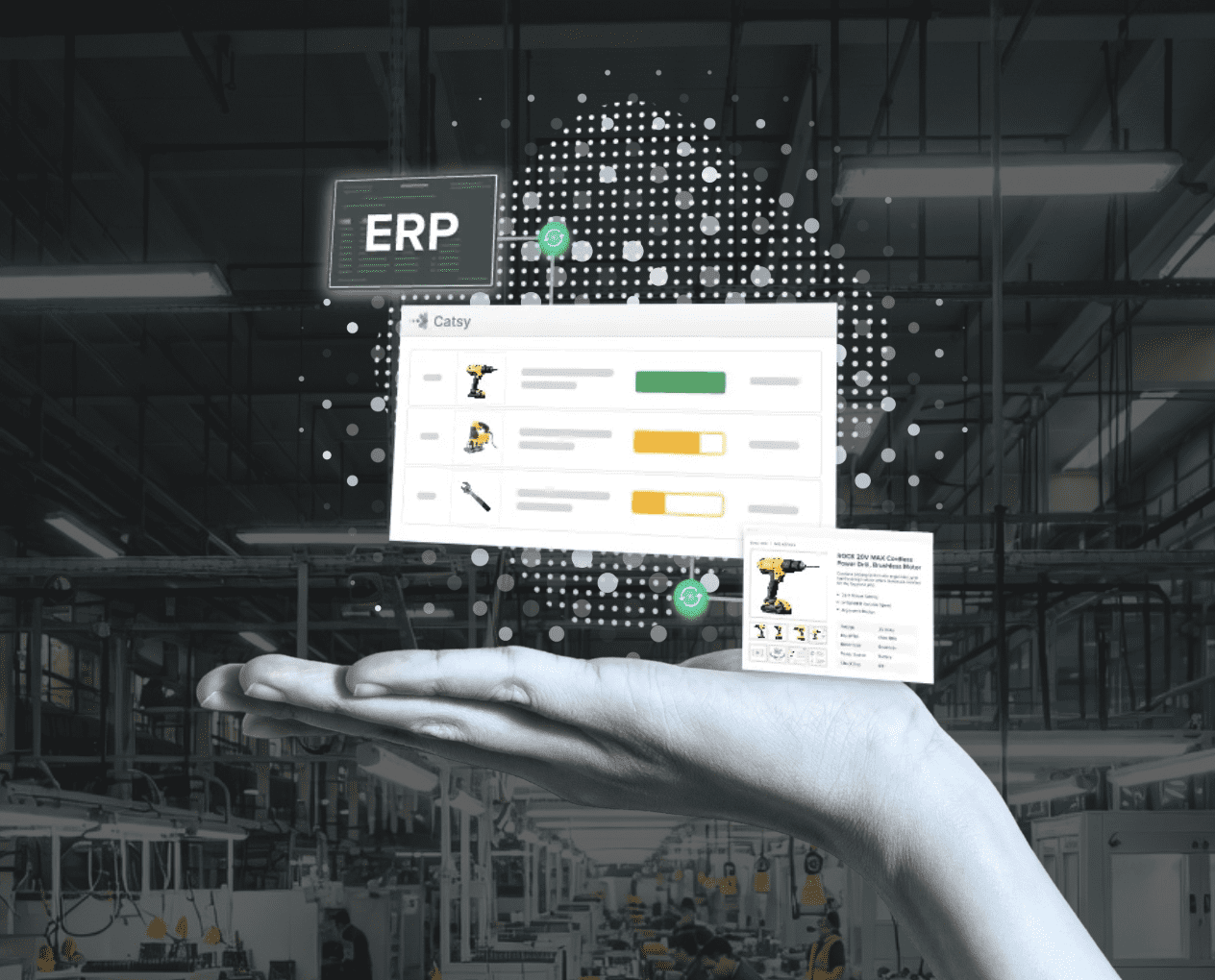
That structure solves two problems specific to industrial catalogs. First, spec sheets stop going stale. A designer used to rebuild the PDF by hand every time a tolerance changed. Now the sheet generates from live data instead. It never drifts from what engineering actually shipped. Second, distributor feeds stop breaking. Manufacturers publishing to partners like Grainger, Motion Industries, or Fastenal often juggle a separate spreadsheet per partner. A governed omnichannel PIM pushes one validated source to every format instead. That cuts the manual re-entry that causes mismatched listings.
Digital asset management carries the other half of the load. CAD files, photography, manuals, and compliance PDFs need version control too. They need the same metadata tagging a PIM applies to structured attributes. That’s why DAM best practices increasingly overlap with PIM governance now, instead of living as a separate discipline.
How Do You Measure Industrial Content ROI in 2026?
Time-to-market is the clearest ROI signal for content infrastructure. Keep spec sheets, compliance documents, and CAD files in one governed system. A seasonal catalog launch or a line extension then moves faster. Nobody waits on a manual PDF rebuild or a spreadsheet update.
Support load is the second signal. When a distributor or engineer can self-serve the current spec sheet or certificate from your site, that’s one fewer support ticket and one fewer delayed quote. It also frees sales reps to spend more of that scarce 40% selling time actually selling, instead of tracking down documentation.
Key Takeaways
Your Product Is Already Superior. Make Your Content Match It.
Your content problem is usually an infrastructure problem: specs and CAD files scattered across folders instead of syndicated from one governed source. See how Catsy’s PIM + DAM system centralizes technical content for every channel. [BOOK-A-DEMO-URL TO FILL]