Top Questions to Ask Before PIM Solution Demo: A Guide for BigCommerce Users
The right questions to ask before your PIM solution demo, plus enterprise “show-me” test scripts BigCommerce buyers can use to stress-test vendors in 2026.
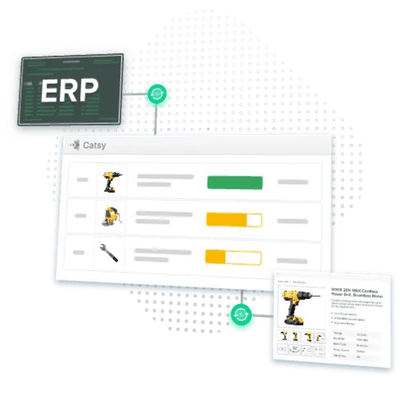
Table of Contents
Ask your PIM vendor to show, not tell. A useful BigCommerce PIM demo tests five things. It tests native, two-way BigCommerce sync. It tests one-record-to-many-channels syndication. It tests hard validation gates that block incomplete SKUs. It tests attribute inheritance as your catalog grows. And it tests the true all-in cost, including migration and training, not just the license fee. Bring your own messy product data and ask the vendor to work with it live. If they can only demo a pre-cleaned sample file, that is itself an answer.
What Is a PIM, and How Is It Different From a DAM or CRM?
A PIM (Product Information Management) system is the record of truth for product data. It holds descriptions, attributes, specifications, and compliance fields. It is not the same tool as a Digital Asset Management (DAM) system, a CRM, or a CMS. Mixing them up during vendor evaluation leads to buying the wrong system.
| System | What It Manages | What It Does Not Do |
|---|---|---|
| PIM | Product attributes, specs, descriptions, and syndication rules for every channel. | Store rich media files or manage customer relationships. |
| DAM | Images, video, CAD files, and other digital assets, plus rights and version control. | Manage structured product attributes or push listings to channels on its own. |
| CRM | Customer records, sales pipeline, and communication history. | Hold or validate product data; a CRM has no concept of a SKU attribute. |
| CMS | Page layout and web content for your storefront. | Enforce product data governance or serve as a single source of truth across channels. |
The vendor-question list below still asks about ERP and CRM integrations side by side. That is intentional. A modern PIM needs to talk to both systems. It replaces neither one.
Does the PIM Integrate Seamlessly With BigCommerce?
Yes, but only if it offers native, bi-directional BigCommerce sync rather than a one-way export. Your tech stack needs a conductor, not another solo artist.
Native BigCommerce integration eliminates data silos. It reduces manual data entry. It keeps your product information current across every connected system. But the PIM cannot be a solo artist either. It has to coordinate with the rest of your stack. Bring these questions to your vendor:
| Ask This | What a Strong Answer Sounds Like |
|---|---|
| Do you offer native BigCommerce API integration, or does it require middleware for legacy systems? | A direct, supported connector; middleware only where a specific legacy system genuinely requires it, not as the default path. |
| How frequently does data sync, and is it real-time, hourly, or manual? | A defined, automatic sync cadence the vendor can name precisely, not “it depends.” |
| Can you handle BigCommerce-specific attributes like custom fields, variants, and meta fields? | A live demo mapping your actual variant structure, not a generic screenshot. |
| What happens when updates occur simultaneously in both systems? | A clear conflict-resolution rule, such as PIM-as-source-of-truth, stated plainly rather than glossed over. |
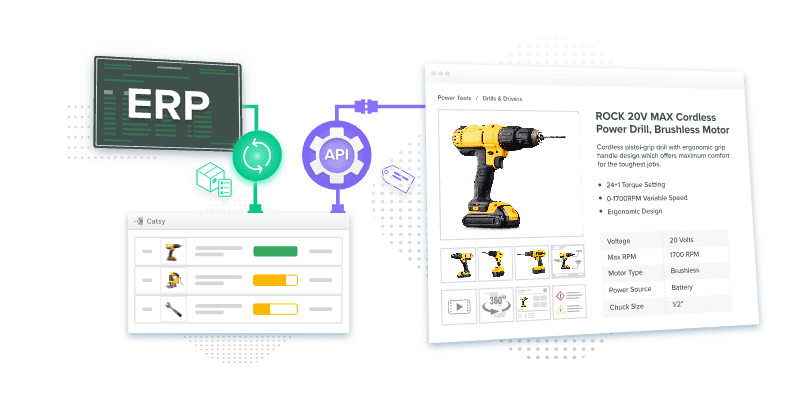
| How do you manage other integrations, like ERP or CRM? | Named, supported connectors or a documented API approach, not a vague “we can build that.” |
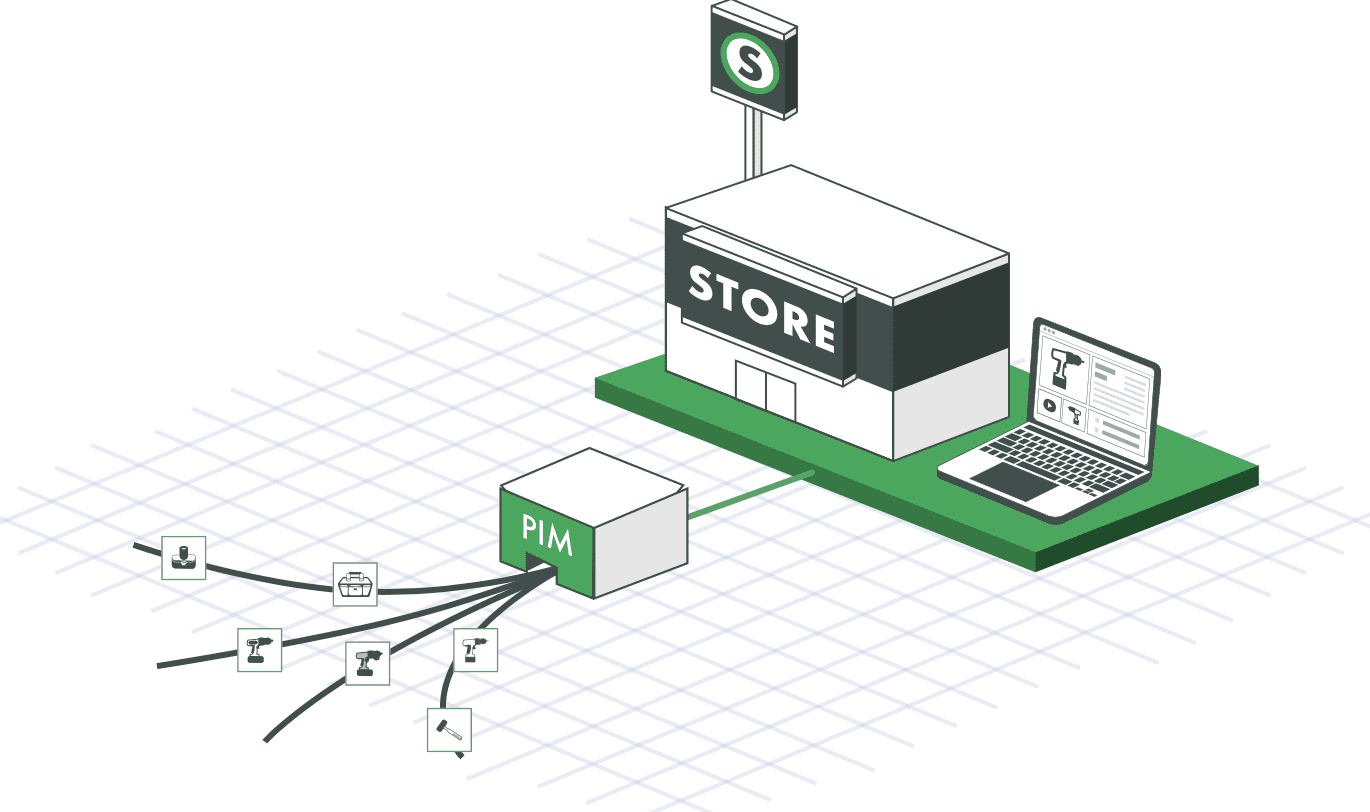
A solid PIM system consolidates product information from internal and external sources into one single source of truth. For BigCommerce users, that means bi-directional sync: your data structure stays intact and your connection to every distribution channel stays consistent.
A robust API layer lets your PIM connect to marketing channels, social sales channels, and advertising networks, creating one hub for product data management.
Red flag: a vendor who is vague about technical specs is a warning sign. So is one who cannot demonstrate live BigCommerce sync. Both usually mean integration limits that surface later, during implementation.
Enterprise show-me test: bring your own raw ERP or supplier CSV export. Include a few messy rows on purpose. Ask the vendor to ingest it live. A PIM built for manufacturers and distributors should log the errors automatically and keep processing. It should not stall or need a developer to write custom mapping code on the spot.
How Does the Solution Handle Multi-Channel Product Syndication?
A capable PIM pushes one product update to every channel from a single record. Your team never has to re-enter the same data twice. Your customers shop everywhere, so your product data has to follow.
BigCommerce merchants typically sell across several platforms at once: Amazon, eBay, social commerce, and B2B distributor portals. That takes automated syndication. It has to adapt data to each platform’s rules without duplicating your team’s work.
| Ask This | What a Strong Answer Sounds Like |
|---|---|
| Which sales and distribution channels do you support beyond our primary platform? | A named list, including B2B distributor portals if that matters to your business, not “most major channels.” |
| How do you handle channel-specific rules like image size, character limits, or required attributes? | Configurable, channel-specific templates the vendor can show you editing live. |
| Can non-technical users adapt data for a new channel without duplicating records? | A workflow a marketing or catalog team member could run without IT involvement. |
| Do you offer automated feed generation and validation? | Feeds that are checked against each channel’s requirements before they go out, not after. |
| How is category and catalog structure managed across channels? | One structure that maps cleanly to each channel’s taxonomy, not a separate manual mapping per channel. |
Product data syndication should distribute your data from one central location to every marketing channel, advertising network, and storefront. Connector counts vary by vendor and change often. Ask each one for their current, named channel list rather than trusting a round figure from marketing copy.
Demand for better multi-channel product experiences keeps pushing PIM adoption forward. The global product information management market was valued near $17.2 billion for 2026. It is projected to roughly double, to $32.8 billion, by 2030. E-commerce growth and rising demand for consistent product data are driving that growth. As your company scales, managing consistency at every touchpoint becomes critical to customer satisfaction and time to market.
Demo checkpoint: ask the vendor to show a single product update flowing to multiple sales channels live. If they cannot demonstrate this easily, expect implementation headaches later.
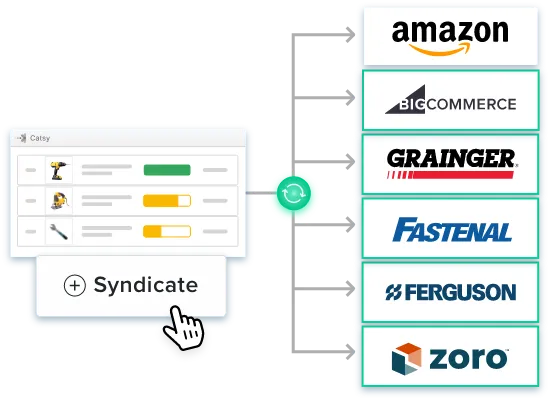
Enterprise show-me test: for B2B and industrial sellers, ask the vendor to push one product to a distributor channel (Grainger, Amazon Business, or similar) and to BigCommerce at the same time. Then show what happens when a required channel attribute is missing. A system with real syndication governance should block that incomplete SKU from reaching the distributor feed.
What Data Quality and Validation Features Are Included?
Look for automated completeness scoring, mandatory-field validation, and a hard block on publishing incomplete listings. Incomplete product data is a conversion killer disguised as a technical problem.
Tracking completeness and validating data before it goes live keeps your BigCommerce store looking sharp and professional. It drives better engagement, too, because customers see accurate information the first time.
Essential questions about data management:
- How do you track product data completeness and readiness for publishing across channels?
- Can you enforce mandatory attributes based on product category or destination channel?
- Do you offer automated quality scoring, enrichment, or real-time alerts?
- What prevents a team member from publishing incomplete information to the store?
- How does the platform handle data standards and data governance across the organization?
Sophisticated PIM systems provide digital shelf analytics to help confirm you are consistently meeting customer expectations. For BigCommerce merchants, that means catching missing descriptions, low-quality images, or incomplete specifications before they ever go live.
Data accuracy affects more than the storefront. It reaches your marketing channels, your CRM, and every touchpoint in the customer journey. The right platform stays flexible enough for customization while still holding the line on quality.
Feature spotlight: configurable validation rules block publication until listings meet your standard. Enrichment tools improve data quality throughout the process.
Enterprise show-me test: if you sell technical, industrial, or regulated products, set a rule requiring full ETIM or UNSPSC taxonomy data. Or require a compliance field, like RoHS or REACH. Then try to publish a SKU that is missing it. A gate that actually blocks the SKU, not just a warning icon, is what real governance looks like.
Can the Platform Scale With Your Growing Catalog?
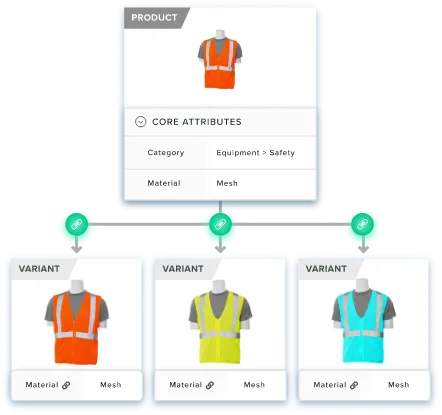
Yes, if the platform holds its own as SKUs, users, and languages all grow together. It has to keep its performance, its attribute inheritance, and its governance intact. Without that, today’s catalog becomes tomorrow’s bottleneck.
Scalability means system performance holds steady as your user count grows. It means products stay manageable across multiple languages. And it means your processes adapt as your business model changes.
| Ask This | What a Strong Answer Sounds Like |
|---|---|
| How big is your largest customer’s catalog, and how does performance hold up? | A specific reference catalog size and a straight answer on performance, not a deflection to “it scales.” |
| Are there limits on products, users, API calls, or asset storage? | Published limits by plan tier, stated up front, not discovered after signing. |
| How does pricing change as we scale users and channels? | A pricing model you can project forward yourself, not one that requires a new quote at every step. |
| Can the system support multiple languages and multi-currency for international growth? | Native localization workflows and version control, not a manual translation spreadsheet bolted on. |
| Does the platform grow with your digital asset management needs for images, video, and marketing materials? | Shared storage and governance between product data and assets, not two disconnected systems. |
BigCommerce merchants increasingly target multiple regions. Product lines expand faster than manual processes can track. Workflow tools for larger teams, permissions that protect data security, and automation that cuts manual entry all matter more as your catalog grows.
Expansion essentials: ask about Digital Asset Management (DAM) for marketing materials, CRM integration for customer engagement, and how the PIM handles enrichment at scale across every channel.
Enterprise show-me test: ask the vendor to update one spec, price rule, or compliance value on a parent SKU. Watch how fast, and how accurately, that change cascades to every variant child SKU. This matters most for catalogs with hundreds of variants per parent, common in fashion, hardware, and industrial parts. The test shows whether the platform holds a true single source of truth at scale, or whether updates need manual touch-ups SKU by SKU.
What Are the True Implementation Costs and Timeline?
The license fee is only part of the cost. Data migration, integration setup, and training usually add to it. License fees are the headline price, but your operational costs write the real story.
Operational costs include data migration, training, integration setup, and ongoing maintenance. Understanding them up front prevents budget surprises. It also lets you calculate a genuine ROI for the investment.
Financial transparency questions:
- What is included in base pricing versus additional costs like implementation, training, and support?
- How long does a typical BigCommerce PIM implementation take, and what could extend the timeline?
- What internal resources are needed during setup, particularly from IT, marketing, and product teams?
- Do you charge for data migration from spreadsheets, legacy systems, or manual sources?
- What does ongoing support look like, and are updates included?
Transparent vendors give clear detail on the initial costs of integration: data migration, ERP setup, configuration, and staff training. Operational costs for adding channels or connecting new systems later should be part of that same conversation.
Budget reality: factor in internal labor for training, data cleanup before migration, and ongoing content creation. Many organizations underestimate these hidden costs.
Most PIM implementations for mid-sized BigCommerce stores run 8 to 16 weeks. This range reflects general practitioner experience, not a single published study. Treat it as a planning guide, and ask each vendor for their own documented timeline. Be wary of anyone promising a much faster rollout without a clear roadmap for integration, migration, and training.
Enterprise show-me test: ask the vendor what “white-glove onboarding” actually includes. Ask what gets billed separately through an implementation partner. Get that distinction in writing. Two vendors with similar per-seat pricing can carry very different real costs once ERP mapping, taxonomy setup, and data cleanup are priced apart.
What Should an Enterprise “Show-Me” Test Look Like in a PIM Demo?
It should replace a vendor’s verbal answer with a live task performed on your own data, in the room. Use this matrix as a scoring sheet your evaluation team fills in during, not after, each demo.
| Evaluation Pillar | Generic Vendor Question | Live Show-Me Test | Strong Outcome |
|---|---|---|---|
| System Integration | “Does it integrate with our ERP or CRM?” | Upload a raw, unedited ERP or supplier CSV with a few missing fields. | Errors are logged and flagged automatically; the import does not crash. |
| Taxonomy and Governance | “Can we customize categories and attributes?” | Map 20-plus custom attributes on a parent SKU family and check child inheritance. | Inheritance is complete, with field-level locks preventing unauthorized edits. |
| Data Completeness | “Do you have completeness scoring?” | Require a taxonomy or compliance field, then try to publish a SKU missing it. | A hard validation gate blocks the SKU, not just a warning label. |
| DAM and Media Handling | “Does it manage digital assets?” | Link a spec sheet or technical rendering to a parent SKU and export channel-specific image sizes. | Assets transform automatically, with no external editing software required. |
Key Takeaways
Bring Your Messy Data to the Next Demo
See these show-me tests run on your own catalog with a BigCommerce PIM demo. Catsy’s BigCommerce PIM syncs every store hourly and pairs product data with built-in digital asset management, so you are not evaluating two disconnected systems.