Free AI Product Description Generator for E-commerce
See how a free smart product content creator turns PIM data into SEO-ready product descriptions, and what changed for AI product content in 2026.
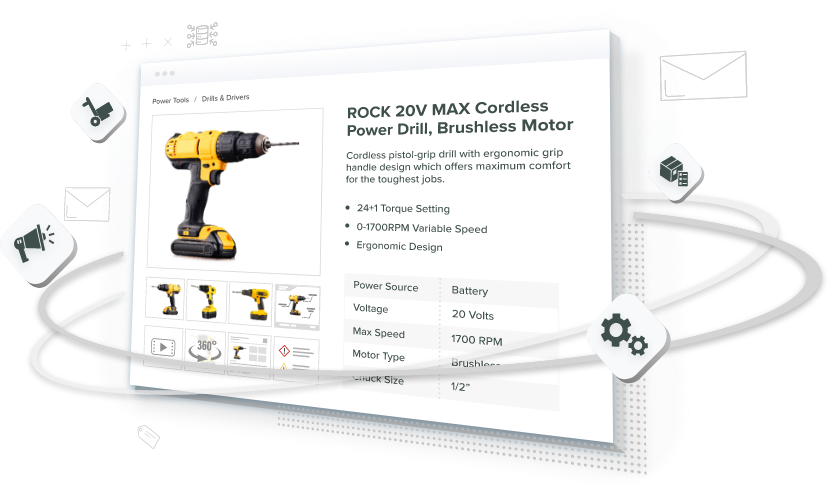
Table of Contents
Key Terms to Know
Writing product descriptions by hand is slow. Rewriting each one for Amazon, Shopify, your own site, and a few distributor portals is slower, and somewhere along the way the versions stop matching.
A free smart product content creator drafts titles, descriptions, and feature lists from basic product data in seconds. It works best when the data going in is clean, which is why this guide covers product information management (PIM) as much as AI.
Demand is growing fast. Grand View Research valued the generative AI in content creation market at $14.8 billion in 2024, estimates $26.0 billion in 2026, and projects $80.1 billion by 2030, a 32.5% compound annual growth rate from 2025 to 2030. Text generation, which covers AI-written marketing copy, held the largest share in 2024.
What a Smart Product Content Creator Actually Does
A smart product content creator reads structured product data, such as specs, attributes, and categories, and turns it into ready-to-publish copy for each sales channel. Most tools write channel-specific descriptions, SEO-friendly titles, and feature lists, and many add bulk generation and persona optimization.
Catsy’s free smart product content creator for products covers these basics at no cost. Catsy reports that it can save up to 90% of content creation time.
Marketers already rely on AI. In the Content Marketing Institute’s 2026 B2B research, 95% of B2B marketers said their organizations use AI-powered applications. Among those users, 89% use AI content creation tools, and 87% say productivity went up. Straits Research values the wider digital content creation market at $35.28 billion in 2025 and projects $120.28 billion by 2034.
Missing or Mismatched Product Details Cost Sales
Shoppers notice when product information is thin. In its usability testing, Baymard Institute found that missing product details lead some shoppers to leave the page or the site entirely, while others guess, which can cause frustration and unnecessary returns. Its benchmark of large e-commerce sites, published in 2021, found that 10% did not keep product descriptions consistently detailed.
Manual work makes mismatches more likely. Each channel ends up with its own version of the copy, and large catalogs never get finished. The problem grows when teams reformat the same product data for every distributor.
Good content still pays. HubSpot’s marketing statistics for 2026 rank website, blog, and SEO as the top channels for return on investment, and about 94% of marketers plan to use AI in content creation in 2026. The hard part is scale. Writing strong copy for a few dozen products is manageable. Doing it by hand for thousands of SKUs is not.
Where PIM Fits In
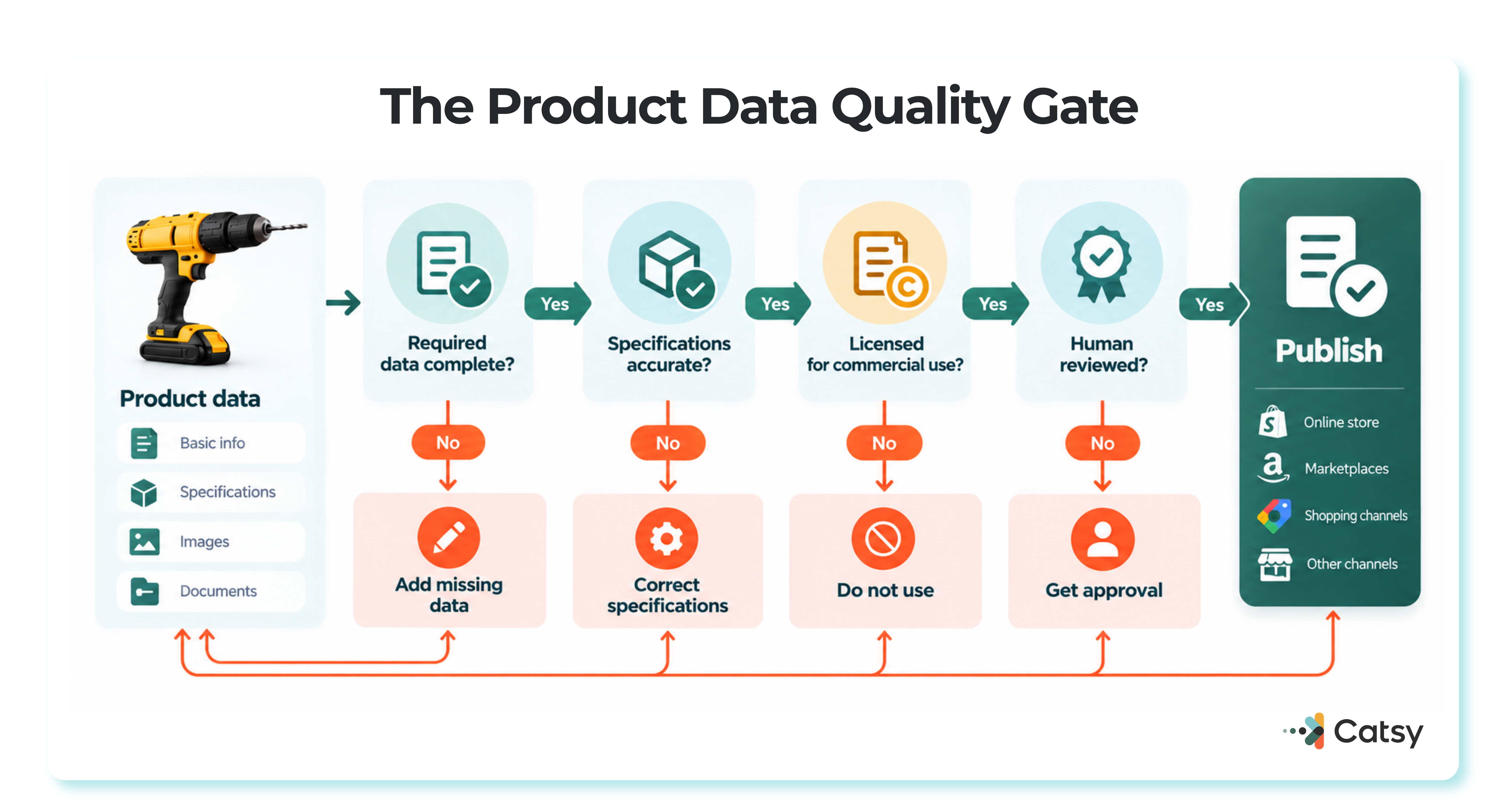
PIM software keeps specifications, images, documents, and marketing copy in one place. For an AI tool, that matters, because it can only write accurately about what it is given.
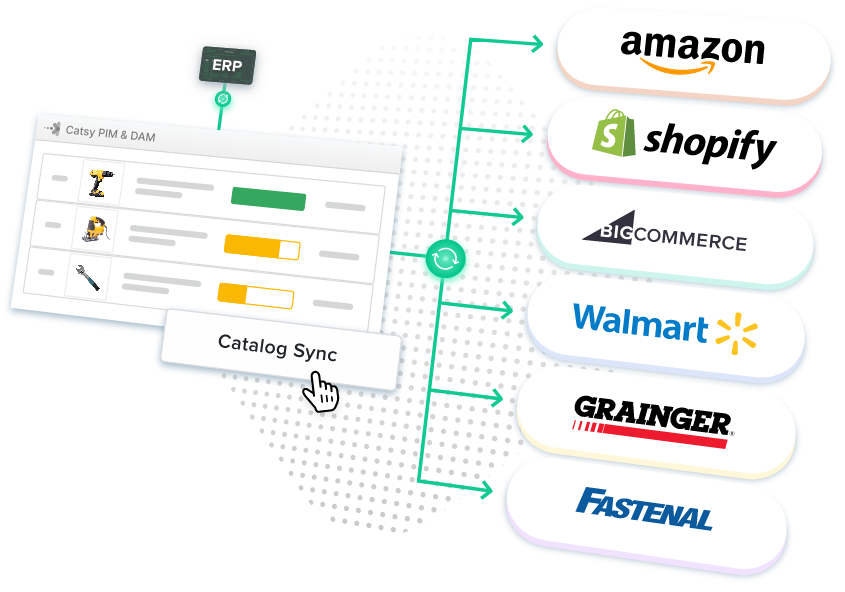
Catsy’s content creator works in three steps:
1. Add product data. Upload basic product information or connect your existing catalog.
2. Let the AI draft. It writes copy for your target audience with SEO keywords built in and tone adjusted for buyer personas.
3. Download and use. The content is ready for any sales channel or marketplace, and teams can polish it in Google Docs or Notion AI.
Marketplaces show how mainstream this has become. Amazon says more than 900,000 sellers have used its generative AI listing tools and accept the output with little or no editing about 90% of the time. Acceptance is not accuracy, though. Clean source data and a review step still decide whether the copy is right.
Features Worth Checking
Speed is the obvious one. A good tool turns a handful of attributes into a usable first draft, so writers start by editing.
Persona optimization matters more than it sounds. A facilities manager and a retail shopper care about different benefits, and the copy should reflect that, including across languages.
Bulk generation separates a writing helper from a catalog tool. It drafts content for many SKUs in one run, which is how teams automate product catalog enrichment without losing brand consistency.
SEO support places the words buyers search for into titles, descriptions, and metadata. Inside a PIM, you can also manage SEO keywords and asset metadata next to the copy.
Channel formatting shapes one product record to each destination’s rules, such as title length and required fields, whether the destination is Amazon, Shopify stores, or your own site.
The free version handles smaller catalogs and testing. Paid tiers of AI content tools, and full PIM platforms, usually add higher bulk volumes, API access, more export formats, deeper integrations, and priority support — our guide to choosing the right PIM platform type and our roundup of the best PIM software both cover what to look for.
The Free Tools That Fill the Gaps
Product copy is one piece of the job. Many teams also use Canva, whose free plan lists more than 1.6 million templates, over 1,000 design types, 5GB of storage, and real-time collaboration.
For social scheduling, Buffer offers a free plan for posting, replying, and tracking results, while Later plans Instagram and TikTok posts on a visual calendar. Ocoya generates captions, hashtags, and visuals, then schedules them. Snappa (free plan) and GIMP (free software) cover image editing, Powtoon has a free plan for animated videos, and Zapier automates tasks between apps.
Rolling It Out
Start by getting the data ready. Gather core specs, selling points, and buyer personas, and keep product images organized in a digital asset management system. Then connect the content creator to your PIM or e-commerce platform and set your bulk generation options.
Before generating anything at scale, write down product data quality standards for tone, detail, and required fields. Pilot a small set of products, track generation speed, search rankings, and conversions, then expand to the full catalog and A/B test different copy approaches.
Consistency across channels is worth measuring too. Accurate content on every channel you sell through supports repeat business.
What Changed in 2025 and 2026
Speed Gains Are Common, Quality Gains Are Not
Among marketers using AI for content creation, 87% reported higher productivity, but only 58% saw better quality, 12% saw worse quality, and 39% saw better performance, according to the Content Marketing Institute. For product content, the product record usually decides the outcome. Missing attributes produce confident copy with gaps.
Marketplaces Write Listings Too
Amazon launched generative AI listing tools at the end of 2023, announced a bulk spreadsheet workflow in 2024, and added Enhance My Listing in 2025. If every marketplace writes its own version of your copy, one approved PIM record keeps the facts consistent. Catsy’s guide to running Amazon listing operations at scale shows how.
AI Assistants Read Product Feeds
More shopping now starts with AI tools. In February 2026, Shopify president Harley Finkelstein said orders from AI searches were about 15 times higher than in January 2025, as reported by The Canadian Press.
On March 24, 2026, OpenAI expanded its Agentic Commerce Protocol (ACP) to support product discovery through merchant product feeds. It also said the first version of Instant Checkout, launched in September 2025, was not flexible enough, so merchants now use their own checkout, according to OpenAI. AI tools compare structured attributes first, which is why unstructured product data leaves B2B catalogs invisible to AI shopping agents.
Governance Stops One Error From Spreading
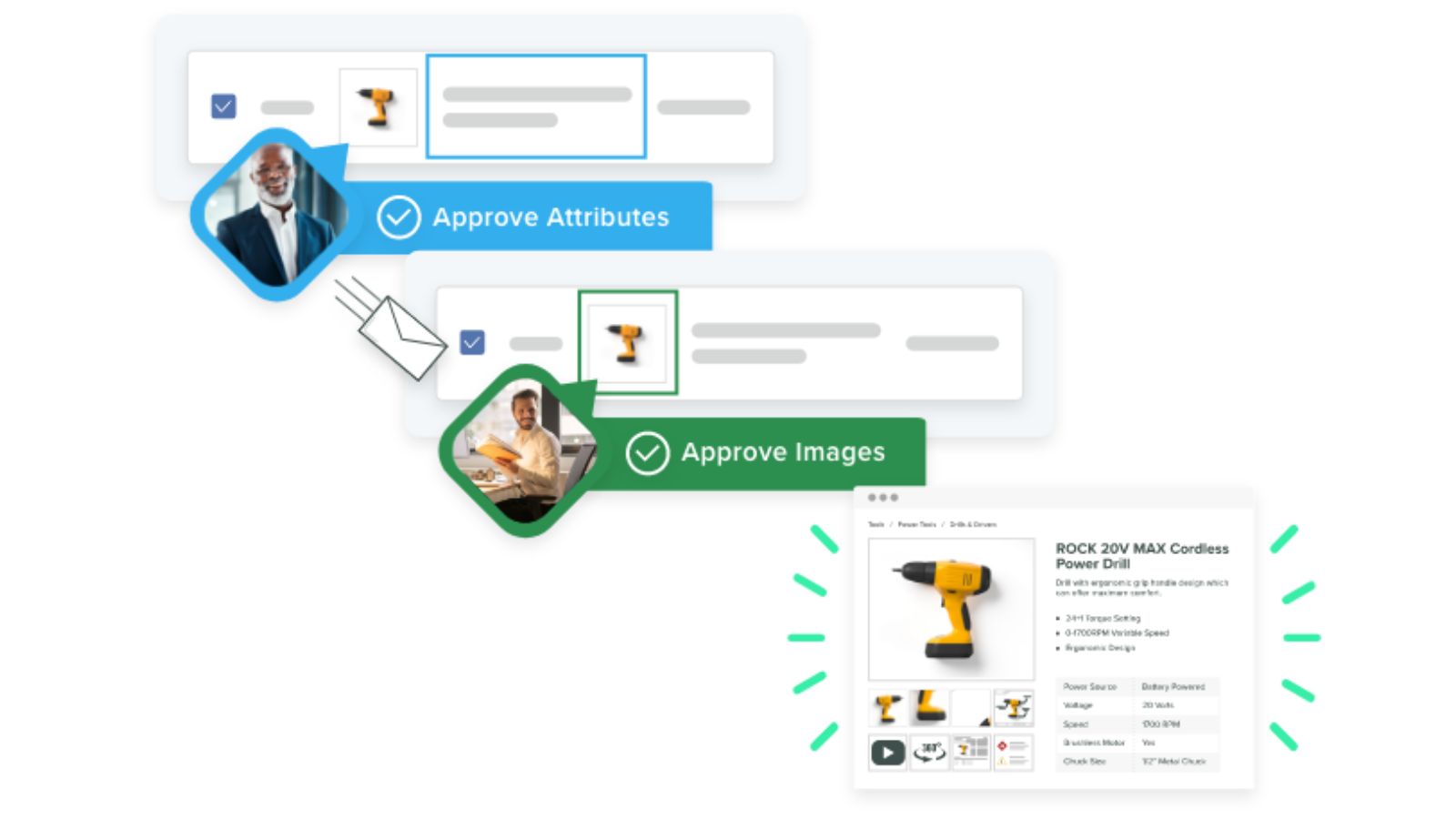
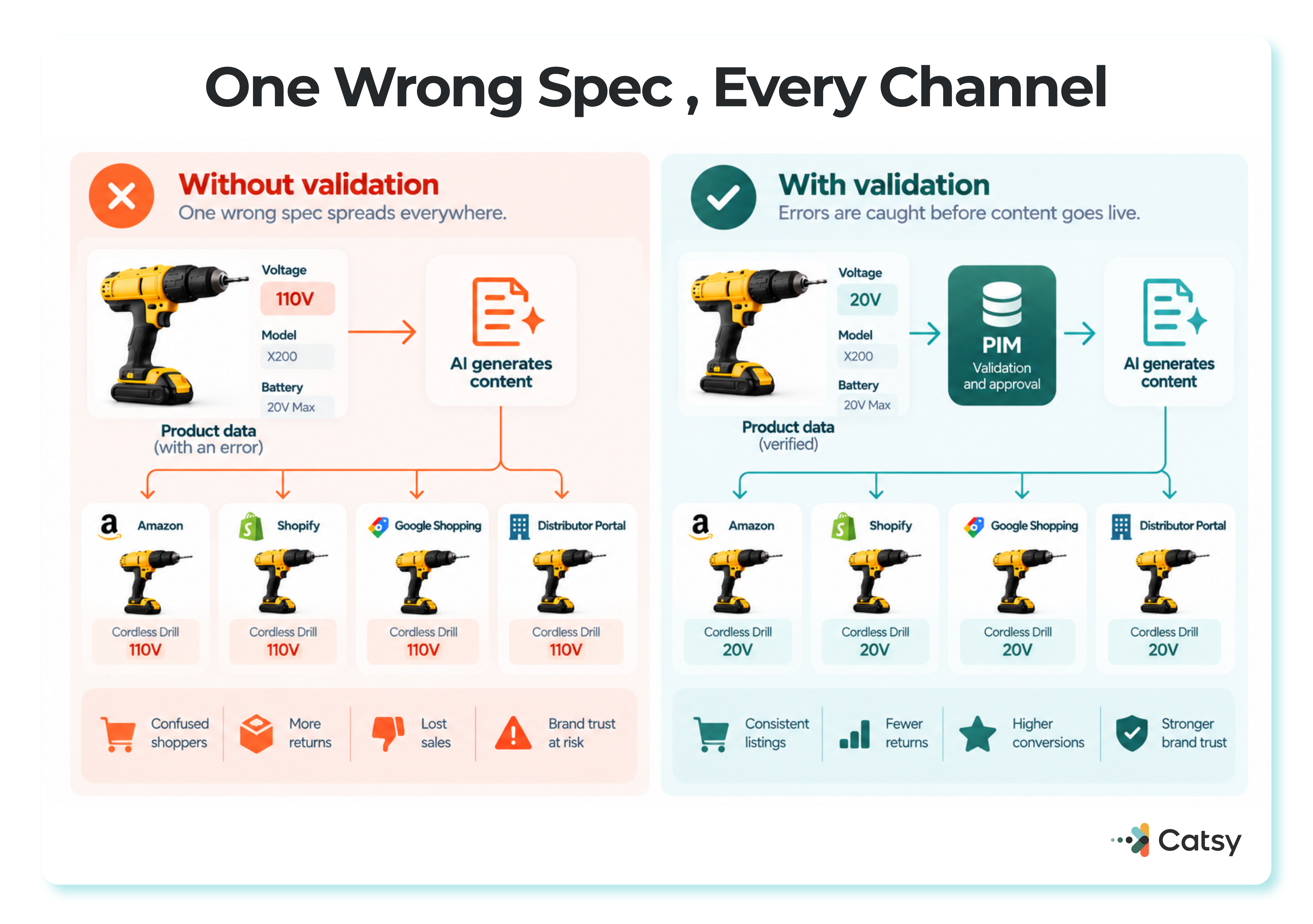
A wrong voltage rating written once can reach every channel that receives the feed. The safer model lets AI draft while a qualified person approves high-impact changes, backed by data governance rules and approval workflows.
Where to Start
You can try the free smart product content creator on a few products first.
When you are ready to run it across a full catalog with governance and channel publishing, book a Catsy demo.