Content Management Software: The Complete Guide for 2026
Product data often lives in disconnected tools, making it difficult for teams to stay aligned. PIM brings structure and consistency by centralizing product information, so teams can work from the same data without relying on manual updates or duplicate systems.
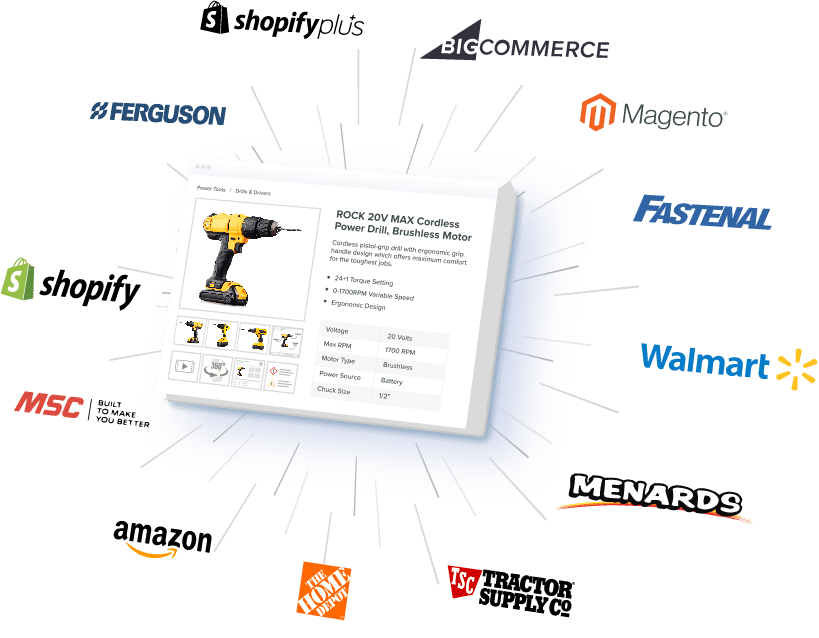
Table of Contents
Product data often lives in disconnected tools, making it difficult for teams to stay aligned. PIM brings structure and consistency by centralizing product information, so teams can work from the same data without relying on manual updates or duplicate systems.
Product data has never been more complex. Every day, businesses create thousands of descriptions, images, specs, and marketing materials that need to travel across websites, print catalogs, and social media.
If you want to keep up, you need to create, edit, and publish content efficiently. What’s more, your content should be appealing, localized, and relevant to your customer.
Traditional content management systems can handle some of this, but today’s multichannel reality means you’ll likely need something more powerful. A user-friendly content editor and a clean interface are critical to managing web content without deep technical expertise.
The challenge is no longer just “where will I store my content,” although that’s the core function of a CMS. It’s about enriching product data, keeping that data consistent across a dozen or more channels, and adapting that content for different languages and regions.
That’s where specialized Product Information Management systems come into play. They transform how you handle your valuable product content.
1. What Is a Content Management System and Why It Matters
The bottom line: a content management system (CMS) is software that gives you the infrastructure you need to efficiently create, organize, edit, and distribute your digital content. Not all CMS platforms are created equal, so choosing the right one is essential for building your websites and online stores, as well as for managing the content you’ve already published.
An earlier industry estimate had put the market on a path toward $57.3 billion by 2030; the current research reflects a larger, faster-growing category overall, driven in part by AI-powered content tooling.
This reflects how critical CMS has become to digital business success. It supports digital channels and enables consistent branding across as many platforms as you utilize. Built-in analytics and personalization tools further help you track performance and tailor content to your target audience.
What’s happening: organizations like yours are managing more content complexity than ever. Websites, mobile apps, social media, and third-party marketplaces multiply the product data landscape, with many businesses managing data across a dozen or more channels.
Most CMS platforms, including the most popular (think WordPress and Drupal), were originally designed for website content. Things have changed, though, and the best CMS platform for your business now depends on additional features: multichannel publishing, workflow management, and support for media assets among them.
The Types of Content Management Systems
Want to collaborate, edit, and publish your content efficiently? You need content management tools, workflow management, and publishing controls. These features help ensure content quality, streamline approvals, and support highly engaging content.
The best CMS platforms offer third-party integrations, built-in security features, analytics, access controls, and robust content storage.
As you shop for a system, look for free trials and free-plan options, since these are valuable for evaluating fit before you commit. Look for all-in-one solutions that give you the tools you need to build websites and online stores, including support for custom domains and web hosting (or integration with your preferred host).
Consider how much community support is available, too. Remember: DAM and CMS serve very different, but complementary, roles. Marketing tools and SEO features are critical for growth, and enterprise-grade solutions like Adobe Experience Manager Sites offer advanced capabilities for large organizations.
2. The Evolution: From Basic CMS to Specialized Solutions
The bottom line: content management has evolved from simple website builders to sophisticated, AI-assisted platforms that can handle omnichannel distribution.
The shift: TechTarget’s 2025 trends coverage named generative AI the top content management trend of that year, as businesses shifted from pilot programs to widespread implementation. Heading into 2026, TechTarget’s updated research shows generative AI still topping the list, now alongside agentic AI, predictive analytics, and automated information security as the trends shaping enterprise content management. This represents a fundamental change in how brands approach content creation and distribution.
What’s Driving Change
Modern headless CMS platforms provide flexibility, scalability, and the ability to deliver content seamlessly across websites, mobile apps, and other digital channels. Today, brands have access to drag-and-drop editing, making it easier to design and update web pages visually, even without dedicated IT resources.
The marketplace reality: WordPress remains the most widely used CMS, though its footprint has narrowed somewhat since earlier estimates put it at 43.3% market share. As of late August 2026, W3Techs reports WordPress running roughly 41.2% of all websites it tracks, a 59.1% share of the CMS market specifically. SaaS competitors continue gaining ground, offering simpler, managed solutions with lower technical overhead.
Many of these systems are positioned as all-in-one solutions because they combine multiple business tools. Advanced platforms like Adobe Experience Manager Sites also continue to meet enterprise needs.
Why specialization matters: generic CMS platforms are strong for managing unstructured content, like blog posts and marketing pages. But they lack the sophistication in data modeling, validation rules, and channel-specific formatting that product content needs. Modern CMS solutions increasingly emphasize third-party integrations and custom code for advanced customization.
Strong community support has become a valuable asset, particularly for open-source and extensible platforms, since it encourages flexibility and innovation.
3. Why Traditional Web Content Management Falls Short for Product Data
The bottom line: traditional CMS platforms create bottlenecks (and added expense) when businesses try to manage product information across multiple sales channels.
The problem: your product data is fundamentally different from your website content. A single product may have over 50 attributes, like SKU, price, dimensions, or materials. It could exist in 15 variants, require two dozen images, need translation into eight languages, and sell across a dozen channels, each with its own formatting requirements.
Where Traditional CMS Falls Short
The cost of inefficiency: businesses still managing product content in spreadsheets or general-purpose CMS platforms tend to spend meaningfully more time on manual data entry, and that manual handling is a well-documented source of downstream errors. Gartner’s research on data quality puts the average annual cost of poor data quality at $12.9 million per organization, a figure that scales down proportionally for smaller catalogs but illustrates how quickly inconsistent product data becomes an operational cost rather than just an inconvenience.
4. How PIM Software Solves Modern Content Challenges
The bottom line: Product Information Management systems provide the specialized infrastructure product-centric businesses need to manage content at scale across unlimited channels.
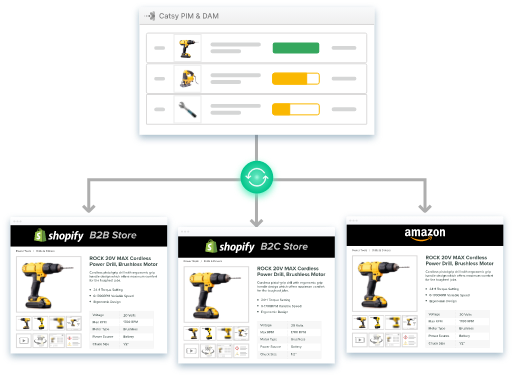
What PIM does differently: PIM systems are purpose-built for product data. Your PIM becomes the single source of truth for all product information, letting teams centralize and enrich content before it’s distributed efficiently.
Core Capabilities That Matter
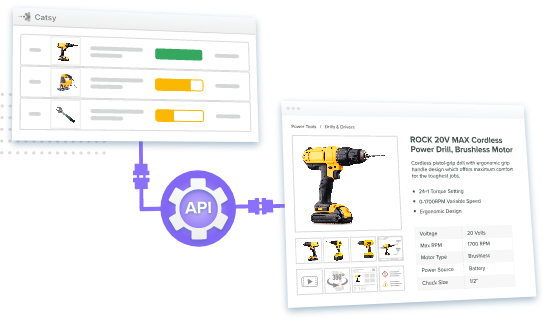
Real-world impact: Gartner’s research on data quality (cited above) helps explain why organizations that centralize product data through a PIM tend to see faster time-to-market and fewer data-quality issues: most of the cost of poor product data comes from the same root causes, fragmented systems, manual re-entry, and no single owner for the data, that a PIM is built to eliminate.
Advanced Features Driving ROI
The multichannel advantage: modern consumers shop everywhere, from your website or app to Amazon and eBay. PIM systems help ensure your product information stays consistent, accurate, and optimized no matter where customers find you. Manufacturers in particular lean on this: PIM for manufacturers typically means managing BOM-level detail, technical specifications, and compliance documentation across every channel a distributor or retail partner requires, while PIM for e-commerce sellers focus more on scaling a fast-growing catalog across storefronts and marketplaces.
5. Implementing the Right Content Creation and Management Strategy
The bottom line: success means choosing the right tool for each content type and building an integrated system that serves your entire organization.
The Strategic Framework
Implementation Best Practices
Building the ecosystem: the most effective approach combines tools strategically. Use a CMS for marketing content and PIM for product content, then integrate them for a seamless experience. If you’re comparing PIM platform categories, from enterprise suites to integrated PIM plus DAM systems, match the category to your catalog complexity and team structure before comparing individual vendors.
Future-proofing considerations: AI capabilities, headless architecture, and API-first design help ensure your content management stack can adapt as technology and channels evolve. As you choose a platform, evaluate the coding or technical experience your team will need, the ability to connect a custom domain, and the reliability of the hosting options.
Note: when selecting a CMS or PIM, review any available free-plan options to test features and onboarding experience before committing to a paid solution.
6. Content Management and PIM Heading Into 2026
The trends shaping content management in 2025 haven’t reversed, they’ve deepened. TechTarget’s 2026 content management trends coverage still ranks generative AI at the top of the list, now joined by agentic AI and predictive analytics as content teams move from experimentation to production use.
One of the more consequential shifts is how content gets discovered in the first place. Adobe’s 2026 AI and Digital Trends research, based on a global survey of 3,000 executives and practitioners, found that 48% of organizations are now optimizing their content specifically to be interpreted and surfaced by AI-powered discovery tools, rather than for traditional search alone. The same research found 69% of respondents expect agentic AI to assist employees with research, insights, or knowledge retrieval within their content operations.
For product-centric businesses, this raises the bar on structured data. AI shopping assistants and LLM-powered search tools increasingly parse product attributes, specifications, and availability directly, which means product content that’s incomplete, inconsistent, or trapped in unstructured formats is easy for both traditional search engines and AI systems to miss. This is one more reason why the distinction between a general CMS and a purpose-built PIM matters more in 2026 than it did even a year or two ago: structured, validated product data is what makes a catalog legible to both channels and AI systems at the same time. It’s also part of why Product Experience Management (PXM), which extends PIM with content scoring and channel-readiness analytics, has become a more common conversation among teams evaluating their next platform.
Key Takeaways
Summary: as content demands grow, user-friendly solutions with robust core functionality will become essential for managing complexity and supporting business growth.
Give Your Product Content a Single Source of Truth
A general CMS can carry your blog. It was never built to carry your catalog. Catsy centralizes product data and digital assets in one PIM and DAM platform, so every channel you sell on pulls from the same accurate, enriched source. Request a demo, or browse Catsy’s PIM and DAM resource center to see how a centralized system replaces disconnected tools and manual updates.