PIM vs MDM: Key Differences (And Do You Need Both?)
PIM vs MDM explained. Learn how product information management and master data management differ, work together, and which to start with in 2026.
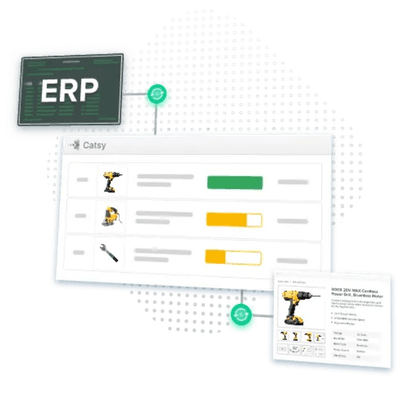
Table of Contents
Key Terms to Know
Most product data problems we see at Catsy start the same way. A company grows, its catalog grows faster, and soon each team trusts its own spreadsheet as the “source of truth.”
The ERP has foundational data, but not the details purchasing keeps in its own files. Website pages fall behind, sales reps see outdated details in the CRM, and launches stall because three departments work from three versions of the same catalog. We see these symptoms constantly in our work on data quality and data governance.
None of this is cheap. Poor data quality costs organizations at least $12.9 million per year on average, according to Gartner, based on its 2020 research.
The two usual fixes are product information management (PIM) and master data management (MDM). The names sound alike, and even vendors mix them up, but they solve different problems for different teams. The choice matters more in 2026, now that AI shopping assistants and new EU product rules both depend on clean, structured product data.
PIM: Product Data Built to Sell
A PIM is where a company organizes, improves and publishes the product information customers see. (Our What Is PIM page goes deeper.) It structures product data, runs checks for duplicates and errors, fills gaps before launch and adds the content that helps a product sell.
A product information management (PIM) system usually holds specs and attributes, including regulatory details such as Prop 65 warnings. It also holds SKUs and variants, marketing copy, some pricing and stock data, linked images and versions formatted for each channel.
By our estimate, about 90% of a PIM’s work is making product data accurate and complete, then sending it wherever customers shop. The rest is internal, such as building catalogs. Product, e-commerce and marketing teams work in it daily. Launches get faster, and fewer products come back because a listing was wrong.
MDM: One Trusted Record for the Business
MDM is a company-wide approach, and the software behind it, for governing the core data every department relies on: products, customers, suppliers, locations, finances and employees. It merges records from ERP, CRM and business intelligence (BI) tools into one trusted version called the golden record. If the ERP says a customer is in Maine and the CRM says Texas, MDM decides which is true.
MDM usually belongs to IT, data stewards and compliance teams, while PIM is led by merchandising and marketing. MDM’s goal is governance, from compliance reporting to merging systems after an acquisition.
On April 6, 2026, Gartner published a new Magic Quadrant for Master Data Management Solutions, describing MDM as the way organizations keep shared master data uniform, accurate and consistent. That role grows as AI projects depend more on trusted data. MDM still does not write product descriptions or manage the images AI shopping tools read.
Where the Line Falls
| PIM | MDM | |
|---|---|---|
| Main focus | Product data for commerce | Data governance across the company |
| Scope | Product data only | Many data areas |
| Main users | E-commerce, marketing, product teams | IT, data stewards, compliance |
| Data flows | Outward, to sales channels | Inward, across internal systems |
| Time to value | Faster to deploy | Longer implementation |
Some people call PIM a subset of product-focused MDM. On paper, that is accurate. In practice, PIM holds what customers see, such as descriptions and lifestyle photos, while MDM holds identifiers, classifications and hierarchies. PIM pushes data out to sales channels. MDM pulls data in so internal systems agree.
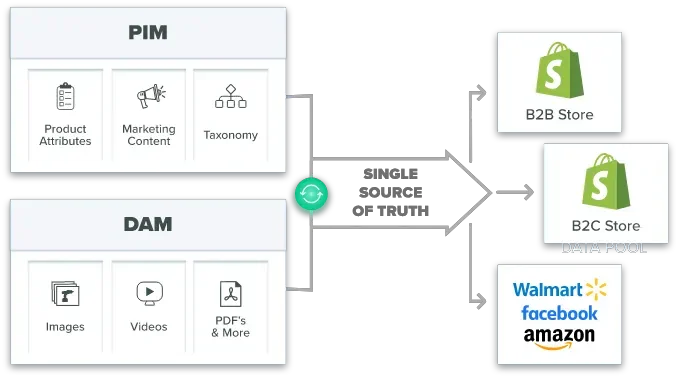
Some PIM platforms also include digital asset management (DAM). Catsy keeps product data and digital assets in one platform, so there is no separate PIM and DAM to keep in sync.
The Payoff from Each System
A PIM replaces scattered spreadsheets with one hub. You publish once to every channel, from your website to Amazon, so the work that once took days can now only take hours. The PIM also reformats data for each channel automatically, an approach Catsy calls one database for every sales channel. Validation rules and approval workflows catch mistakes before customers see them.
Product data now shapes discovery as well. Adobe’s 2025 holiday shopping data showed traffic to retail sites from generative AI tools rose 693.4% year over year, though Adobe notes the user base is still modest. AI assistants can only recommend what they can read.
MDM on the other hand creates one view of master data across departments, adds audit trails and gives analytics and AI projects data people trust. Skipping it is costly. More than 1 in 4 data and analytics professionals who see poor data quality as an obstacle to data literacy estimate their organization loses over $5 million a year to it, and 7% put the loss at $25 million or more (Forrester Data Culture And Literacy Survey, 2023). In February 2025, Gartner reported that 63% of organizations lack, or are unsure they have, the right data management practices for AI. Gartner also predicts that organizations will abandon 60% of AI projects without AI-ready data through 2026.
Reading the Signs
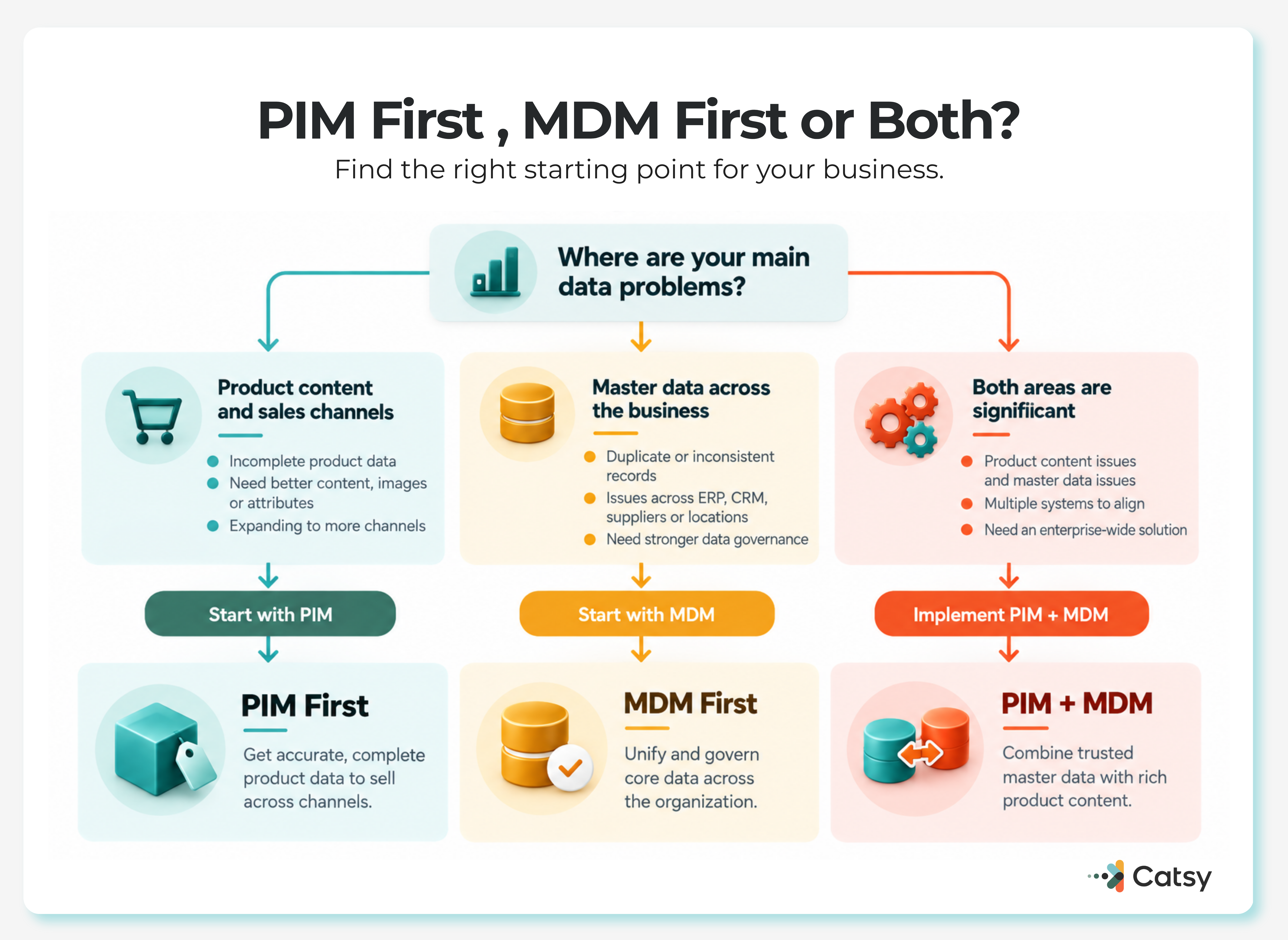
Start with PIM if you sell complex catalogs across several channels, product data errors are hurting customer trust, teams retype the same data into different platforms, or you are adding marketplaces, new markets or new languages. A PIM also helps AI shopping assistants read accurate details for every SKU.
MDM fits better when data problems reach customers, suppliers and finance, when regulations require audit trails, or when internal AI agents need governed records.
Many companies need both like for a consumer electronics brand selling 2,000 SKUs on its Shopify site, Amazon, Walmart and 15 other retail partners. The e-commerce team also needs PIM to keep fast-changing specs accurate everywhere. Finance needs supplier data and identifiers aligned across ERP and analytics, which is MDM’s job.
For mid-market companies with roughly 500 to 5,000 SKUs, PIM is usually the better first step, with MDM added later.
Running Both Together
Data usually moves like this:
Often the ERP plays that upstream role instead. In the Regal Brands case study, a scheduled ERP sync feeds Catsy, which publishes to five Shopify storefronts. A PIM can also send validated records to GDSN, the GS1 network that suppliers and retailers use to share product data.
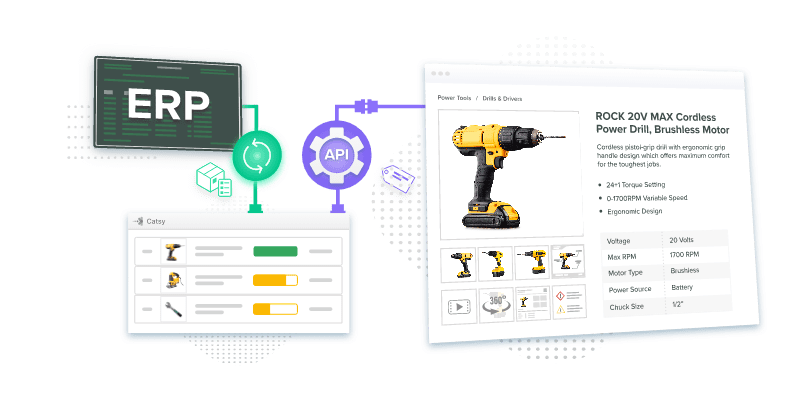
Give each system one job, agree upfront on who owns each field, and define APIs and governance rules before you build.
DAM, PLM and the 2026 Shift
DAM stores images, videos and brand files, and keeping it apart from PIM means syncing records and images by hand. Our PIM vs DAM guide covers the difference. PLM manages a product from concept to manufacturing, and PIM picks up where it ends. That handoff matters most for manufacturers. See our PIM vs PLM guide for more on that handoff.
On January 11, 2026, Google announced the Universal Commerce Protocol, an open standard for AI agents that shop on a person’s behalf, co-developed with Shopify, Etsy, Wayfair, Target and Walmart. Shopify’s Spring ’26 Edition then opened its Catalog API to every developer and reported that AI searches using its structured catalog convert at twice the rate of searches using scraped data. Keeping that data complete is everyday PIM work for Shopify and other channels.
In Europe, the European Commission made the Digital Product Passport Registry operational on July 20, 2026, as part of the passport system created under the Ecodesign for Sustainable Products Regulation (EU) 2024/1781. The Registry stores product identifiers, while the full data stays with the company or its service provider. Passports become mandatory one product group at a time, starting with certain large batteries in February 2027. Meeting these rules takes both systems: MDM for identifiers, PIM for published product details.
Choosing Where to Start
| If your priority is | Start with |
|---|---|
| E-commerce growth and product content quality | PIM |
| Enterprise data governance and compliance | MDM |
| Customer-facing content and internal consistency | PIM + MDM |
| Showing up in AI shopping assistants | PIM |
| Grounding enterprise AI agents in governed records | MDM |
Business-led projects usually start with PIM and IT-led ones with MDM. Most companies add the other later.
Timing matters too. Catsy’s typical deployment runs 10 to 14 weeks from integration kickoff to first channel publication. Our PIM platform comparison for 2026 explains the main platform types, and our guide to the best PIM software covers specific vendors.
The Bottom Line
PIM and MDM are not rivals. PIM enriches product data and sends it wherever customers shop. MDM governs master data across the company and keeps it consistent and compliant. Start with the system that fixes your biggest pain point today, not the one with the loudest vendor.
If PIM is your starting point, request a demo to see how Catsy keeps product data, images and approvals in one place.
Key Takeaways