
How to Set Product Data Quality Standards for Product Listings
Learn how to define product data quality standards for listings, the six dimensions to measure, how to set thresholds, and how to enforce them.

Table of Contents
You’ve listed a product online but it is missing two important details, it shows an old weight, and is in the wrong category. What do you do? And what happens to the product data shown to your customers?
These errors often go unnoticed until a retailer’s system or a customer calls them out. It’s not usually because someone was careless but more so because there was never a clear, consistent guide on what a good listing should include, especially when new team members come on or things get busy. Clear product data quality standards provide that guide.
Having a data quality standard can solve the problem by giving everyone a clear rule for deciding if a listing is detailed, correct, and truly ready to go live. Because to be honest, the quality of listings really just depends on who is entering the information that day. This directly affects both product listing quality and overall product information quality.
Key Terms to Know
What Makes a Product Data Quality Standard Effective?
A standard product data needs to be specific and measurable. Even to setting title lengths or requiring lifestyle images. If a rule can’t be checked, then it will not produce consistent quality in the long run. That is why most teams use trusted data quality frameworks like ISO 8000-61. It offers clear steps and roles for managing data and makes company standards easy to follow and hand over to team members. This measurable approach creates a stronger foundation for product data quality.
The Business Cost of Poor Product Data Quality
It’s no secret that poor product data can be expensive, with a 2025 Akeneo survey of 1,800 shoppers finding that 66% had abandoned a purchase because of missing or inaccurate product information, and 40% had returned a product last year because of incorrect product data. In retail, inaccurate or missing product details can also contribute to returns, which were expected to reach $849.9 billion in 2025. Clear data standards can help prevent these avoidable mistakes. Even distributors with 2,000 SKUs across three retailers can face the same issues. They often discover these only after a listing is rejected. These problems show why ecommerce product data quality and product catalog data quality need clearly defined standards.
Six Dimensions of Product Data Quality to Measure
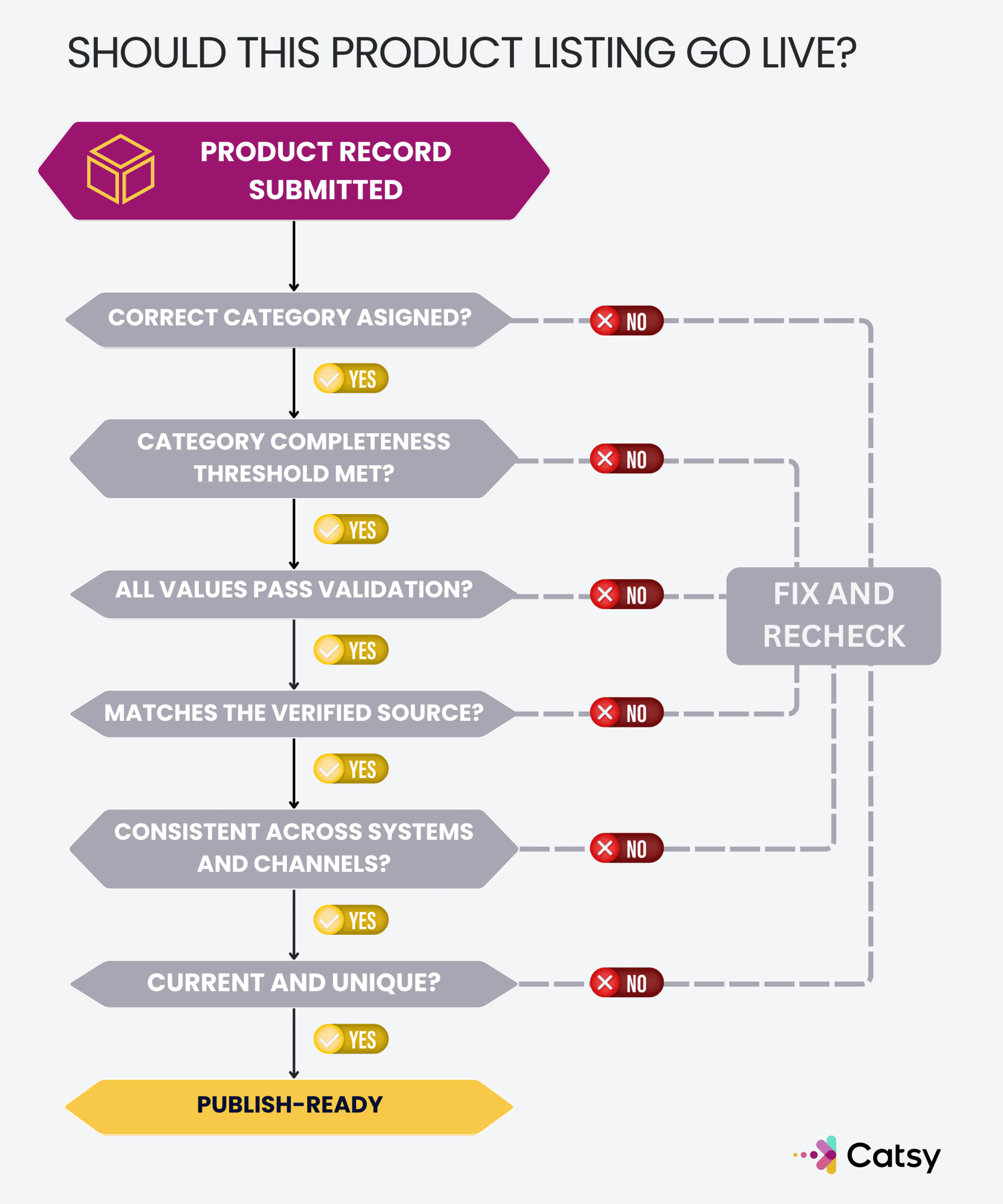
When you write your rules field by field, you can leave important gaps. So a better approach is to group them by data quality dimension. Gartner identifies nine dimensions, but you can apply six of these most directly to product listings. This makes missing standards easier to spot, especially for consistency and validity, because this is where many cross-channel issues begin.
| Dimension | What It Checks | Example Standard |
|---|---|---|
| Accuracy | Information matches the actual product | Dimensions and materials match the manufacturer’s specifications |
| Completeness | Required fields are filled | At least 90% of required attributes are completed |
| Consistency | Details match across channels | Names and colors match across the website, Amazon, and ERP |
| Timeliness | Information is current | Prices and inventory update within 24 hours |
| Validity | Values follow approved formats | Weight uses a valid number and unit |
| Uniqueness | Records are not duplicated | Each SKU has one unique GTIN |
Product data accuracy and product data completeness are highly visible, product data consistency and product data validation are equally important too because many listing problems begin when these connected systems disagree.
How to Build Product Data Quality Standards
Start With Marketplace and Retailer Requirements
You do not need to create data standards from scratch or overhaul your system for that matter. Each marketplace already provides channel requirements that offer a practical starting point.
For example, Google’s product data specification shows which attributes are required and flags issues that need correction. There’s also GS1’s Global Data Model that provides consistent product attributes used across the industry. Check both of these requirements and it will give your brand a reliable foundation for accurate, complete, and channel-ready product listings.
Set Product Data Completeness Thresholds by Category
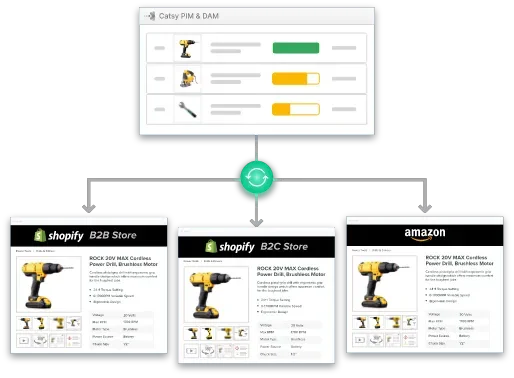
Catalog completeness cannot be measured by one universal checklist because every category requires different information. That’s just it. For example, a fastener needs thread pitch and material grade, while a shirt needs fabric weight and care instructions. So each category should have its own required attributes and publishing threshold. This is where you’ll need a completeness score to show how many required fields are filled. If a product scores only 40%, the team can immediately see that it is not ready to publish. This score is one of the most practical product data quality metrics for evaluating listing readiness.
Create Enforceable Product Data Validation Rules
The system should flag the record if the weight is blank, zero, or entered in kilograms. You can ask whoever is assigned to place a record in pounds, but it is much better to have this rule as automatic. This is the purpose of product data governance. It can turn written guidelines into rules that your system can enforce.
Start with these basic checks:
These checks reduce manual errors before products are published and strengthen product data validation.
Assign Data Ownership at the Attribute Level
Most of the time, standards fail not because they are wrong, but because nobody is there in standby to check when something goes wrong. Ownership at the whole-product level is too broad but ownership at the attribute level holds. Marketing owns the description, engineering owns dimensions and specs, the channel team owns marketplace mapping. This is usually a dedicated data owner’s job and without that specified role, a field can sit wrong for months.
Make Sure to Keep Your Standard Alive in The Everyday
A written standard sitting in a shared document dies within three months unless your team uses it as the default path. If you want to keep it alive, here are some tips to keep in mind:
The rule also has to live where the work happens. For example, if an error pops up inside a tool that your team uses every single day, they fix it. If it lives on a policy document, they will mostly likely ignore it. That is where software like Catsy’s PIM comes in useful. It can put the guardrails straight into the daily routine so your standards hold up and improve PIM data quality.
Product Data Quality Metrics Your Team Should Track
I hate to say it but your data standards are useless unless you measure what is actually happening. If you want real traction, track these four simple product data quality metrics:
It also helps to monitor how quickly new SKUs reach the market. This way, it’s easier to catch recurring problems early, improve workflows, and prevent retailers or customers from finding errors first.
Common Product Data Quality Mistakes to Avoid
This is where teams usually go wrong so make sure to keep your eyes open:
Writing the standard is half the work but enforcing it, consistently, across every category and channel, is the harder half.

Key Takeaways
Set the Standard For Your Team, Then Automate It
Catsy’s product information management platform applies completeness scoring and channel-specific validation rules automatically, so a listing cannot go live until it meets the standard a team actually defined. For manufacturers with complex technical specs, or brands syndicating to Amazon and other marketplaces, that is the difference between rules that live in a document and rules that live inside the workflow. This helps teams maintain consistent product data quality across their catalogs.
Define Your Data Standards