Best Product Catalog Management Software for E-Commerce
Managing thousands of SKUs across ecommerce platforms and marketplaces quickly becomes chaotic without a centralized system. Here’s how to evaluate your options in 2026, and what implementation actually looks like.


Most catalog management problems don’t announce themselves. They accumulate. A product description gets updated on the website but not on Amazon. A price change makes it into the ERP but takes a week to reach the distributor portal. A new SKU launches without its spec sheet because nobody coordinated the upload. None of these feel like a system problem at first — they feel like one-off mistakes.
They’re not. By the time a business is managing several hundred SKUs across multiple channels, these aren’t one-off mistakes. They’re the predictable output of a process that was never designed to scale. Product catalog management software is what replaces that process with one that can.
Poor data quality costs organizations an average of $12.9 million per year. — Gartner, Magic Quadrant for Data Quality Solutions, 2020 (based on 154 reference customers surveyed across 16 data-quality vendors)
What Is Product Catalog Management?
Product catalog management is the operational practice of keeping product data accurate, complete, and consistent. That means every format and channel where it appears — digital storefronts, print catalogs, distributor portals, marketplace listings, and internal systems.
It’s not just organizing product information. It’s governing it: who can change it, when changes propagate, what “complete” means for each channel, and how errors get caught before they reach customers. Most businesses start doing this in spreadsheets, which works fine until it doesn’t.
What’s the Difference Between PIM, DAM, MDM, and Native Ecommerce Tools?
These four categories solve related but distinct problems, and confusing them is the most common mistake in a software evaluation. A PIM governs structured product data. A DAM governs the files attached to it. MDM governs data across the whole enterprise, not just products. Native ecommerce tools handle basic catalog needs inside a single storefront.
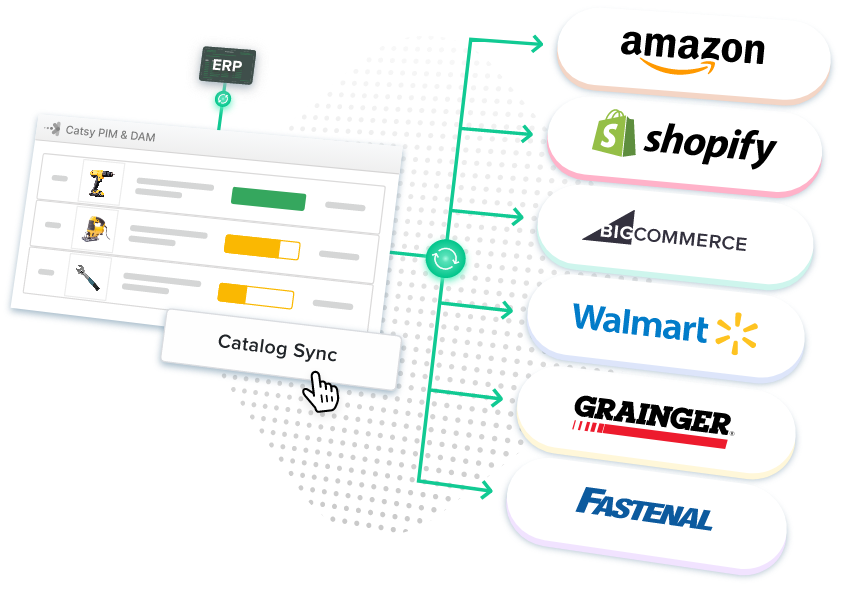
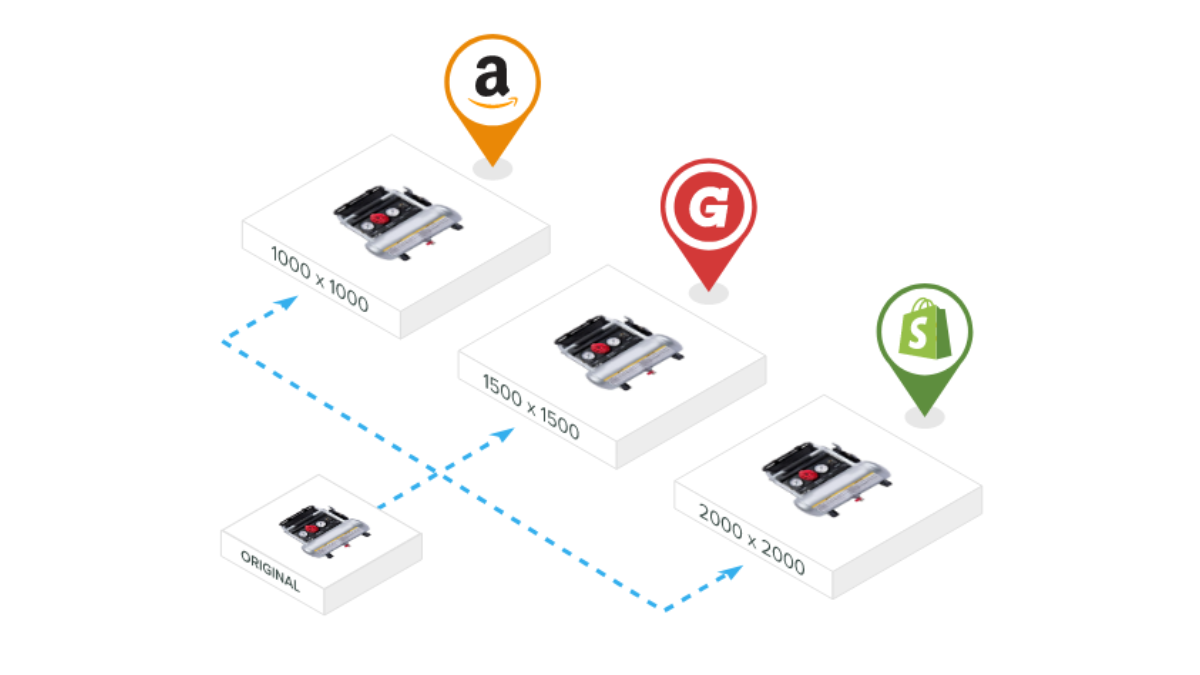
Product catalog management software is a centralized platform. It handles the full lifecycle of your product data. That means ingesting it from suppliers or ERP systems, enriching it with descriptions and assets, validating it against channel requirements, and distributing it automatically to every sales channel at once. The key word is automatically. Rather than someone manually updating product listings channel by channel, the software handles distribution and keeps everything synchronized. When a spec changes, the change flows everywhere — Amazon, your Shopify store, your distributor portal, your print catalog templates — without your team touching each one.
| Category | What It Governs | Target Catalog Size | Examples |
|---|---|---|---|
| Product Information Management (PIM) | Structured product data — validation rules, approval workflows, completeness scoring | 500 – 50,000+ SKUs, depending on platform | Catsy, Akeneo, Salsify, InRiver, Plytix |
| Digital Asset Management (DAM) | Files — images, videos, spec sheets, CAD files | Scales with asset volume, not SKU count | Native in Catsy and Plytix; often separate for Salsify/InRiver (e.g., paired with Bynder) |
| Master Data Management (MDM) | Data across the whole enterprise — customer, supplier, financial, and product | Large organizations with complex data hierarchies | Enterprise MDM suites |
| Ecommerce-native catalog tools | Basic storage and publishing on a single storefront | Under ~1,000 SKUs, single channel | Shopify, BigCommerce native tools |
For teams whose primary problem is product data specifically, PIM is the more targeted fit than MDM. The practical question inside PIM itself is whether DAM is a separate system or built in. Separate systems mean a second vendor, a second approval workflow, and an integration that needs maintenance. Catsy handles both in a single interface — the same record that holds your product attributes also links to the correct asset versions, so digital asset management doesn’t require a second system.
Why Do Businesses Need Product Catalog Management Software?
The inflection point is usually somewhere between 300 and 500 SKUs across three or more channels. Before that, manual processes are annoying but manageable. After it, they’re a revenue problem.
Here’s what the breakdown looks like in practice:
- Pricing errors reach customers because someone updated the ERP but the channel feed runs on a delay
- Product descriptions go stale on secondary channels while the primary storefront stays current
- New product launches slip because assets, specs, and listings all need to be assembled separately per channel
- Customer experience fragments — what someone finds on Amazon doesn’t match what’s on your website
In July 2020, McKinsey surveyed 899 executives and found the pandemic had compressed roughly three to four years of digital-operations change into a few months — a specific, pandemic-era finding, not an ongoing trend. What’s held true since is the pressure that survey captured: more channels, more SKUs, more touchpoints, all requiring consistent data that a growing team can no longer maintain by hand. Catalog management is one of the first places that pressure surfaces. The businesses that implement automated product catalog practices early consistently outpace those that wait until the pain is severe.
What Are the Key Benefits of Catalog Management Software?
Centralized data delivers five concrete benefits — consistency, speed, and fewer errors chief among them.
| Benefit | What It Looks Like in Practice |
|---|---|
| Centralized product content | One place where product data lives, gets approved, and gets distributed. Marketing, sales, and operations pull from the same source instead of maintaining different versions. |
| Multi-channel consistency | When a product update happens, it happens everywhere. Customers see the same title, specs, and imagery on your site, Amazon, or a distributor’s portal. |
| Faster time-to-market | Leigh Country, an outdoor furniture retailer, cut product launch time from two to three weeks down to minutes after implementing Catsy, per Catsy’s published case study. ROI appeared within 12 months. |
| Reduced manual errors | Validation tools catch missing fields, out-of-spec images, and invalid attribute values before they publish — before they become a customer complaint or a return. |
| Improved customer experience | Accurate specs and complete descriptions reduce purchase uncertainty. When customers know exactly what they’re getting, return rates fall. |
How Does Catsy Deliver on Catalog Management?
Catsy addresses the operational problems mid-market ecommerce businesses, manufacturers, and distributors run into with one integrated PIM and DAM platform, rather than a checklist of disconnected features.

| Category | What Catsy Offers |
|---|---|
| Pricing | Varies based on catalog size, channels, and deployment. Book a demo for a quote tailored to your business. |
| Implementation | 10 to 14 weeks for mid-market catalogs — faster than multi-system environments requiring separate API integrations |
| Best for | Visual-first brands, B2B companies needing GDSN compliance, and teams managing 500 to 5,000+ SKUs |
| Key differentiator | Native PIM + DAM in a single platform — one approval workflow, one license, no syncing overhead |
| Channel templates | Pre-loaded templates for Amazon, Walmart, Grainger, Home Depot, and print catalog production |
| Validation | Built-in completeness scoring and validation rules per channel before syndication |
| ERP integration | Connects to SAP, NetSuite, and major ERP systems; operational data flows from ERP, enriched content from PIM |
| GDSN compliance | Includes support for complex attributes, certifications, CAD files, and distributor portals |
What Drives the Cost of Catalog Management Software?
Catalog software pricing depends on six factors specific to your business, not a fixed rate card. Rather than quoting ranges that may not apply to your situation, the most useful step is a conversation with vendors using your actual catalog and channel requirements.
- SKU volume and catalog complexity
- Number of user seats
- Add-on modules (AI enrichment, GDSN, additional channel templates)
- Implementation and onboarding scope
- Whether DAM is included or a separate purchase
- Billing structure (monthly vs. annual)
Book a Catsy demo to get a clear picture of what a fit looks like for your team.
What Should You Expect for Implementation Timelines?
The single biggest variable in any implementation isn’t the platform — it’s the state of your data going in. Clean, well-structured product data cuts timelines significantly. A catalog with inconsistent attribute naming, missing GTINs, and duplicate SKUs adds weeks before a single channel connection is made.
| Timeline | Tier | What’s Involved |
|---|---|---|
| 1 to 4 months | Fast Track | Applies when data is clean and integrations are minimal. Catsy typically lands here for mid-market catalogs — integrated PIM + DAM eliminates the API work separate systems require, and pre-loaded channel templates mean you’re not building from scratch. |
| 4 to 8 months | Standard Implementation | The realistic range for most mid-to-large catalogs. Includes data migration, integration work, and team training. Budget the data quality phase generously — it’s where timelines slip most often. |
| 6 to 12+ months | Enterprise Rollout | ERP synchronization, governance model design, and phased rollout across regions or business units. The complexity here is organizational as much as technical. |
What Features Actually Matter in Catalog Software?
Seven capabilities separate a platform that holds up under your real catalog from one that only looks good in a demo.
- Centralized data repository — one source that every channel draws from
- Bulk editing — not just for convenience; for the moments when a regulatory change hits 2,000 SKUs simultaneously
- Multi-channel publishing with channel-specific formatting — Amazon and Grainger want different things from the same product record
- Validation before syndication — catching errors in your workflow, not in a channel rejection notice
- Workflow management — approval chains that match how your team actually operates
- ERP and ecommerce integrations — certified connections, not just template exports that need manual maintenance
- AI enrichment tools — for metadata tagging, content generation, and taxonomy at scale
One decision shapes the whole evaluation: whether DAM is inside the platform or outside it. An integrated DAM means assets and product data share the same record, governance, and syndication pipeline. A bolted-on DAM means a second integration point that can break and a second tool your team has to maintain.
For regulatory context, the European Commission’s Ecodesign for Sustainable Products Regulation, including Digital Product Passport requirements, is expanding the compliance data burden for manufacturers selling internationally. Make sure any platform you evaluate can accommodate that without a custom build.
What Are the Common Challenges in Product Catalog Management?
Six recurring failure patterns show up across almost every catalog that hasn’t been centralized.
| Challenge | What It Looks Like |
|---|---|
| Data silos | Marketing has one version, the ERP has another, and the distributor portal has whatever was exported six months ago |
| Manual entry errors | Someone updates a dimension in one place and forgets three others; the customer gets the wrong product |
| Channel inconsistency | Your Amazon listing shows one spec, your website shows another; a customer contacts support to figure out which is right |
| Launch delays | A new product is ready in the warehouse but can’t go live because content, images, and channel requirements haven’t landed in the same place |
| Scaling friction | Adding a channel or product line requires effort proportional to catalog size instead of being incremental |
| Relationship complexity | Kits, bundles, variants, and accessories that belong together don’t stay together without a system designed to maintain those relationships |
The common thread: these aren’t individual mistakes. They’re the output of a process that requires too many handoffs and has no single point of accountability for data quality. Centralized software eliminates the handoffs.
Who Needs Product Catalog Management Software?
| Business Type | Why It Matters for Them |
|---|---|
| Retail businesses | Seasonal retailers with heavy creative production feel the PIM + DAM problem acutely — new collection imagery needs to reach every channel simultaneously, and managing that across separate systems kills launch timelines. |
| E-commerce companies | Marketplace sellers discover quickly that each channel has its own format requirements. Native APIs and retailer-specific templates handle that automatically — the same product record, shaped correctly for each destination. |
| Manufacturers | Industrial manufacturers carry some of the most data-intensive catalogs anywhere: certifications, CAD files, SDS documents, cross-reference numbers, UNSPSC codes, and dozens of technical attributes per SKU. |
| B2B wholesalers | Account-specific pricing, large assortments, and distributor portals that each want data in a slightly different format make catalog automation essential. |
How Does Catalog Management Software Work?
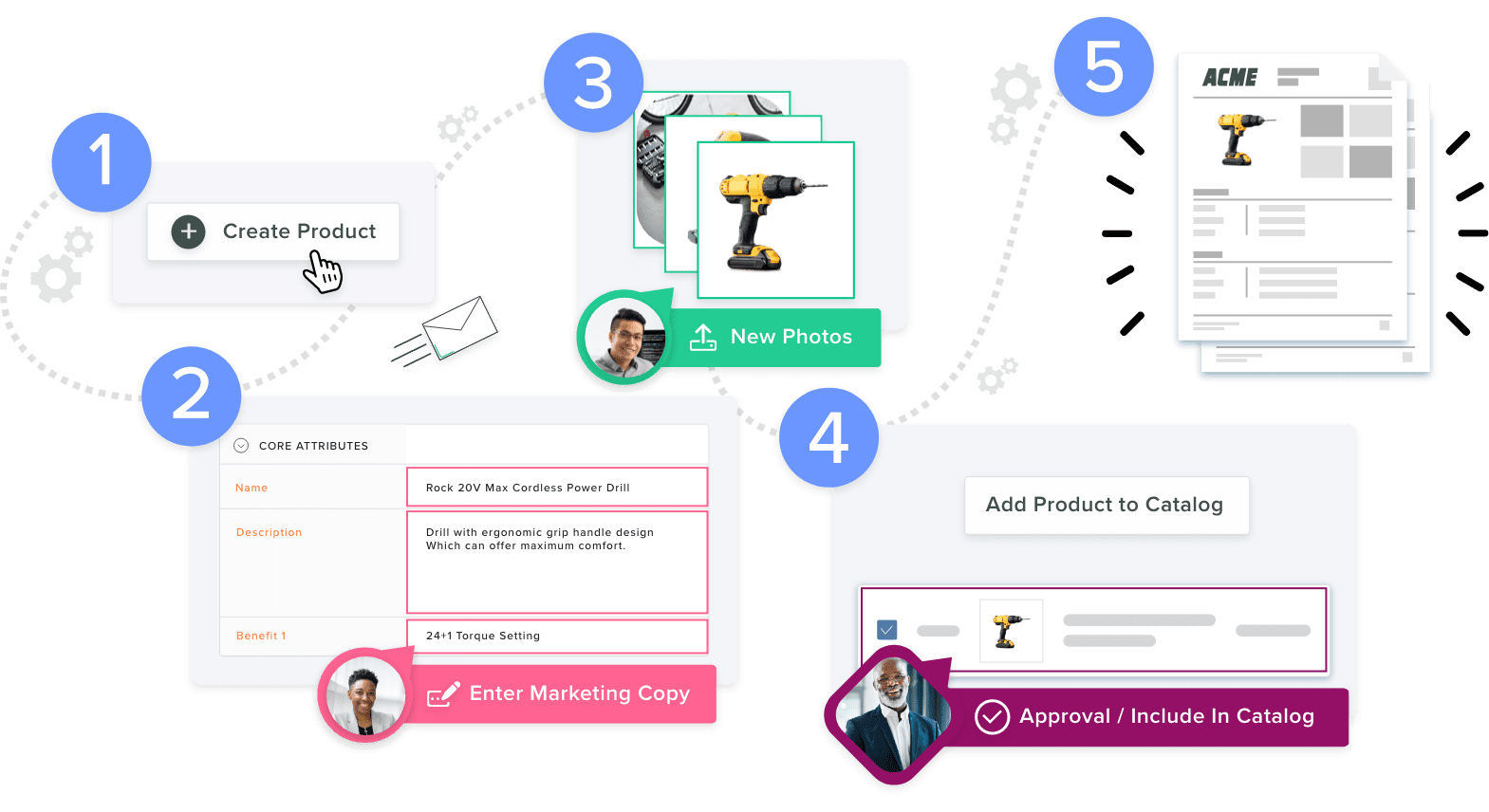
The workflow is consistent across platforms, even if the execution varies, and runs in five steps.
| Step | What Happens |
|---|---|
| 1. Ingest | Product data comes in — from suppliers, ERP systems, or internal teams entering new items |
| 2. Centralize | The platform centralizes everything in a single governed repository |
| 3. Enrich | Your team enriches products — descriptions, images, specs, certifications, relationships |
| 4. Validate | Validation checks confirm completeness against each channel’s requirements before anything publishes |
| 5. Syndicate | The system syndicates automatically to every connected channel; when something changes, the update propagates |
How Does Catalog Software Integrate With Your Tech Stack?
The integration landscape for catalog software includes Shopify, Amazon, Walmart, SAP, NetSuite, BigCommerce, and Magento as the most common connection points. For Shopify merchants specifically, PIM software designed for Shopify handles multi-store management and automated enrichment natively.
The distinction worth asking about in every demo: certified integrations versus template-based exports. Certified connections are maintained by the vendor when platform specs change. Template-based exports work until the channel updates its requirements — then they’re your team’s problem to fix. Modern platforms increasingly support MACH architecture for flexible, API-first deployments, but the quality of specific integrations matters more than the architecture claim.
What Are the Best Practices for Product Catalog Management?
Six practices consistently change outcomes — and they’re mostly the ones teams skip because they’re unglamorous.
- Define what “complete” means per channel before you configure anything — if you don’t have clear completeness rules, validation tools can’t enforce them
- Establish data ownership by attribute, not by system — who is responsible for pricing accuracy? Specs? Imagery? These need named owners
- Build approval workflows that match your actual process — not an idealized one; the workflow that fits how your team actually works is the one people will use
- Audit before you migrate — bad data migrated to a new platform is just bad data in a better-organized location
- Treat syndication as ongoing operations, not a launch task — channel requirements change, specs update, new channels get added; the process needs an owner
- Rich media is product data — plan for images, videos, and documents as part of the data model, not as an afterthought to be connected later
How Do You Choose the Right Catalog Management Software?
Six steps keep an evaluation grounded in your actual catalog instead of a vendor’s feature grid.
| Step | What To Do |
|---|---|
| 1. Assess catalog size and trajectory | Not just where you are, but where you’ll be in 18 months |
| 2. Map your channels | Understand what each one actually requires — format, attributes, asset specs, compliance fields |
| 3. Confirm integration needs | Check against your existing ERP and ecommerce stack; ask specifically whether connections are certified or template-based |
| 4. Align with budget | Ask vendors to walk through total cost of ownership, including implementation and DAM, not just the license |
| 5. Review implementation timelines | Weigh them against your actual data quality — honest answers here save months later |
| 6. Request a real demo | Use your real product data and your hardest distributor template — never a prepared catalog |
When product images are as critical as your product data, an integrated PIM + DAM removes the operational burden of syncing separate systems. It cuts out an entire category of integration failures. Catalog management software isn’t interesting infrastructure. It’s the kind of system you notice most when it’s absent — a pricing error that reaches a customer, a launch that slips because nobody owns the data assembly, a new channel that requires a project instead of a configuration.
Key Takeaways
- 01.
The 300–500 SKU threshold isn’t a rule of thumb: it’s where failure modes become measurable — pricing errors, launch delays, and channel inconsistency all compound past that point.
- 02.
Poor data quality costs $12.9 million a year on average: per Gartner’s 2020 Magic Quadrant for Data Quality Solutions survey of 154 reference customers — built from errors that look small individually and compound across every channel.
- 03.
PIM, DAM, and MDM solve different problems: a PIM governs product data, a DAM governs the files attached to it, and MDM governs data enterprise-wide — most mid-market teams need the first two combined, not the third.
- 04.
Integrated PIM + DAM eliminates a category of problems: one approval workflow, one source of truth, no integration layer to maintain between product data and its assets.
- 05.
Implementation timelines depend more on data quality than platform complexity: a catalog audit before migration is the single change that most consistently shortens go-live.
- 06.
“Best” depends on catalog size, not a single winner: Salsify and InRiver fit large-scale enterprise syndication, Akeneo fits developer-led builds, Plytix fits early-stage brands, and integrated platforms like Catsy fit mid-market manufacturers and distributors.
- 07.
Always demo with real data: a platform that handles clean sample data well tells you nothing about how it handles your actual, messiest catalog.
See Catalog Management Built for Your Actual Catalog
Catsy is a single source of truth for your Product Information and Digital Asset Management — one platform, one workflow, no syncing overhead.