

What You’ll Learn
Why the PIM vs ERP debate usually starts after product data problems show up
What each system actually owns and why it matters
How poor data quality quietly drains revenue
When a growing company should invest in PIM software
Why businesses that scale successfully almost always use both
Most companies don’t realize they have a product data problem until it starts costing them revenue.
It shows up in small ways first. A product listing with the wrong specs. Inventory mismatched with what’s actually in stock. Marketing launches a campaign using outdated descriptions, and sales scrambles to fix the fallout.
Stack these moments together and you get lost sales, frustrated customers, and teams buried in manual cleanup instead of building anything.
That’s usually when someone asks: should we fix this with our ERP, or do we need a PIM? The answer depends on understanding what each system actually does — because PIM and ERP serve fundamentally different purposes.
An enterprise resource planning (ERP) platform is business management software that runs internal operations — supply chain management, financial reporting, human resources, and core business processes.
A product information management (PIM) system is built for the buyer. It ensures customers see accurate data, quality images, and compelling descriptions wherever they shop.
ERP keeps the business running. PIM keeps your products sellable.
Growing companies juggling multiple sales channels will eventually need both. Gartner’s Data Quality Market Surveyfound that poor data quality costs organizations an average of $15 million per year — and growing businesses feel it faster because their systems haven’t matured yet.
“Poor data quality costs organizations an average of $15 million per year.” — Gartner Data Quality Market Survey
1. PIM vs ERP: The Difference Most Companies Discover Too Late
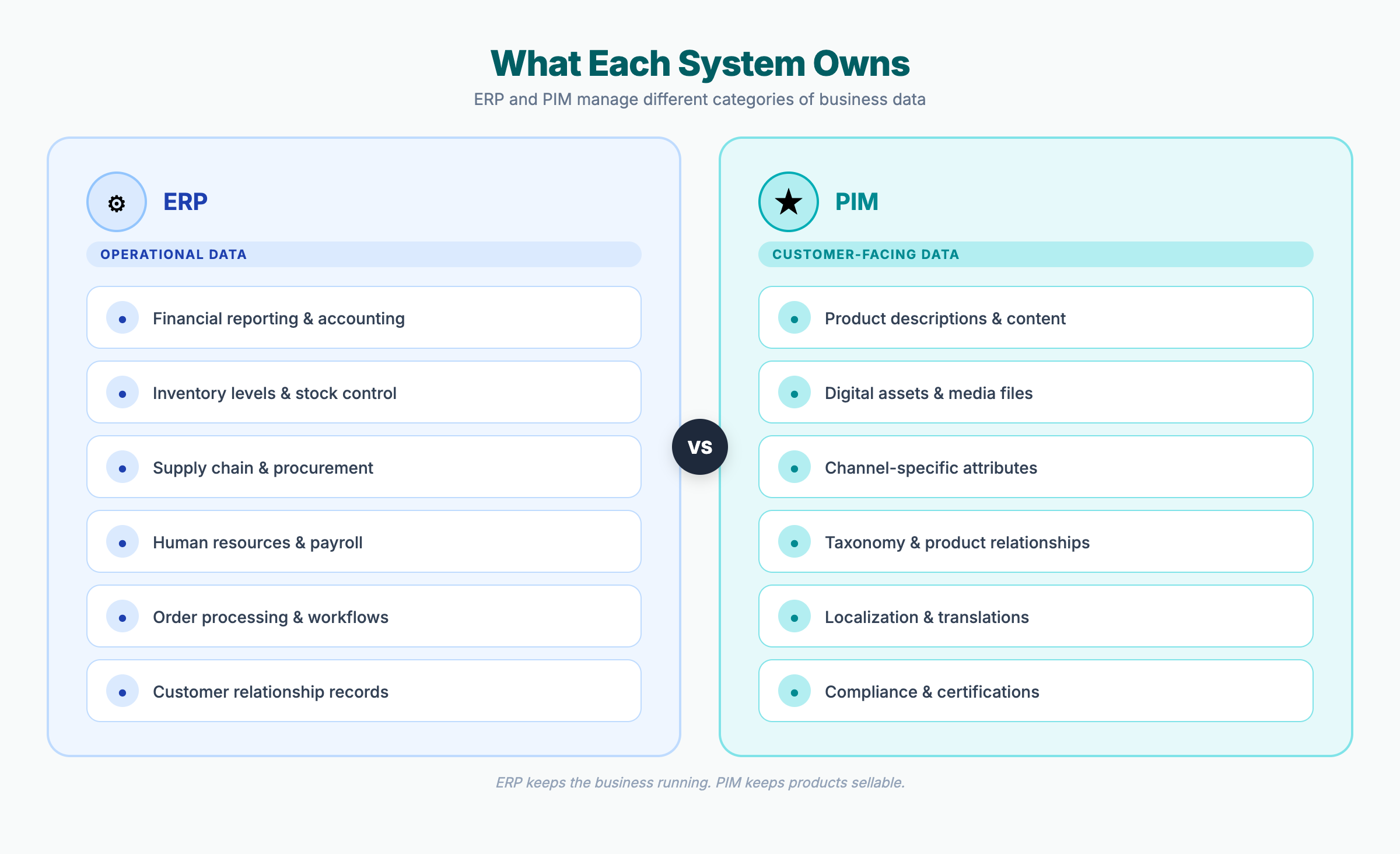
Many companies assume their ERP can handle product data. The logic makes sense — ERP already stores SKUs, pricing, and stock levels.
But ERP platforms were designed for operational control, not buying experiences.
When businesses force ERP into a product content role, friction shows up fast:
Product listing updates take too long
Digital assets scatter across folders and drives
Teams build spreadsheet workarounds
Data silos form between multiple departments
Errors multiply across external channels
The core issue is ownership.
ERP owns operational data. PIM owns customer-facing product data.
Once companies accept that separation, workflows get cleaner, data governance improves, and errors stop compounding across channels.
2. What Is a Product Information Management System?
A product information management (PIM) platform acts as a central hub for managing all product-related data. It consolidates product information into a single, centralized location — eliminating data silos and ensuring consistent, accurate information across teams and sales channels. Instead of letting information live across disconnected systems, PIM software brings structure to the content your customers actually see.
Inside a PIM system, teams manage:
Product descriptions
Technical specifications
Digital assets and media
Channel-specific attributes
Localization
Taxonomy and product relationships
Compliance details
Organization is only half the value. What makes PIM powerful is data governance — validation rules that ensure data accuracy and prevent half-finished or inconsistent listings from going live. PIM is tailored for marketers, e-commerce managers, and product managers — the teams responsible for how products appear to buyers.
McKinsey research found that companies delivering strong customer experiences grow revenue 4 to 8 percent above their market average. Consistent, accurate product data across every channel is how that experience gets built.
“Companies delivering strong customer experiences grow revenue 4–8% above their market average.” — McKinsey
Many growing brands explore PIM after realizing their ERP can’t support modern merchandising demands. Launch cycles slow down. Teams spend more time fixing data than enriching it.
PIM solves that by creating a single system for data management and distributing accurate data across multiple channels without constant rework. Product teams enrich raw SKU data with compelling descriptions, optimized keywords, translations, and localized content — then distribute it everywhere customers find them. Platforms that combine PIM with digital asset management — like Catsy — take this further by keeping product images, videos, and documents in sync with product records, eliminating the gap between data and creative assets.
3. What Is an Enterprise Resource Planning System?
If PIM is readiness for the buyer, ERP is stability behind the scenes.
An ERP system connects multiple departments through a shared data structure so the business operates without constant friction. It handles back-end efficiency in business operations, serving finance, operations, HR, and logistics teams.
ERP platforms typically support:
Financial reporting
Inventory control
Supply chain operations
Procurement
Customer relationship management and database records
Human resources and recruitment processes
Order workflows
The demand for operational visibility keeps growing. Fortune Business Insights projects the global ERP market will grow from $106 billion in 2026 to over $281 billion by 2034.
ERP is excellent at managing operational data. It is not built to manage buying experiences. Stretching ERP into a product content platform creates bottlenecks, not efficiency.
Key Features of ERP Systems
Unified view of core business processes
Strong financial controls
Real-time stock levels
Supply chain visibility
Automation across business functions
Governance for internal operations
Deploying an ERP system improves efficiency and decision-making through real-time data access, stronger reporting, and workflow automation. Predictability is what allows businesses to scale.
4. Key Differences Between PIM and ERP
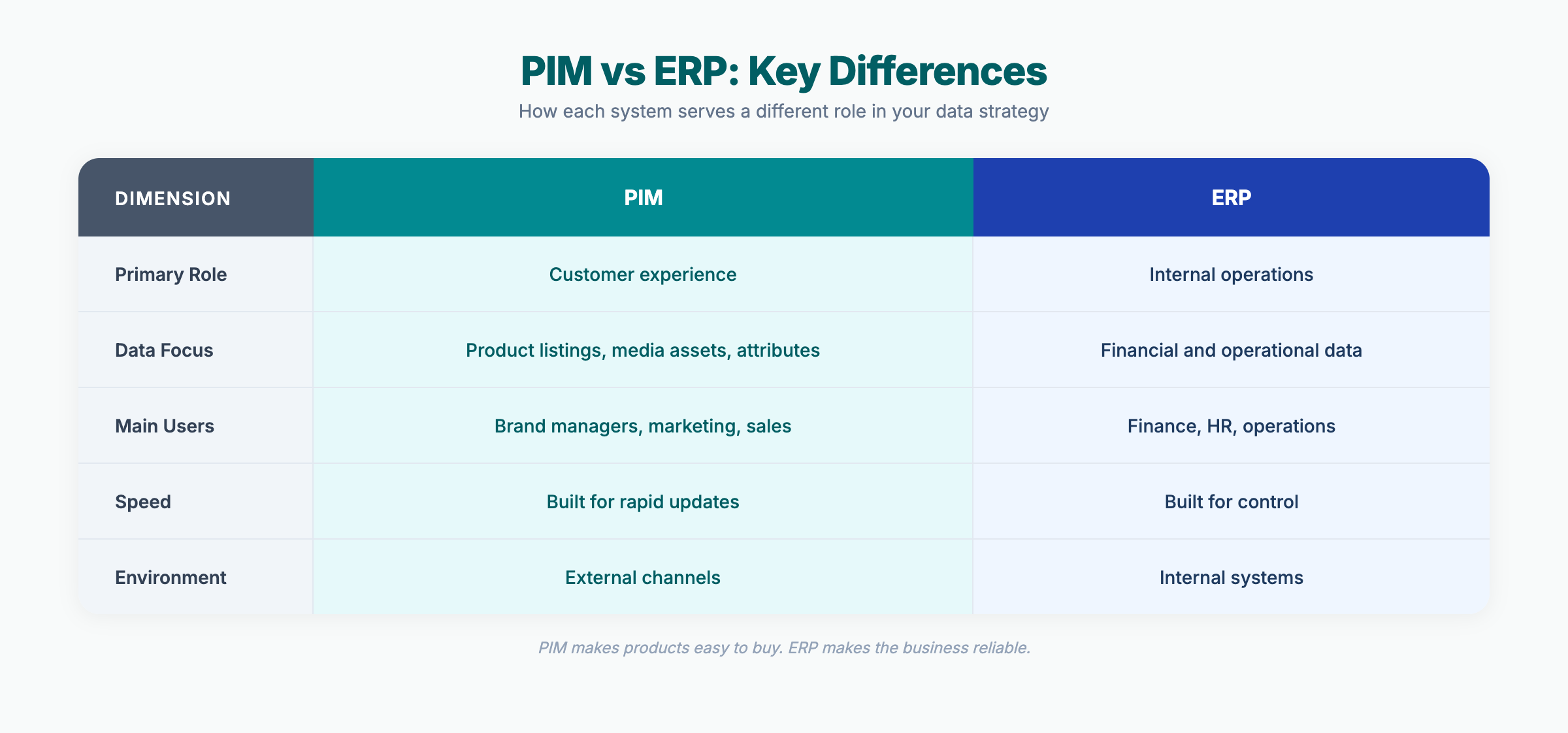
PIM makes products easy to buy. ERP makes the business reliable.
“PIM makes products easy to buy. ERP makes the business reliable.”
PIM is focused on front-end customer experience. ERP is focused on back-end operations. Confusing their roles creates problems fast. Growing companies deliver stronger customer experiences when each platform acts as the authority for its domain.
5. Why Growing Companies Stop Treating This as an Either-Or Decision
Growth exposes weak data structure. More products mean more complexity. More channels mean more chances for inconsistency.
Without a clear system, teams compensate with manual work. Efficiency drops. Launch timelines stretch.
This is where PIM and ERP integration starts paying off.
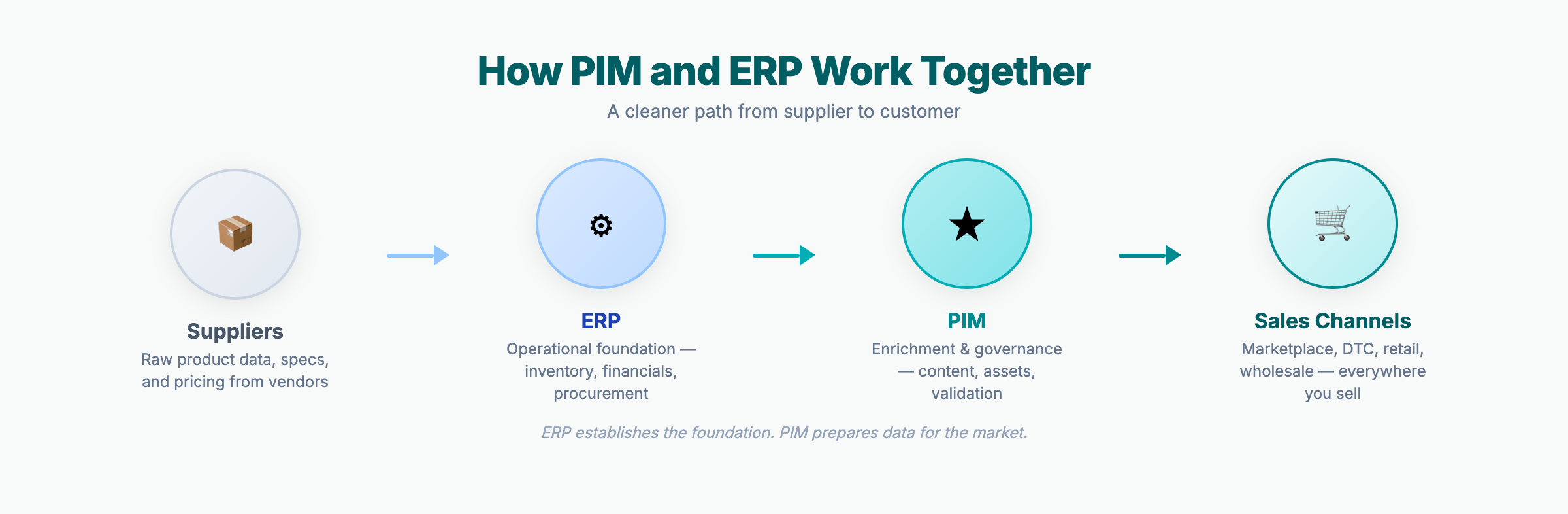
Suppliers → ERP → PIM → Sales channels
ERP establishes the operational foundation. PIM enriches the data and prepares it for the market. Both systems consolidate data from disparate sources into a single source of truth, eliminating silos and discrepancies. Together, they create a cleaner path from supplier to customer.
Key Benefits of Integrating PIM and ERP
Faster time to market
Higher data consistency across channels
Fewer manual corrections
Stronger customer experience with high quality data across every channel
Better control of operational costs
How Data Actually Flows Between Systems
In practice, ERP and PIM handle different stages of the product data lifecycle.
ERP creates the foundation. When a new product enters the system, ERP assigns the SKU, sets the base cost, records supplier details, and establishes inventory levels. ERP systems serve as the central hub for operational data — stock counts, purchase orders, financial transactions — that internal teams rely on to run daily operations.
PIM takes that foundation and makes it sellable. Product teams enrich raw SKU data with compelling descriptions, images, and specifications, which are then distributed across sales channels. PIM ensures high data quality through validation rules and completeness scores, preventing half-finished listings from reaching customers.
The flow in practice:
ERP receives supplier data — cost, stock, lead time
PIM enriches with descriptions, digital assets, and specifications
PIM distributes product data to marketplaces, e-commerce platforms, print catalogs, and retail partners
Changes propagate — a price update in ERP automatically flows to PIM, which pushes up-to-date information across all sales channels
When companies skip the PIM layer and push ERP data straight to channels, the results are predictable: bare-bones listings with missing descriptions, no lifestyle imagery, and formatting that doesn’t match each platform’s requirements.
Sales teams end up fielding questions that good product content would have answered. Manual tasks pile up as people copy-paste between systems instead of publishing from a single source.
Integrating PIM and ERP reduces operational and marketing costs by minimizing manual data entry and errors — which is where most of the hidden expense lives.
Research from Deloitte and others consistently shows that organizations with mature data governance outperform peers operationally.
Companies that scale smoothly usually recognize they need both before the cracks widen.
6. What to Look for in a PIM That Complements Your ERP
Many businesses aren’t sure where PIM ends and ERP begins — or whether they need one or both. Choosing the right solution, or integrating both, can drive operational efficiency, strengthen data governance, and improve go-to-market performance.
PIM and ERP play distinct but complementary roles. Choosing the right PIM solution means evaluating how well it connects to your existing ERP and whether it reduces — or adds — integration complexity.
API-first architecture. Your PIM needs to connect cleanly with your ERP and the other systems your team already uses. Look for platforms with documented, well-maintained APIs rather than relying on custom middleware. The fewer intermediaries between systems, the fewer points of failure.
Flexible data modeling. ERP manages structured data — SKUs, costs, stock levels, and vendor info. PIM needs to handle everything ERP can’t: rich descriptions, localized content, channel-specific attributes, and complex product variations. Unlike ERP, PIM provides the flexibility to manage those variations without developer involvement for every change.
Integrated digital asset management. Many companies pair PIM with a separate DAM, creating yet another system to integrate and maintain. The strongest approach is a PIM with DAM built in — platforms like Catsy combine both in a single system, eliminating the sync layer between product data and media assets.
Implementation timeline. Enterprise ERP deployments are often resource-intensive and expensive due to their complexity. Your PIM shouldn’t require the same overhead. Mid-market PIM solutions like Catsy typically deploy in 10 to 14 weeks, meaning you can start seeing improved efficiency across multiple platforms well before your next product launch cycle.
Multichannel readiness. PIM platforms are purpose-built to ensure consistent, high-quality product data across all sales channels. Verify that the platform supports your current channels and can scale to new ones without custom development for each.
Key Takeaways
The PIM vs ERP discussion is about ownership, not replacement.
ERP systems manage internal operations and core business processes.
PIM platforms ensure accurate product data reaches customers.
Poor data quality quietly erodes revenue and efficiency.
Integrating PIM with ERP creates the foundation for scalable growth.
Businesses rarely regret investing in better data structure. They usually regret waiting too long.