

What You Will Learn
How product catalog management software centralizes product data across multiple sales channels
Which catalog management platforms are leading the market in 2026
What pricing and implementation realistically look like
The features mid-market ecommerce businesses should prioritize
How to choose software that scales with your business
Managing thousands of SKUs across e-commerce platforms, marketplaces, and physical retail gets unsustainable fast without the right system. Most scaling businesses learn this when inconsistent pricing reaches customers or outdated product descriptions cause confusion.
Manual processes create data integrity problems and pricing delays — both translate directly to lost sales. As your catalog grows alongside your customer base, maintaining consistency across channels becomes an operational bottleneck.
Product catalog management software solves this. Companies that adopt product information management softwaregain a centralized hub where internal teams maintain accuracy while improving operational efficiency.
According to Gartner, costs organizations an average of $12.9 million per year, based on a survey of 154 enterprise customers across 16 data quality vendors.
“Poor data quality costs organizations an average of $12.9 million per year.” — Gartner, Magic Quadrant for Data Quality Solutions, 2020
This guide covers how catalog management software improves customer satisfaction and helps e-commerce businesses scale without sacrificing data quality.
What Is Product Catalog Management?
Product catalog management is the process of organizing, maintaining, and distributing catalog content across formats — from digital catalogs to printed collateral.
It involves managing product details like titles, descriptions, pricing, images, seasonal availability, and inventory levels while ensuring consistency across locations and digital channels.
Historically, businesses relied on spreadsheets to manage catalog data, but comparisons like our Excel vs dedicated PIM solutions for product data highlight how quickly spreadsheets break down at scale. Modern catalog management focuses on creating a single source of truth so that sales teams, managers, and marketers all work from the same accurate information.
What Is Product Catalog Management Software?
Product catalog management software is a platform that centralizes your product data and automates catalog processes across multiple systems, similar to an integrated Product Information Management (PIM) and Digital Asset Management (DAM) platform like Catsy.
Rather than manually updating product listings channel by channel, catalog software enables bulk edits and automated syndication — keeping your info consistent no matter where customers find you.
Most solutions connect with inventory management systems, content management software, and ecommerce platforms to maintain data integrity throughout the sales process.
Advanced platforms support enriched product data, customizable templates, and API integrations so teams can act on accurate information faster; understanding how APIs power PIM and DAM integrations helps you evaluate these capabilities.
Why Businesses Need Product Catalog Management Software
Manual catalog management typically breaks down once a business reaches around 300 to 500 SKUs across three or more sales channels. At that point, maintaining data accuracy becomes a serious time drain.
“Manual catalog management typically breaks down at 300-500 SKUs across three or more sales channels.”
Common risks include:
Selling products at the wrong prices
Publishing outdated product content
Creating inconsistent customer experiences
Slowing down launch timelines
McKinsey’s research on ecommerce acceleration found that companies have been forced to modernize digital operations faster than expected, making scalable systems a competitive necessity.
Catalog management software addresses these pressures by replacing manual workflows with automation — reducing errors, speeding up launches, and freeing teams for higher-value work, especially when you adopt automatic product catalog creation and maintenance practices.
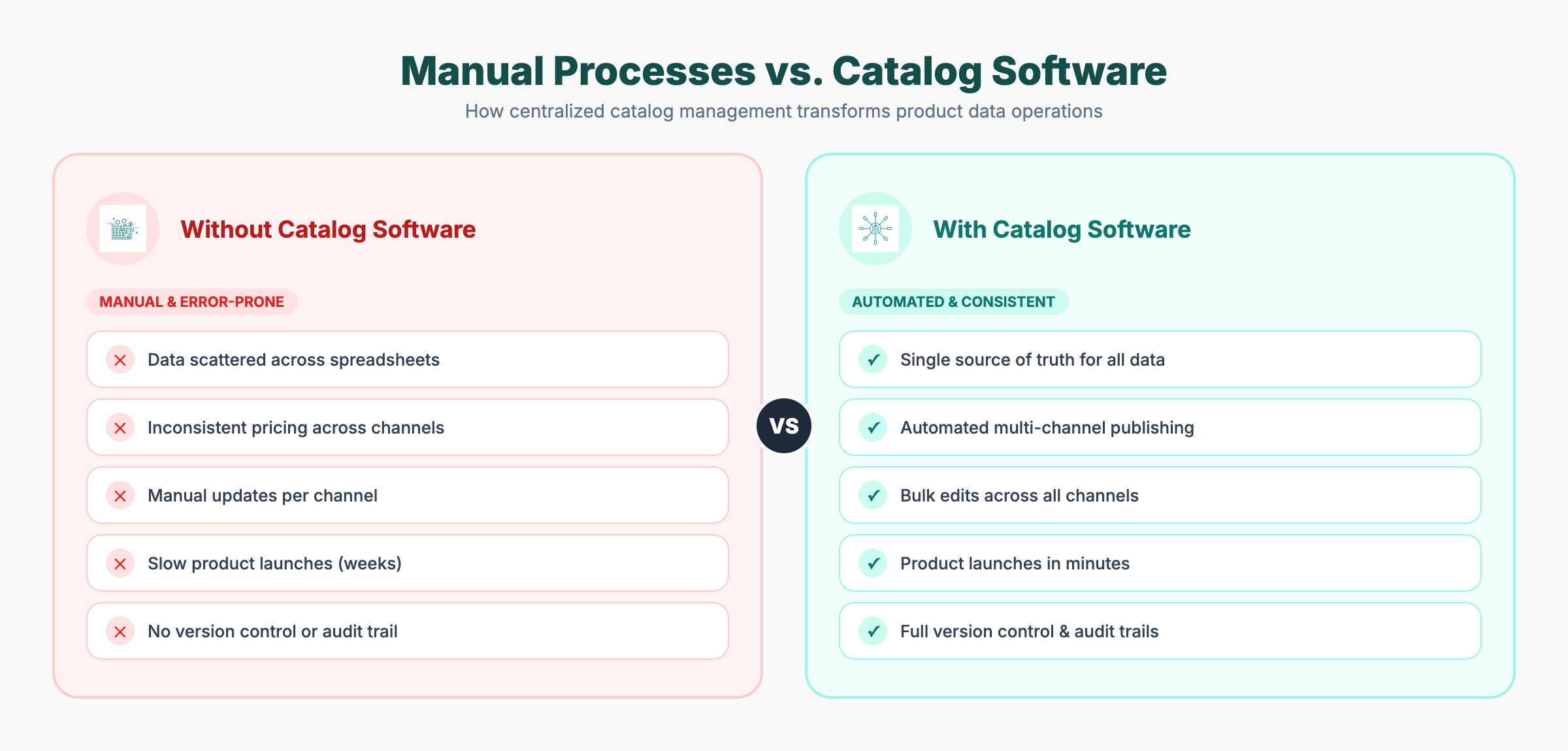
Key Benefits of Catalog Management Software
Centralized Product Content
A centralized hub eliminates data silos and ensures all products are managed from one platform. Marketing and sales teams collaborate without version conflicts.
Multi-Channel Consistency
Automatic publishing keeps product listings aligned across every platform, including physical locations. Customers see the same information no matter where they shop.
Faster Time-to-Market
Bulk edits and automated workflows shorten launch cycles.
Outdoor furniture retailer Leigh Country reduced product launches from two to three weeks to minutes after implementing Catsy’s unified platform, achieving ROI within 12 months by eliminating manual workflows and enabling instant multi-channel publishing.
“Leigh Country reduced product launches from 2-3 weeks to minutes, achieving ROI within 12 months.” — Catsy case study
Reduced Manual Errors
Automation and validation tools protect data integrity by catching inconsistencies before they reach customers.
Improved Customer Experience
Accurate product descriptions, detailed specs, and high-quality digital assets help customers buy with confidence — leading to higher satisfaction and fewer returns.
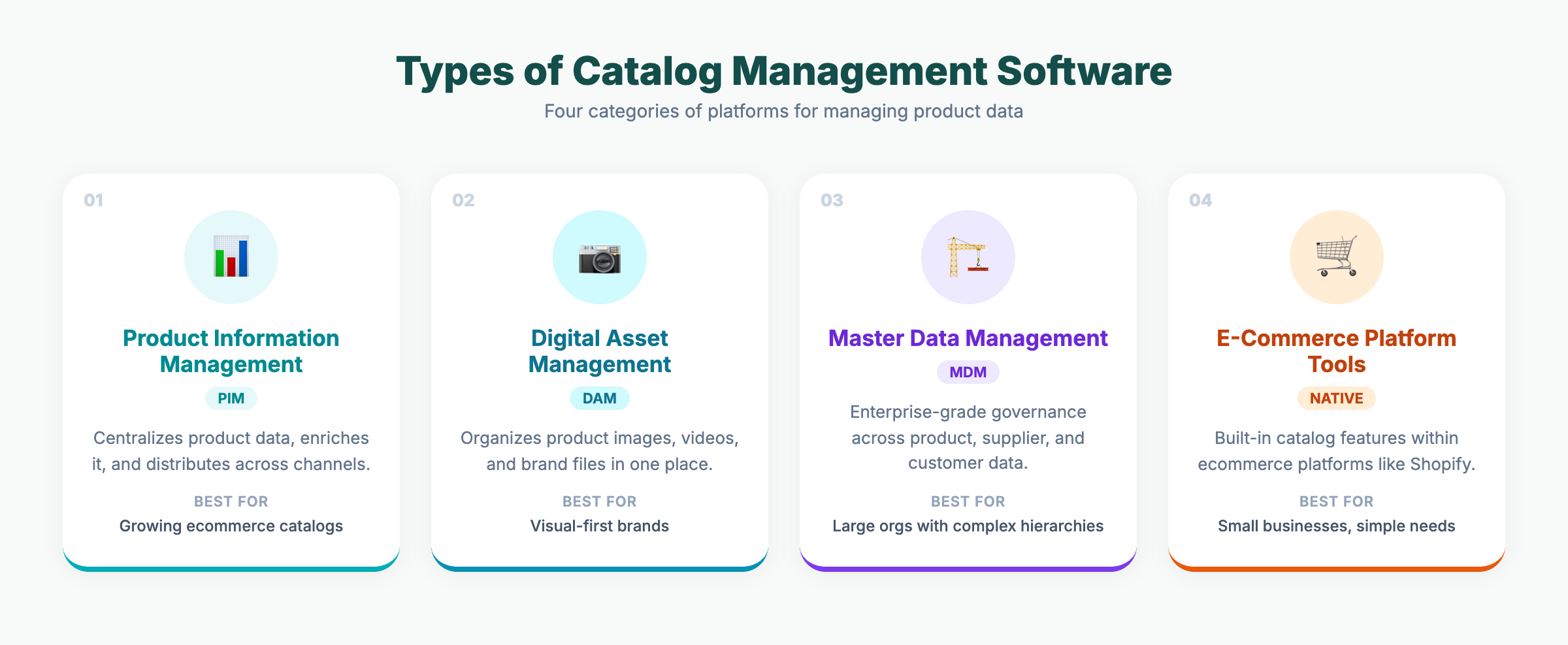
Types of Product Catalog Management Software
Product Information Management (PIM) Systems
PIM systems focus on centralizing product data, enriching it, and distributing it across multiple channels. They are ideal for ecommerce businesses managing growing catalogs.
Digital Asset Management (DAM) Systems
DAM platforms organize product images, videos, and brand files.
Rather than integrating separate PIM and DAM systems, a platform like Catsy is purpose-built to manage product data and creative assets within a single interface. This eliminates integration overhead, reduces licensing costs, and provides unified governance — one approval workflow covers both product content and imagery, similar to how a digital asset management (DAM) system for e-commerce content centralizes images, videos, and brand files.
Master Data Management (MDM) Systems
MDM platforms provide enterprise-grade governance across product, supplier, and customer data. They’re typically used by large organizations with complex hierarchies.
E-Commerce Platform Catalog Tools
Many ecommerce platforms include native catalog features suitable for smaller businesses with simpler needs, but they often lack the scalability required by mid-market organizations with large sales teams and IT departments.
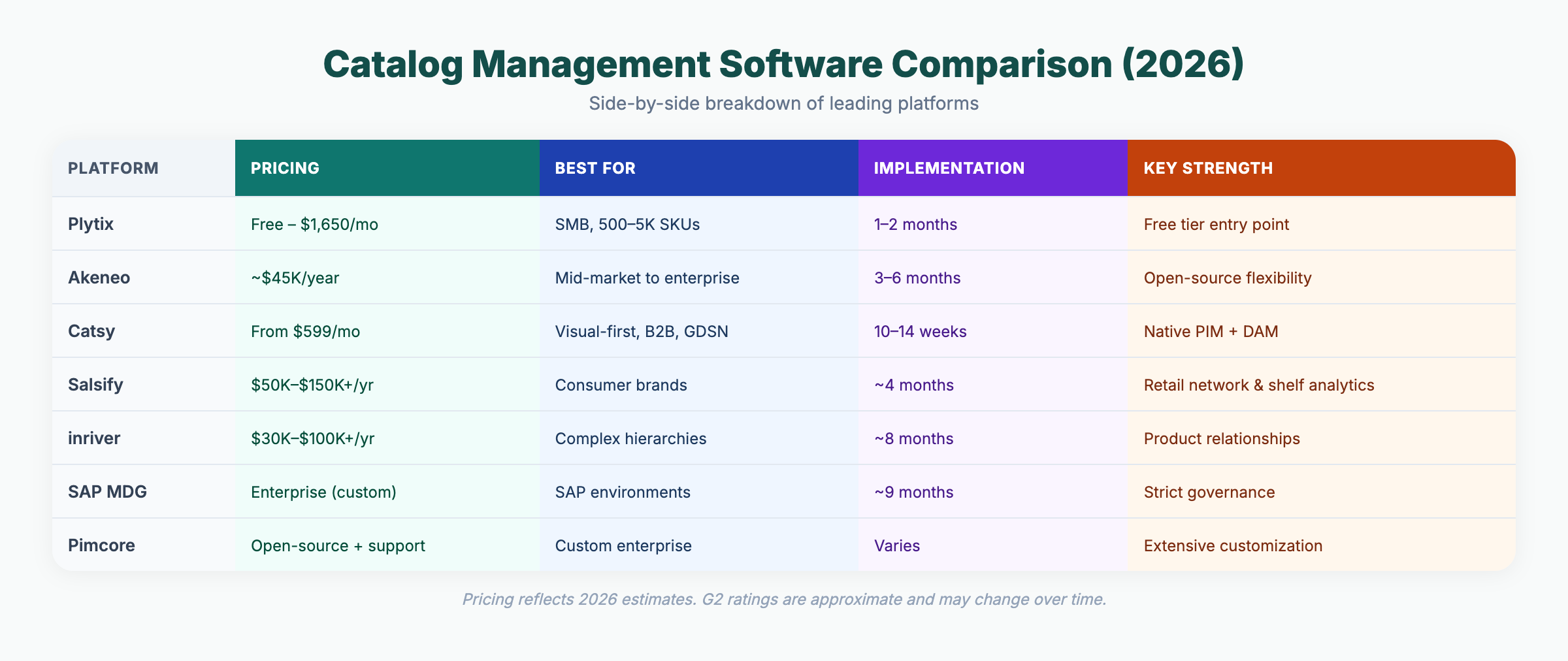
Top Product Catalog Management Software Solutions (2026)
Here’s a breakdown of leading catalog management solutions based on verified user data, pricing research, and implementation timelines. G2 ratings shown are approximate and may change over time.
Plytix
Pricing: Free tier available; paid plans approximately $450 to $1,650 per month
G2 Rating: ~4.7/5
Implementation: Typically one to two months
Best for: Small to mid-market brands managing 500 to 5,000 SKUs
Akeneo
Pricing: Approximately $45,000 annually for Growth Edition
G2 Rating: ~4.4/5
Implementation: Three to six months
Best for: Mid-market to enterprise companies with technical resources
Catsy
Pricing: Starting at $599 per month
Implementation: About 10 to 14 weeks for mid-market catalogs
Best for: Visual-first brands, B2B companies needing GDSN compliance, and teams managing 500 to 5,000 SKUs
Key differentiator: Native PIM plus DAM in a single platform
Salsify
Pricing: Typically $50,000 to $150,000+ annually (custom quotes required)
Implementation: Around four months with longer time to ROI
Best for: Consumer brands with heavy marketplace presence
inriver
Pricing: Often $30,000 to $100,000+ annually
G2 Rating: ~4.3/5
Implementation: About eight months
Best for: Businesses with complex product hierarchies
SAP Master Data Governance
Pricing: Enterprise licensing (custom quotes; varies widely by deployment)
Implementation: Around nine months
Best for: SAP environments requiring strict governance
Pimcore
Pricing: Open-source with enterprise support options
G2 Rating: ~4.5/5
Best for: Enterprises needing extensive customization
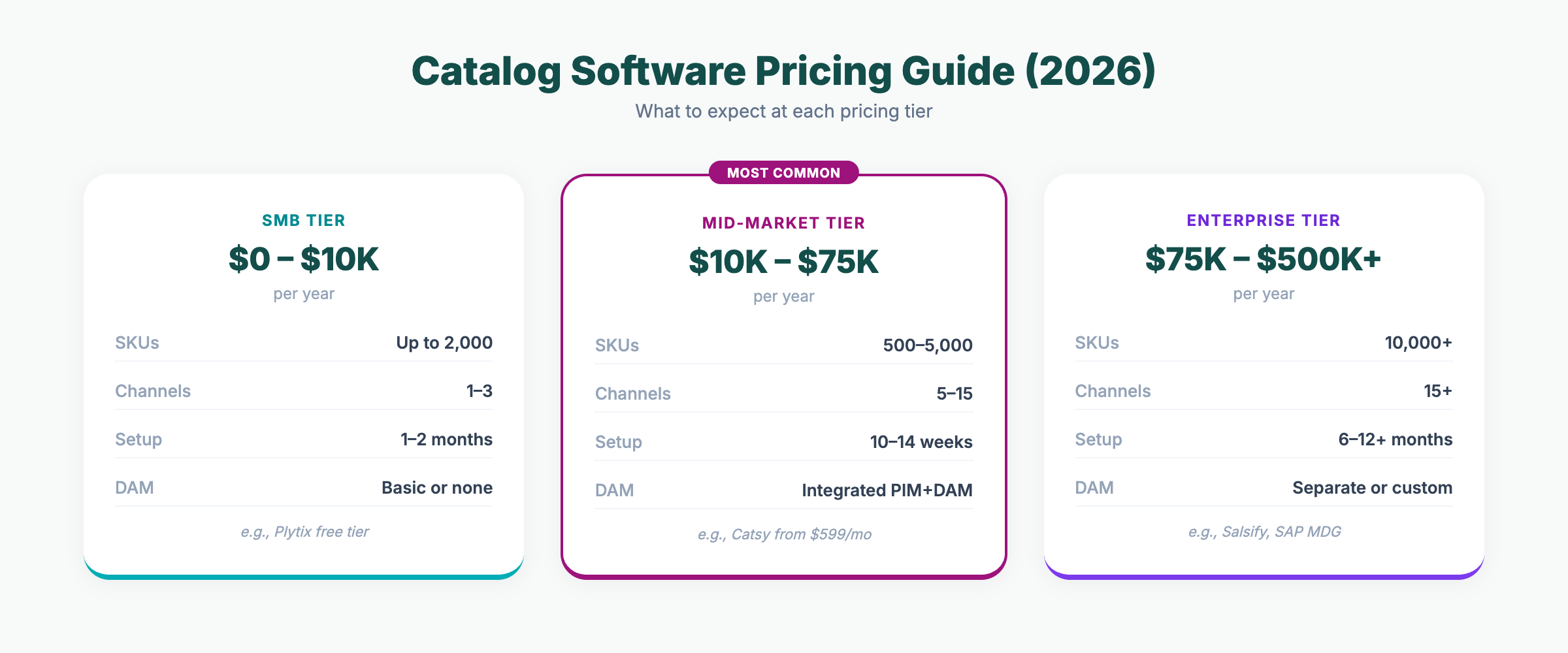
Catalog Management Software Pricing Guide (2026)
Catalog software pricing varies widely depending on SKU count, user volume, and deployment model.
SMB Tier ($0 to $10,000 per year)
Free tools and entry-level platforms typically supporting up to 2,000 SKUs.
Mid-Market Tier ($10,000 to $75,000 per year)
Supports growing ecommerce businesses with integration needs and larger catalogs.
Example: Catsy starts at $599 per month and scales to roughly $2,000 to $3,500 for mid-market deployments, including both PIM and DAM functionality within a single license; check out our pricing tiers to see how costs change as you grow.
Enterprise Tier ($75,000 to $500,000+ per year)
Designed for organizations managing extremely large catalogs with complex workflows.
Pricing variables often include:
SKU limits
User licensing
Add-on modules
Implementation fees
Billing structure
The pricing listed above reflects 2026 estimates and may vary by vendor.
Implementation Timelines: What to Really Expect
Implementation timelines vary based on data quality, catalog complexity, and integration requirements, and following a structured SaaS PIM implementation guide can help you plan each phase.
Fast Track (1 to 4 months)
Applies to SMB tools with clean data and minimal integrations.
Platforms with integrated PIM and DAM (like Catsy) typically implement in about 10 to 14 weeks for mid-market catalogs. Teams avoid lengthy API integration projects that separate systems require.
Standard Implementation (4 to 8 months)
Includes data migration, integrations, and training.
Enterprise Rollout (6 to 12+ months)
Often involves ERP synchronization, governance models, and phased deployment.
Set realistic expectations so you can plan resource allocation before kickoff.
Essential Features to Look for in Catalog Software
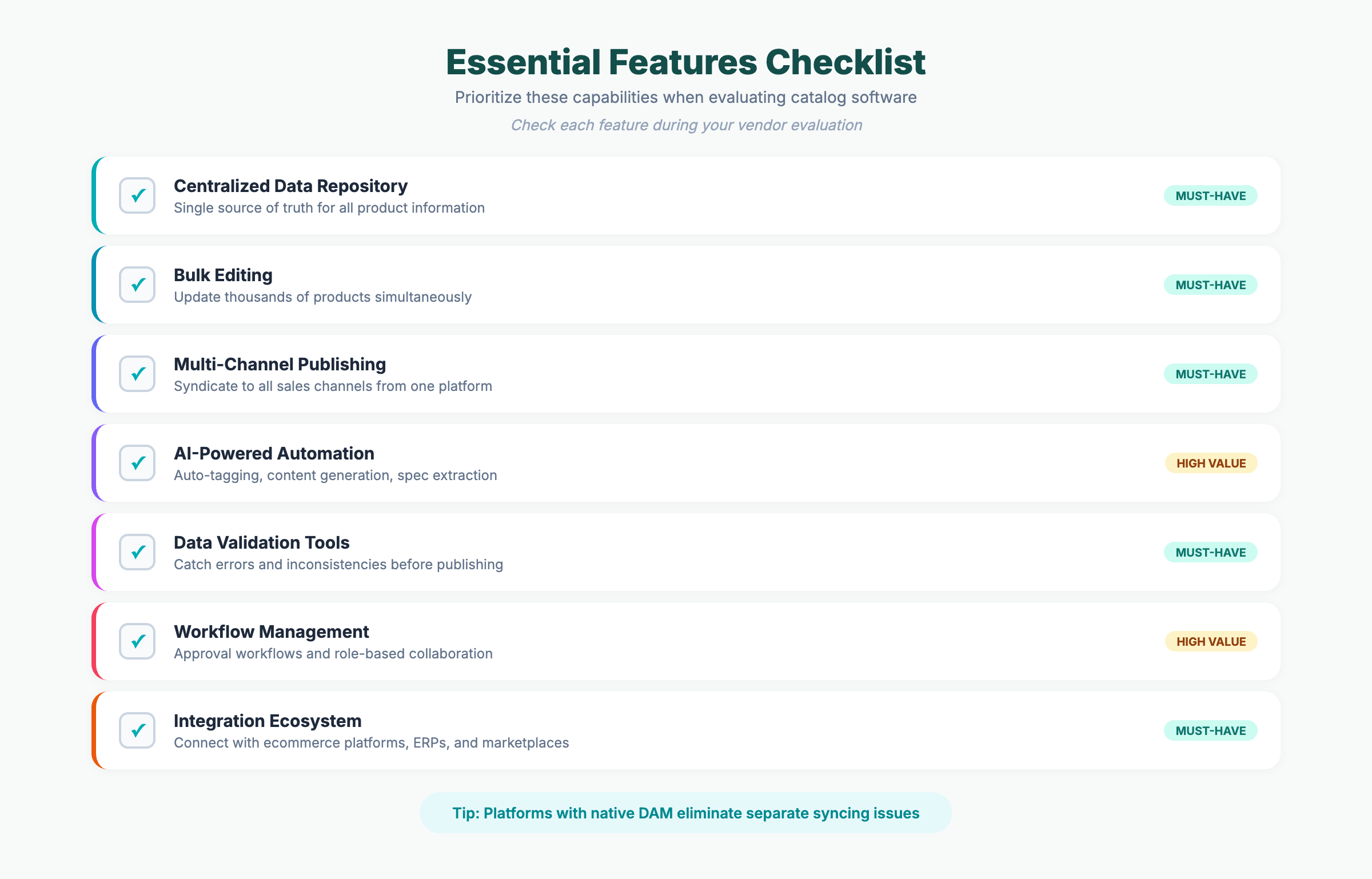
Prioritize these capabilities when evaluating solutions:
Centralized data repository for a single source of truth
Bulk editing to save time at scale
Multi-channel publishing for omnichannel readiness
AI-powered automation for tagging and content generation
Data validation tools to ensure accuracy
Workflow management for collaboration
Integration ecosystem for ecommerce and ERP connectivity
Some platforms include native DAM capabilities within the PIM interface, eliminating syncing issues and simplifying workflows. Others require API integrations. Consider whether unified workflows or specialized tools fit your business better.
For regulatory guidance impacting product data, review the European Commission’s Ecodesign for Sustainable Products Regulation, which includes Digital Product Passport requirements.
Common Challenges in Product Catalog Management
Businesses managing growing catalogs frequently run into:
Data silos across departments
Manual data entry errors
Inconsistent product information across sales channels
Slow product launches
Difficulty scaling catalogs
Complex product relationship management
These challenges typically stem from relying on outdated tools rather than centralized software.
Who Needs Product Catalog Management Software?
Retail Businesses
Retailers managing seasonal catalogs across multiple channels benefit from centralized catalog management.
Visual-first retailers with heavy creative production often prefer integrated PIM + DAM solutions like Catsy — they eliminate the operational burden of syncing separate systems by providing image organizer and DAM software for e-commerce.
E-Commerce Companies
Marketplace sellers managing thousands of SKUs need automation to stay competitive.
Solutions like Catsy offer native APIs and retailer-specific templates that automate format conversion across channels.
Manufacturers
Manufacturers rely on accurate technical documentation and distributor catalogs, making dedicated product catalog management for industrial brands particularly impactful.
Industrial companies needing GDSN compliance should prioritize platforms with built-in support. Catsy includes templates for complex attributes like certifications and CAD files alongside distributor portals, while still being flexible enough to accommodate unique catalog and data requirements.
B2B Wholesalers
Wholesalers often manage large assortments with account-specific pricing structures, making catalog automation essential.
How Catalog Management Software Works
Platforms vary, but most follow a similar workflow:
Teams input data from external sources and internal systems
The platform centralizes everything in a unified repository
Teams enrich products with descriptions, images, and specifications
The system syndicates content automatically across sales channels
Continuous updates happen with version control and audit trails
This process keeps catalog content accurate while reducing manual effort.
Integrations: Connecting Catalog Software to Your Tech Stack
Common integrations include Shopify, Amazon, Walmart, SAP, NetSuite, BigCommerce, and Magento. For example, PIM software designed for Shopify merchants focuses on seamless multi-store management and automated enrichment. Modern platforms increasingly support MACH architecture, enabling flexible, API-first deployments with real-time synchronization.
Strong integration ensures your catalog stays aligned with inventory levels and pricing across systems.
Best Practices for Product Catalog Management
Establish clear data standards
Maintain a single source of truth
Implement approval workflows
Audit catalog data regularly
Optimize product content for search
Use rich media to increase conversions
Plan for compliance requirements
Following these practices helps maintain data integrity long-term.
Choosing the Right Product Catalog Management Software
Use this decision framework, and first make sure you understand what Product Information Management (PIM) is and how it works:
Assess catalog size
Evaluate channel complexity
Confirm integration needs
Align with budget
Review implementation timelines
Request demos using real product data
When product images are as critical as your other product data, consider whether an integrated PIM + DAM platform is the right move. Platforms like Catsy can simplify operations compared to managing separate systems, delivering faster implementation and unified workflows.
“When product images are as critical as your product data, an integrated PIM + DAM eliminates the operational burden of syncing separate systems.”
Final Thoughts
Catalog management software is essential infrastructure for ecommerce companies at scale. The right platform improves efficiency, ensures accuracy, and supports consistent multi-channel experiences.
As your catalog grows, centralized software lets you scale without operational friction. Review vendor comparisons, assess pricing tiers, and request demos to identify the solution that fits your needs.