
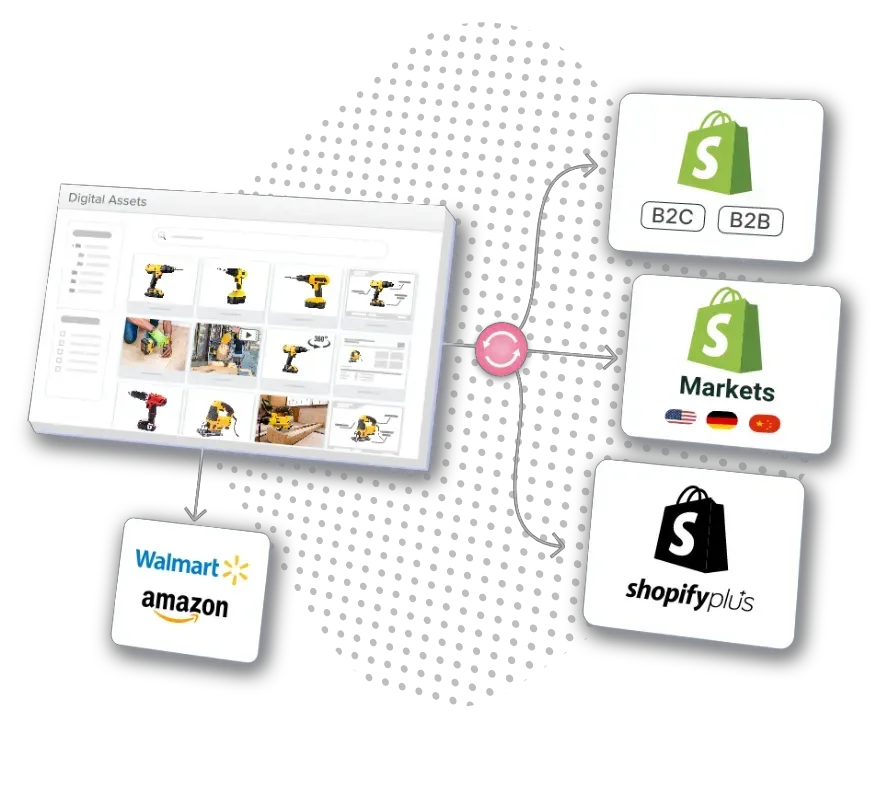
As Shopify merchants expand beyond a single ecommerce store, product data complexity rises fast. Product descriptions, product attributes, technical specs, media files, and product images multiply across multiple platforms, multiple systems, and multiple versions. Shopify functions brilliantly as a sales layer. It was never designed to be an information management system.
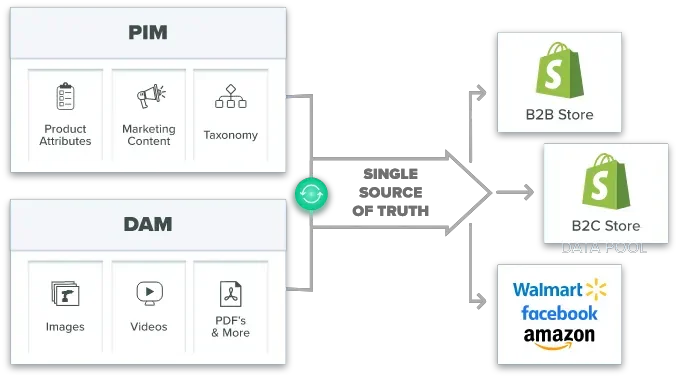
That’s why Shopify PIM adoption is accelerating heading into 2026. Businesses now operate multiple Shopify stores, sell through multiple sales channels, and manage growing product catalogs across regions, currencies, and units of measure. Manually managing all of that product data simply doesn’t scale. A structured product information management approach creates a single source of truth — without slowing down your store or sales layer.
1. What Is Driving Shopify PIM Adoption in 2026?
Key Drivers Behind Shopify PIM Adoption
Manual tasks like data transfer, manual data entry, and manual updates introduce incorrect data and reduce data accuracy — especially when product data lives across multiple systems simultaneously. The financial stakes are measurable.
The merchants feeling this most acutely are those who’ve crossed certain thresholds: 500+ SKUs, three or more sales channels, or expansion into a second market. At those inflection points, the data management approach that worked for a single domestic store stops being manageable and starts being a liability.
2. The Hidden Complexity of Multi-Store, Multi-Country Shopify Setups
Where Complexity Shows Up
Shopify functions as a sales layer. It is not an information management system. It doesn’t enforce governance across stores, maintain translation workflows, convert measurements, or ensure that a spec change in one market propagates correctly to all others. That’s not a criticism — it’s a design choice. Shopify is built to sell. PIM is built to govern the data that makes selling possible.
The hidden cost of multi-store complexity isn’t just operational overhead — it’s missed revenue from incomplete listings, customer trust lost to inconsistent product information, and team time diverted from growth to data reconciliation. These costs compound with every new store, every new market, and every new channel added without a centralized data foundation.
3. When Shopify Merchants Know It’s Time to Adopt a PIM
Common Warning Signs
As complexity increases, merchants often lose control over product data governance and discoverability inside Shopify. Operational bottlenecks appear because teams are manually managing product data across multiple systems with no single authoritative source. Different team members update different fields in different places, and the catalog starts to fracture.
At this stage, the need is not just for more tools — it’s for team collaboration, version control, and role-based permissions that allow the entire team to work efficiently without overwriting each other. This is typically when brands begin evaluating the best PIM for Shopify.
The Threshold Question
A useful self-check: if a product description is wrong on your Amazon listing, how long does it take your team to find it, identify the authoritative version, correct it, and confirm the fix has propagated to every other channel where that product appears? If the honest answer is “hours” or “it depends on who’s available,” you’ve crossed the PIM threshold.
4. Why PIM Software Is the Foundation for Scalable Shopify Growth
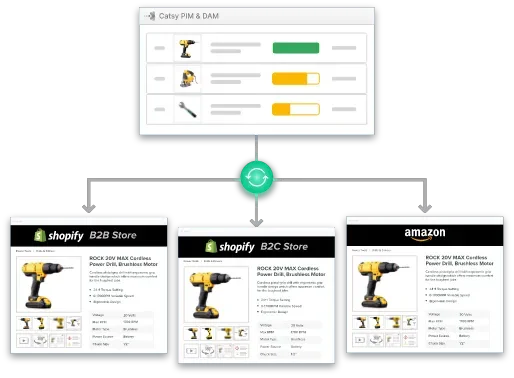
What a Modern PIM Platform Centralizes
What the Right PIM System Enables
Shopify notes that brands expanding internationally see materially higher growth when product data is structured correctly, as outlined in Shopify’s guide to global ecommerce expansion. The infrastructure that makes international growth possible isn’t the storefront — it’s the product data governance layer beneath it.
5. How Shopify PIM Adoption Works in Practice
A Typical Adoption Workflow
Common Challenges During Adoption
Implementation of a PIM solution with Shopify typically takes 3 to 6 months, depending on catalog size, variant complexity, and ERP integration scope. Careful field mapping is essential to prevent data mismatches, sync lag, or accidental overwrites. The merchants who get the most from their implementation are those who invest in the data audit and governance design phases — not just the technical connection.
According to Catsy customers, merchants reported up to 90 percent error reduction and 75 percent faster product launches after implementing a centralized PIM approach. That’s not a marginal improvement in operational efficiency — it’s a structural change in how the business manages product data.

Key Takeaways

Frequently Asked Questions
Shopify PIM adoption is the process of implementing a product information management system to centrally manage product data for a Shopify store and all connected sales channels. Rather than maintaining product descriptions, attributes, images, and technical specs separately in each storefront or spreadsheet, a PIM creates one governed source of truth that feeds every channel automatically.
Not every merchant does — but most will reach a point where they do. A single store with a small, stable catalog can manage fine without one. Once you’re managing 500+ SKUs, multiple storefronts, three or more sales channels, or international markets with different languages and measurement systems, the operational cost of manual product data management typically exceeds the cost of PIM software. The question isn’t whether you need it eventually — it’s whether you wait until the pain is acute or act before it becomes a bottleneck.
PIM improves data accuracy by eliminating the manual steps where errors enter — manual re-entry, copy-paste between systems, per-store updates that drift from each other. Validation rules enforce required fields and correct formats before data reaches channels. A single authoritative record means there’s no question about which version is current. And role-based permissions ensure that only the right people can change the right fields, with audit trails showing every modification.
Yes. Modern PIM platforms typically include Digital Asset Management (DAM) capabilities, or integrate natively with a DAM. This means product images, videos, 3D assets, spec sheets, and compliance documents are stored, versioned, and linked directly to product records. When a product image is updated, it automatically distributes to every connected channel. This eliminates the common problem of different storefronts showing different — sometimes outdated — versions of the same asset.
Yes, significantly. Search engines reward structured, complete, consistent product content. A PIM enforces completeness across required SEO fields — meta titles, descriptions, alt text, structured attributes — and ensures that content is consistent across every channel where the product appears. For international merchants, PIM also manages market-specific SEO metadata in the correct language for each storefront, rather than relying on machine translation applied after the fact.
The ideal time is before expanding into new markets or adding distribution channels — not after the complexity has already created problems. Practically, most merchants adopt PIM when they recognize the warning signs: spreadsheets as the primary product data tool, inconsistencies across channels, catalog updates taking weeks, or incorrect data reaching partners. If any of those describe your current situation, the adoption timeline should start now rather than after the next expansion.
The best PIM for Shopify combines native Shopify integration with strong data governance capabilities: validation rules, completeness scoring, role-based permissions, version control, and automated multi-channel syndication. For multi-store merchants, multi-language and multi-currency support are non-negotiable. For product-heavy operations, integrated DAM — or strong DAM connectivity — matters as much as the PIM itself. The right fit depends on your catalog size, channel complexity, and growth trajectory, but the foundation is always the same: one governed source of truth that feeds every channel cleanly.
Where to Next?
The shift to centralized product information management isn’t a technology decision — it’s a strategic one. The merchants who make the switch before the complexity becomes a crisis are the ones who expand into new markets from a solid data foundation rather than charting their course through a sea of inconsistent spreadsheets and manual updates. When you’re ready to evaluate options, our guides below cover the decisions that matter most.
See How Catsy Solves the Shopify PIM Challenge
Catsy’s integrated PIM + DAM is purpose-built for Shopify merchants managing complex catalogs across multiple stores, markets, and channels — one governed source of truth, automated syndication, and real-time sync to every connected storefront.
Book a Demo