Shopify MCP is a standard interface that lets AI assistants query a Shopify store directly — search the catalog, pull product details, check availability, and build carts for shoppers, all through a live endpoint on the store's own domain. No app in the middle. The agent talks to the product data, and the product data answers.
The short history: MCP, the Model Context Protocol, is an open standard from Anthropic that gives AI assistants a common way to connect to outside tools and data. Shopify adopted it as part of its AI toolkit and shipped two pieces that matter to merchants — a Storefront MCP server that handles shopping actions (cart operations, checkout, policy questions, order status), and a Catalog MCP that lets agents search and retrieve the product catalog itself. This piece is about the catalog side, since that's where the data does the talking.
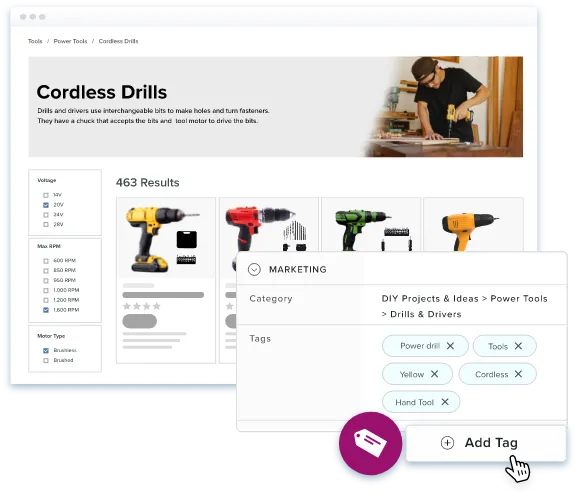
The first time an agent gets pointed at a Shopify catalog, the thing that stands out isn't the technology — it's how ordinary it feels. The agent asks for products the way a buyer would. The catalog answers with whatever's in the fields. No page design, no brand story, no salesperson filling the gaps. Just the data.
That's the shift worth understanding. Product information isn't behind the storefront anymore. For a growing class of shoppers, it is the storefront.
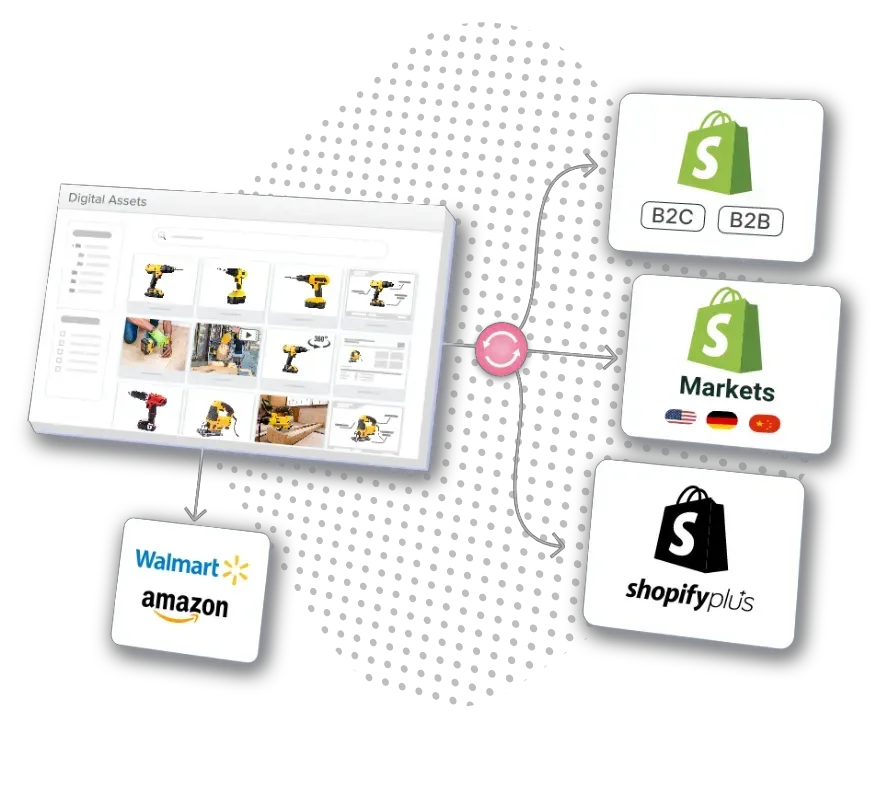
Three similar-sounding names, one line each:
The Catalog MCP exposes three tools, and they map neatly to how a buyer actually shops:
Walk through what a real call looks like. A procurement agent searches a store for "stainless cam-lock fitting 2 inch." What comes back is structured data, field by field: titles, descriptions, price ranges, images with alt text, variants and SKUs, availability signals, categories, ratings, and links to seller policies. The consumer version runs the same mechanic — an assistant hunting "trail running shoes for wide feet" is matching option values and variant data against a shopper's requirements, across every store it can reach.
Now the part that changes how a catalog should be thought about: the agent has no patience and no imagination.
A human shopper who sees "SS cam-lock, 2 in." can infer that SS means stainless steel. An agent can't, or won't risk it. A human facing two identically-titled variants clicks into both and squints at the photos. An agent just sees two indistinguishable records. A human missing a spec might call the store. An agent moves to the next one on the list.
What renders on a human product page as "good enough" comes back to an agent as nothing. A description that says "see spec sheet for details" — nothing. A material attribute left blank because "it's in the photo" — nothing. Every gap that's been papered over with design, brand trust, and customer service is now a hole an agent falls straight through.
On a human storefront, strong design and brand can carry weak data. Beautiful photography, a confident layout, a recognizable name — they buy forgiveness for a thin spec table. Agent-mediated shopping removes that cushion. When an AI assistant compares products across five stores, it's comparing structured fields: attributes, variants, price, availability, policies. The best-presented catalog doesn't win. The best-populated one does.
That makes data quality a ranking factor in a literal sense. Populated attributes determine whether a product matches the query at all. Clean variant structure determines whether the agent can pick the right configuration. Accurate availability determines whether it trusts a store enough to put it in the cart — agents treat stock signals as truth, not as a suggestion.
For manufacturers and B2B brands, this lands closer to home than the consumer hype suggests. The near-term, genuinely real use case isn't someone asking a chatbot to buy sneakers — it's agentic procurement: an agent re-ordering parts against a spec list, week after week, across every supplier and channel that exposes a catalog.
Spec-dense catalogs are precisely where data gaps hurt most, and precisely where complete, consistent data compounds. If products are chosen on dimensions, materials, and compatibility, the store whose data answers those questions wins the order, quietly and repeatedly, without anyone browsing anything.
Pull ten representative SKUs from Shopify admin — a few bestsellers, a few long-tail — and run these checks honestly:
Titles distinguish variants without context — if two variant titles are identical except for a code buried at the end, an agent can't reliably tell them apart
Required attributes are populated per category — every category has fields a buyer needs; "see description" is not a value
Descriptions contain the specs agents parse — materials, dimensions, compatibility, in the text, not locked inside a PDF or a photo
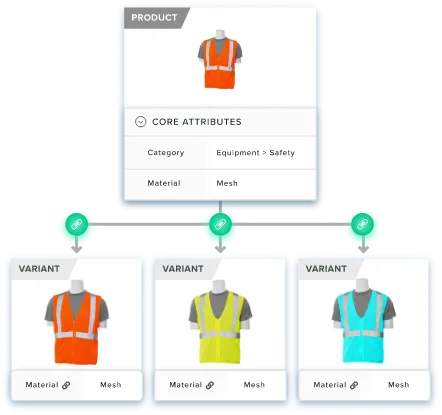
Variant and option structure matches how buyers specify the product — if customers order by size and material, those are the option values, not "Style A / Style B"
Images are present and correctly associated per variant — the agent passes images to the shopper; a wrong-variant photo is a returned order
Availability and inventory are accurate — agents treat the stock signal as truth; phantom inventory doesn't just annoy, it disqualifies
Identifiers are present and consistent across channels — SKUs, GTINs, and variant IDs are how lookup_catalog finds a product; mismatched identifiers between the store, the ERP, and distributor feeds break the chain
Policies are filled in — agents answer policy questions from the data; blank means "unknown," and unknown loses to a competitor who answered
Running this audit once is a project. Keeping all eight true continuously, across every SKU, every update, every channel, is a system — that's the job a PIM does: product data management as an operation, not an event. Catsy applies validation rules and completeness scoring to every product before it syncs to Shopify, so agent-readiness gets enforced at publish, not discovered after. If you're weighing how to get there, start with how PIM and DAM work with Shopify.
A grounded look forward, minus the crystal ball. The standards underneath this — MCP, and the commerce protocols forming around it — are consolidating fast, and more surfaces are getting agent interfaces: checkout, B2B portals, marketplace feeds.
Honest uncertainty: the specifics will shift. Tool names, endpoints, the underlying AI models, and which agent platforms win are all in motion, and anyone who claims to know the 2028 landscape is guessing. But the direction doesn't depend on which standard wins. Every version of this future reads structured product data and skips the design. The merchants who win early agent traffic will be the ones whose catalogs were already clean when the traffic showed up, because this kind of data quality can't be retrofitted in a weekend.
The good news: "agent-ready" isn't a new discipline. It's well-run product data — centralized, validated, complete — which is what a product information management system has always been for.


Shopify's implementation of the Model Context Protocol, an open standard that lets AI assistants interact with a store directly. It includes catalog tools for searching products and retrieving details, and storefront tools for carts, checkout, and policy questions, all served from MCP server endpoints on the store's own domain.
They're getting close. Agents can already search a catalog, compare products, check availability, and assemble carts through Shopify's MCP endpoints; completing checkout runs through emerging agentic-commerce flows rolling out now. The practical question isn't whether agents can buy — it's whether the data gives them a reason to choose a given store.
Shopping done by AI agents acting on a customer's behalf — searching catalogs, comparing options against requirements, and executing purchases. Instead of a person browsing storefronts, software queries structured product data across many stores at once. It rewards complete, accurate data over presentation.
No. The Dev MCP server is a developer tool: it runs locally and connects AI coding assistants to Shopify's documentation and Admin API so a team can build apps and integrations faster. The Storefront and Catalog MCP servers are the ones shoppers' agents actually use — those are the ones product data has to be ready for.
The catalog capability is served from the store's own domain rather than through a custom app that needs building or installing, and Shopify has been rolling MCP access out platform-wide. Enablement details vary by plan and are moving quickly. What's certain: when the switch is on, agents see whatever's in the fields today.
More on getting product data ready for the channels that read it directly, not just the ones that render it.
Varies based on catalog size, channels, and deployment. Book a demo for a quote tailored to your business.
Book a Demo