
In today’s competitive landscape, manufacturing process improvement is fundamentally about managing product data effectively. McKinsey research shows that agile manufacturing organizations experience 30 percent faster time-to-market and 20 percent higher productivity than their counterparts. Yet most manufacturing companies still struggle with product information fragmented across disconnected systems, resulting in costly errors, delayed launches, and frustrated distributor networks.
The solution lies in establishing a single source of truth through Product Information Management (PIM) software. By centralizing technical specifications, engineering documentation, and marketing assets, manufacturers can dramatically reduce waste while accelerating product launches — two critical factors for customer satisfaction and operational excellence.
1. The Hidden Costs of Fragmented Product Data
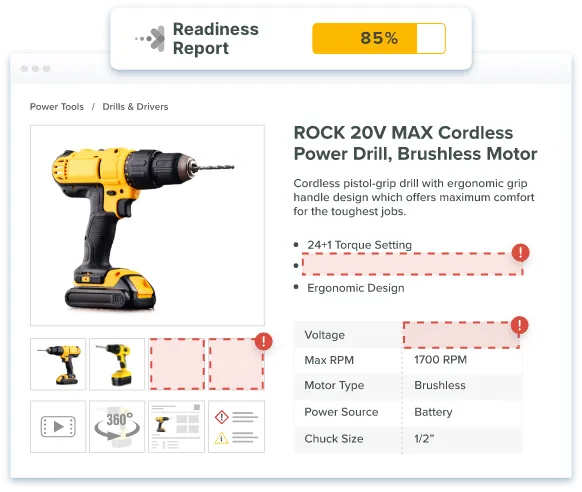
When engineering maintains CAD files in PLM systems, marketing stores content in separate platforms, and distributors track specifications in their own databases, manufacturers lose an average of 25 percent of engineering time to non-productive data management tasks. This directly impacts process efficiency and prevents operations from achieving the consistency that continuous improvement requires.
The Real Impact on Manufacturing Processes
Manual processes create cascading problems. Teams spend hours copying information between systems, reformatting technical data for sales channels, and hunting for the latest version of critical specifications. What works for managing 100 products becomes completely unmanageable at 1,000 products distributed across 20 channels.
Product quality suffers exponentially under fragmentation. When multiple versions of specifications exist across isolated systems, eliminating defects becomes nearly impossible:
These inefficiencies translate directly to higher production costs and customer satisfaction problems. According to Gartner research, data silos make consistency significantly harder, and errors that emerge from inconsistent data cascade through the entire production process — affecting customers at every stage.
2. How Product Information Management Transforms Manufacturing Operations
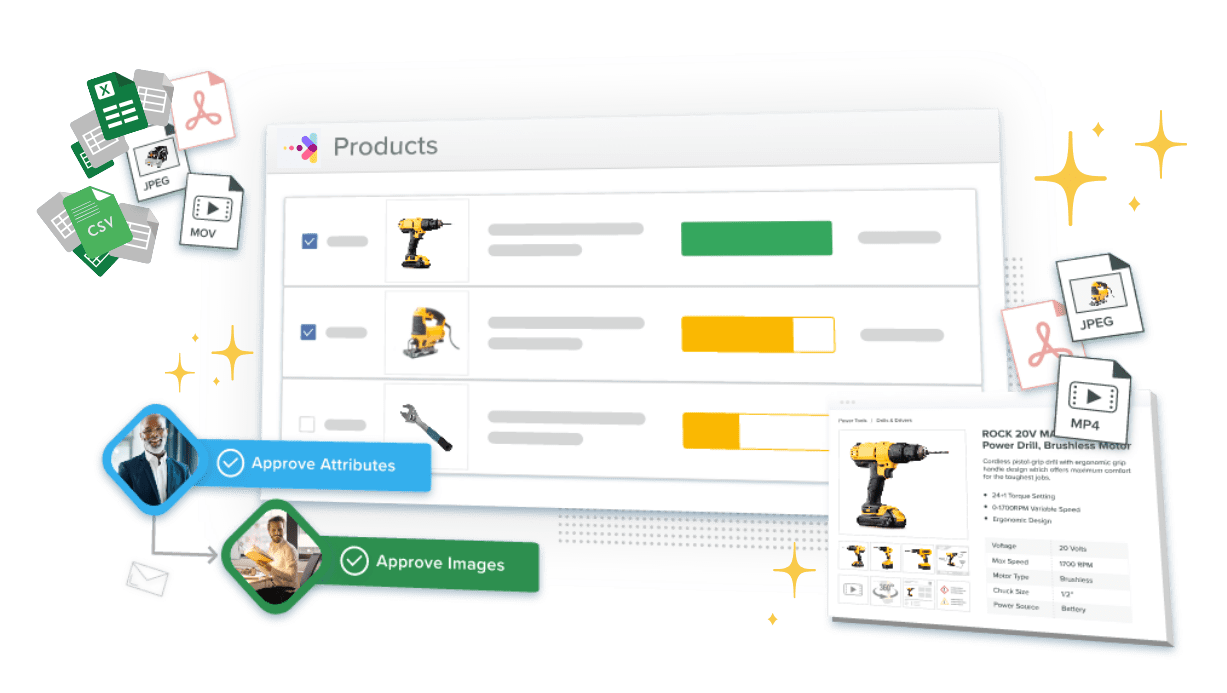
PIM systems integrate lean principles into data management by creating one central repository for all product information. Instead of maintaining separate databases for each team, PIM creates a single source from which data lives, is governed, and syndicates. This mirrors the lean manufacturing principle of eliminating waste — applied to information flow rather than physical materials.
From Chaos to Control
Modern PIM platforms integrate with existing enterprise systems rather than replacing them. Engineering teams continue working in their preferred CAD environments. Sales operates through familiar ERP interfaces. Marketing manages campaigns in their chosen platforms. The difference: all systems pull from and push to the same centralized data source, eliminating the version conflicts and information gaps that prevent improvement.
When design or production details change, updates propagate automatically. Everyone gets the current version without manual notification chains. This reduces errors, keeps assembly lines running from correct specifications, and breaks down the information silos that older systems create between departments.
Automated Workflows Replace Manual Steps
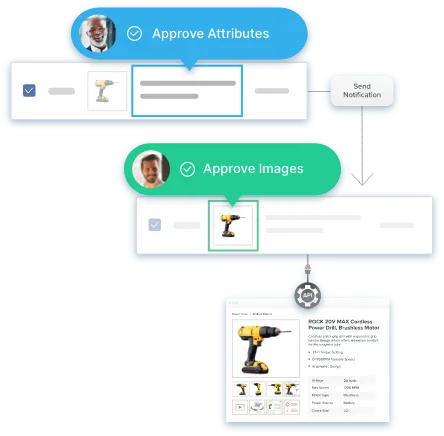
Just-in-Time principles — delivering what’s needed, when it’s needed, to where it’s needed — apply equally to information as to materials. PIM systems apply this logic to product data: when engineering updates a technical specification, the system automatically notifies the right stakeholders, updates all connected platforms, generates channel-ready formats, and syndicates to dealer networks without manual reformatting. The right data reaches the right people at the right time, without the bottlenecks that manual handoffs create.
3. Reducing Production Errors Through Centralized Data Management
An engineer working from version 2.1 of a drawing while production uses version 2.3 is a data governance failure. A distributor sharing specifications that changed three weeks ago is a syndication failure. Marketing promoting features engineering already updated is a workflow failure. These are all symptoms of the same root cause: no single governed source of truth.
Single Source of Truth Eliminates Version Confusion
PIM systems maintain strict version control with detailed audit trails — a cornerstone of Six Sigma and total quality management. Every change is tracked and documented, making it easier to maintain quality standards and satisfy regulatory requirements. Teams always access current information because only one authoritative version exists, eliminating defects caused by data inconsistencies.
When production teams receive accurate bills of materials, assembly instructions align perfectly with engineering specifications and quality requirements stay consistent across all manufacturing locations. The DMAIC framework (Define, Measure, Analyze, Improve, Control) used in Six Sigma requires accurate baseline data throughout — data that PIM systems provide automatically and keep current as products evolve.
Compliance and Quality Control
Manufacturers in regulated industries face stringent documentation requirements. Manual processes and disparate systems make compliance extremely difficult, particularly when regulators demand complete traceability records for raw materials and production outputs. PIM platforms provide automated compliance documentation: every specification change, material substitution, or process modification creates permanent records that satisfy regulatory audits while supporting improvement initiatives.
Workplace safety benefits from this same accuracy. When teams rely on inconsistent or outdated information, safety requirements can be missed. Centralized data management ensures safety documents stay accurate and current across all operations — a non-negotiable for manufacturers in high-risk environments.
4. Accelerating Time-to-Market with Automated Data Distribution
From Months to Weeks
Traditional product launches require sequential coordination across multiple departments and channels. Engineering finalizes specifications. Marketing creates promotional content. Sales prepares catalogs. Distributors update their systems. Each step involves manual data transfer, reformatting, and verification — consuming weeks or months while adding production costs and delaying revenue.
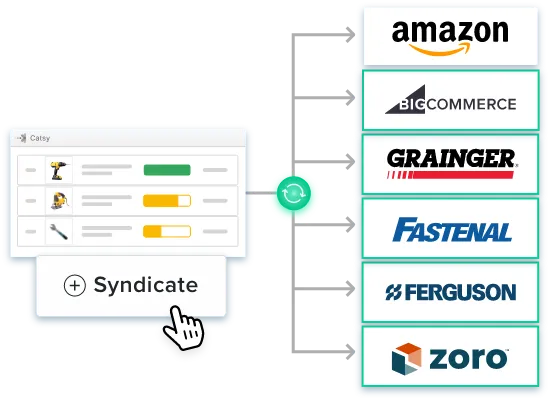
PIM compresses these timelines by automating data syndication. Rather than sequential handoffs, all channels update simultaneously when the PIM record is approved. Research indicates manufacturers using PIM launch products up to four times faster than those using traditional approaches. In competitive markets where first-mover advantage is real, that speed is a strategic differentiator.
This embodies the Kaizen philosophy of continuous, incremental improvement: small automation gains in data handling compound into significant competitive advantage when applied consistently across every product launch.
Seamless Distributor Integration
Modern manufacturing demands efficient B2B relationships and streamlined supply chain operations. Distributors need accurate, current product data to serve their customers effectively — but relying on manual sharing through spreadsheets, PDFs, and email attachments creates delays and mistakes that ultimately hurt customer satisfaction.
PIM enables automated data syndication to distributor networks so information flows consistently and stays current. When specifications change, distributors receive updated data immediately. Digital showrooms reflect current details automatically. Pricing updates roll out across channels without additional effort. This approach reduces wasted time in information transfer, ensures everyone works from the same accurate data, and gives manufacturers the flexibility to respond quickly when market conditions change.
5. Building a Scalable Foundation for Operational Excellence
Designed for Growth
Small manufacturers managing 100 products through spreadsheets often discover their approach fails when scaling to 1,000 products across multiple markets. Manual processes that worked initially become impossible to maintain as complexity grows. Best PIM for Manufacturers platforms scale from hundreds to tens of thousands of products while supporting continuous improvement goals, handling unlimited distribution channels, multiple languages, diverse regional requirements, and complex product hierarchies without performance degradation.
This scalability proves essential as manufacturers expand. Adding new distribution partnerships, entering international markets, or launching new product lines requires zero system reconfiguration. The platform handles increased complexity automatically while maintaining process efficiency across all operations.
Supporting Lean and Quality Principles at Scale
Digital transformation in manufacturing increasingly demands standardized product content classification using frameworks like ETIM and ECLASS. These standards enable efficient master data management for seamless syndication to data pools and distributors — supporting lean production principles by reducing waste in information management.
Total Productive Maintenance (TPM) traditionally focuses on maximizing equipment effectiveness and minimizing downtime. Modern implementations extend this thinking to information systems: PIM platforms require minimal maintenance while delivering maximum uptime, ensuring product data remains accessible 24/7. When information systems are reliable, teams can focus on the higher-value work of process optimization rather than managing data failures.
PIM systems also integrate with IoT devices, AI platforms, and advanced analytics tools. AI adoption in manufacturing — from predictive maintenance to automated scheduling — requires clean, structured product data as its foundation. PIM provides that foundation, making it an enabling infrastructure for the advanced manufacturing technologies coming next.
Human-Centric Automation and Employee Empowerment
Human-centric automation enhances human capability rather than replacing it — allowing workers to engage in problem-solving and strategic work rather than administrative tasks. PIM exemplifies this approach: automating routine data management frees employees to focus on process optimization, quality improvement, and customer engagement.
When employees have access to accurate, real-time product data, they make better decisions and contribute meaningfully to improvement initiatives. Kaizen depends on employee involvement to identify and implement improvements — and that involvement requires workers who aren’t consumed by manual data entry and reformatting. Consistent, accessible product data empowers teams to do the analytical work that actually drives operational excellence.
Future-Proof Architecture
Modern PIM platforms feature API-first architectures that integrate easily with emerging technologies, from AI-powered content generation to blockchain-based supply chain verification. This flexibility maintains compatibility with both legacy systems and new processes, allowing manufacturers to adopt lean techniques and other improvement methods without disrupting current workflows or requiring complete system overhauls. The infrastructure you build today should still be serving your operations when your catalog is five times larger and your distribution network spans twice as many countries.

Key Takeaways

Frequently Asked Questions
Traditional product data management usually refers to engineering systems — PLM, CAD file repositories — that manage technical documentation for design and production. PIM covers a broader range: marketing content, commercial specifications, digital assets, pricing, regional attributes, and the compliance documentation needed for commercialization and distribution. PIM integrates with engineering systems but extends product data visibility across sales, marketing, and supply chain teams, supporting continuous improvement across the entire business rather than just production workflows.
PIM supports lean principles by reducing waste in information management. It creates a single source of truth, removing unnecessary steps in data transfer and eliminating the errors that lead to rework. Kaizen emphasizes continuous improvement and employee involvement — PIM supports both by providing reliable, accessible product data that enables teams to make better decisions and contribute meaningfully to improvement initiatives without spending their time on manual data reconciliation.
TPM traditionally focuses on maximizing equipment uptime and reducing disruptions. Modern operations also depend on reliable information systems, and PIM applies TPM thinking to product data infrastructure: high availability, minimal maintenance requirements, and maximum uptime so accurate product information is accessible whenever teams need it. With a strong data foundation, organizations can track performance indicators, identify trends, and implement targeted improvements across product lines and facilities.
Training is essential for adoption. Employees need to understand how to access and manage centralized product data to work efficiently and confidently. When teams see how a PIM reduces manual tasks, eliminates version confusion, and improves data accuracy, adoption follows naturally. A culture that encourages continuous learning and collaboration helps organizations extract maximum value from the system and sustain long-term process improvement beyond the initial implementation.
PIM improves supply chain visibility by ensuring all partners — distributors, logistics providers, channel partners — work from the same up-to-date product information. This supports better inventory management by providing accurate specifications, dimensions, and attributes that downstream systems rely on for ordering, stocking, and fulfillment decisions. With consistent, current data, organizations can respond more quickly to supply disruptions and make more informed decisions about supply and demand planning.
Six Sigma focuses on reducing variability and meeting customer requirements. PIM helps by maintaining accurate and consistent product information across all channels, which reduces the data variability that causes downstream quality failures. The DMAIC framework requires accurate baseline data throughout each phase — data that PIM provides automatically and keeps current as products evolve. Consistent compliance and safety documentation across all channels also supports broader quality initiatives and regulatory audits.
Organizations combining PIM with lean practices typically see faster workflows, fewer errors, and improved cross-functional coordination. By eliminating manual data handling and improving information visibility, teams reduce the delays that slow product launches and distributor onboarding. Research points to time-to-market reductions of up to 75 percent and error reductions of 30 percent or more. Continuous monitoring and refinement become easier when everyone works from the same accurate data, helping manufacturers stay competitive and adapt to changing market conditions.
Where to Next?
Manufacturing process improvement is a long-horizon discipline — the gains compound over time, and the foundation you build today determines what’s possible in three years. Product data management is that foundation. The manufacturers who have charted a reliable course toward operational excellence are the ones who invested in centralized data infrastructure early, before the complexity of their catalogs and distribution networks made fragmentation a structural competitive disadvantage.
Build the Product Data Foundation for Manufacturing Excellence
Catsy’s PIM + DAM is purpose-built for manufacturers managing complex product catalogs across distributor networks and digital channels — centralizing technical specifications, marketing content, and digital assets in one governed source that syndicates automatically to every channel your customers and partners rely on.
Book a Demo