
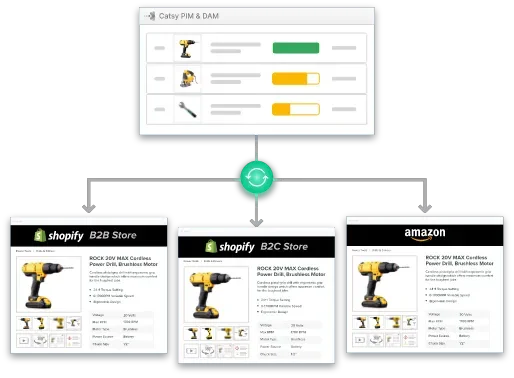
Running a successful Shopify marketplace across multiple countries takes more than the basics. With cross-border ecommerce projected to reach $7.9 trillion by 2030, the opportunity is enormous — but so is the complexity. Whether you’re coordinating multiple sellers across different Shopify storefronts or running a single store that serves customers in many regions, day-to-day operations can quickly become overwhelming for both new teams and experienced operators.
Most marketplace teams run into the same challenges: maintaining brand identity across vendors, managing different shipping requirements, handling payments in multiple currencies, and delivering a smooth checkout experience globally. Shopify works well as a central hub, but international growth usually calls for additional infrastructure. Many teams rely on a PIM system alongside Shopify to act as a control layer for product data — giving merchants, vendors, and developers the structure they need to scale while keeping content accurate and consistent.
1. Why Multi-Marketplace Management Matters for Shopify Merchants
Why merchants expand globally
Market saturation drives expansion. When domestic markets mature, global selling gives you access to buyers facing less competition. Strong brand building can help compete in global marketplaces, and multiple vendors on your platform scale naturally across borders.
Multiple revenue streams emerge. A Shopify marketplace provides multiple revenue streams by hosting diverse products from various sellers. Admins can set fixed or flat-fee commissions on every transaction, creating predictable income as you add more sellers.
Operational burden shifts to sellers. Running a marketplace lets admins avoid the complexities of warehousing, logistics, and delivery — sellers handle those. This reduces the admin’s operational load while maintaining control over brand identity and the buyer experience.
The operational reality for multi-vendor marketplaces
Managing a Shopify marketplace with multiple sellers creates immediate challenges: coordinating shipping methods across time zones, managing local payment gateways, adapting promotions for cultural context, and maintaining compliance across jurisdictions. International buyers expect localized experiences with appropriate shipping options — not confusing foreign currency conversions or unclear delivery timelines.
Why Shopify is the right platform
Shopify features an intuitive interface, drag-and-drop builders, and pre-built themes for rapid deployment. For multi-currency and multi-language support, Shopify offers built-in tools at checkout, including support for more than 130 currencies and automatic exchange rate updates. Shopify prioritizes security with built-in encryption and PCI compliance.
The Shopify App Store includes over 8,000 apps for adding specialized features without custom development — including multi-vendor apps and inventory management tools. Shopify can scale from a few vendors to large-scale operations, with Shopify Plus serving complex needs without requiring a platform change. The Shopify Marketplace Kit allows developers to sell directly from any platform using a collection of APIs, and the Storefronts API gives merchants a modern aesthetic for their shop pages.
2. The Currency and Language Challenge
Research shows 76 percent of online shoppers prefer their native currency, while 92 percent prefer sites that price in local currency. Critically, 33 percent of buyers abandon carts if pricing displays only in USD. For a multi-vendor marketplace, those abandoned carts represent lost commissions across all your sellers.
Multi-currency for ecommerce platforms
Shopify displays prices in over 130 currencies with exchange rates updating automatically. Shopify Payments enables acceptance of all major credit cards and digital wallets without third-party gateways. Key currency management considerations include:
Language localization for multiple sellers
Product categories need culturally appropriate organization, shipping methods require local terminology, and promotions must resonate regionally. Each vendor in your Shopify marketplace needs support creating localized content that maintains their brand identity while appealing to local buyers. Coordinating multiple vendors selling clothing across the US, France, and Japan — the same product needs completely different presentations in each market.
Reaching a wider audience through integrations
Shopify allows centralized management for selling across multiple social media platforms and major marketplaces, with integrated connections for Facebook and other channels. Each market requires localized strategies: SEO tools to improve visibility, digital marketing, content marketing, influencer partnerships, and loyalty programs to attract and retain customers across different markets.
3. Managing Product Information Across Multiple Markets
When running a Shopify marketplace with multiple sellers across countries, product information management becomes exponentially complex. A single SKU represents multiple localized versions, each requiring unique data for different audiences accessing different storefronts.
What varies by market
Core product attributes that must be localized per market:
Marketing content that varies by region:
The manual management trap
Version control failures. When one seller updates a product feature, changes must propagate to all localized versions manually. Multiple vendors working independently means constant synchronization failures. Buyers receive conflicting information, damaging your marketplace reputation.
Consistency failures across sellers. Products might show “in stock” in one market while displaying “sold out” in another despite shared inventory. Multiple sellers managing their own data independently destroys the unified checkout experience buyers expect.
Slow time-to-market. Adding new products across product categories requires duplicating effort for every market. For vendors trying to launch quickly, this delay means lost sales and missed opportunities to reach a wider audience.
Synchronization requirements
Effective Shopify marketplace management requires real-time synchronization. When inventory changes, all markets update simultaneously. When a vendor adjusts pricing, calculations cascade through every currency instantly. When product details change, translations trigger automatically while maintaining brand identity. Establishing a seamless onboarding process for sellers — with tools ensuring data accuracy from day one — prevents the compounding errors that plague manual systems.
4. Systems of Measurement and Regional Compliance
US buyers expect imperial measurements. The rest of the world uses metric. For multiple vendors selling through your digital store, this is fundamental to customer confidence and regulatory compliance.
Measurement conversion for multiple sellers
The same product must display correctly in each market. A 12 oz item at 6.5 x 3.2 x 2.1 inches in the US becomes 340g at 16.5 x 8.1 x 5.3 cm in the UK and Europe. Clothing sizes vary dramatically by region — get this wrong in a multi-vendor marketplace and you’ll face return floods and negative feedback. Temperature specifications matter for electronics, food, and cosmetics: Fahrenheit for US markets, Celsius everywhere else.
Regional compliance for ecommerce platforms
Different countries impose distinct requirements affecting all sellers on your marketplace:
Managing compliance at scale
You need systems providing storage for compliance certifications per market with easy vendor access, automated flagging of products that don’t meet regional standards before buyers see them, updates when regulations change with communication to affected vendors, and market-specific compliance documentation generation. Shopify allows users to print shipping labels and access discounted carrier rates, but compliance management upstream requires dedicated infrastructure.
5. PIM Software: The Control Center for Multi-Marketplace Success
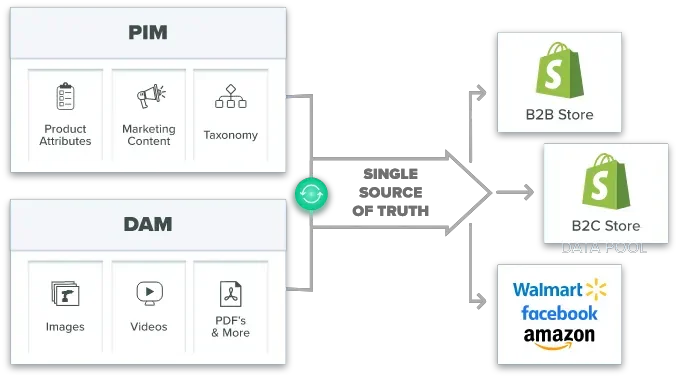
PIM software provides the infrastructure that makes Shopify marketplace operations scalable. Instead of multiple vendors maintaining separate data for each market, you manage one authoritative source that automatically distributes localized versions to all websites, apps, and marketplace integrations.
Understanding Shopify’s limitations for multi-vendor operations
How PIM transforms operations for multiple sellers
Single source of truth for all vendors. All product information lives centrally. One vendor updates data once, and changes propagate everywhere automatically — benefiting sellers, buyers, and internal teams with immediate access to accurate information.
Automated localization across markets. PIM systems integrate with translation services and measurement conversion tools, generating localized content without manual intervention. New businesses can launch in multiple markets simultaneously while established vendors expand product categories efficiently.
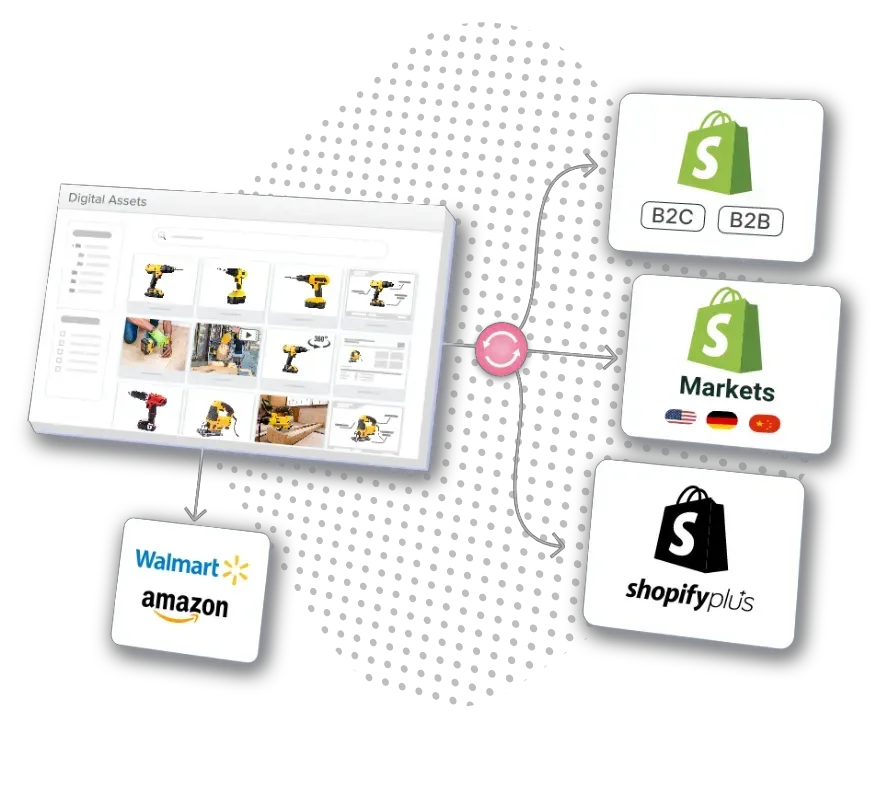
Digital asset management for brand identity. Product images, videos, and documents link to products and distribute to appropriate markets with localized metadata. Developers access assets through APIs, sellers get direct app access, and buyers receive optimized media for their devices.
Workflow automation with vendor support. Approval processes ensure localized content gets reviewed before publishing. Automated workflows provide support for vendors and internal teams, streamlining everything from product creation to the payment process for completed sales.
Real-world impact on your Shopify marketplace
Consider a multi-vendor marketplace with 20 active sellers across 10 countries. Without PIM, each vendor adding new products requires manual entry into 10 separate systems, updating pricing means calculating 10 currency conversions per product per seller, and changing descriptions requires editing 10 localized versions for each vendor. Managing 1,000 SKUs across 20 sellers means maintaining 200,000 product records.
With PIM, one product entry automatically generates 10 localized versions for any vendor. Pricing rules calculate local currencies automatically. Description changes trigger translation workflows across all markets. Managing 1,000 product listings across 20 sellers means maintaining 1,000 master records. The efficiency gain is exponential — and compounds with every new seller or market you add.
Making the transition
Implementing PIM doesn’t require replacing your entire tech stack. Modern solutions integrate with existing systems, allowing phased rollouts that minimize disruption to vendors actively selling through your store. Start with highest-volume sellers and product categories to see immediate impact, migrate product data progressively by category, establish workflows for ongoing maintenance, then expand to additional markets as confidence builds.
Merchants typically report 60 to 70 percent reductions in time spent on product data management, with corresponding improvements in data accuracy and time-to-market. The right platform choice isn’t Shopify or PIM — it’s Shopify with PIM. This combination enables ecommerce platforms to scale smoothly without sacrificing data quality or brand identity.

Key Takeaways

Frequently Asked Questions
Shopify is a popular and practical choice for building an online marketplace. It’s easy to use, ships with a clean dashboard and ready-to-go themes, and can be launched quickly without developer involvement. For a multi-vendor marketplace, you’ll need to add an app to handle vendor management. Many teams also pair Shopify with a PIM system so product data stays organized and vendors can access what they need without losing brand consistency. Pricing starts around $29 per month after a short free trial, with Shopify Plus designed for larger operations that need more flexibility and scale.
Shopify has built-in tools that support more than 130 currencies right at checkout. Shopify Payments allows your business to accept major credit cards and digital wallets without relying on third-party gateways. For multi-vendor marketplaces, smooth payment processing is essential — especially when clearly communicating currency conversion and any associated fees to vendors and buyers. Shopify includes built-in encryption and PCI compliance to protect customer data throughout the transaction process.
Shopify lets you print shipping labels, access discounted carrier rates, and track orders directly from the dashboard. However, Shopify doesn’t always offer the flexibility marketplaces need for complex shipping scenarios with multiple vendors and fulfillment models. Pairing Shopify with a PIM system helps by storing shipping rules by product category and market, then applying the right configurations automatically. Clear communication and documentation for vendors is equally important for keeping fulfillment consistent.
Professional translation goes beyond Shopify’s Store Editor. Coordinating multiple vendors across languages requires systematic processes: the Shopify Marketplace Kit provides developer tools for building UI-optimized marketplace experiences, while PIM systems integrate with professional translation services to maintain brand identity across markets. A seamless onboarding process for sellers is essential — vendors who understand localization requirements from day one create far fewer consistency problems than those who learn as they go.
Shopify’s checkout handles multiple languages, currencies, sales tax, and shipping information for international buyers. Shopify Payments accepts major credit cards and digital wallets without a separate gateway, automatically adjusting for international buyers by showing local currency and relevant payment options. Admins can set commission structures such as flat fees or percentage-based cuts on each sale, with clear reporting so vendors see exactly how fees affect their payouts.
API rate limits can become a bottleneck for high-volume operations, especially when keeping product data, inventory, and orders in sync across multiple vendors and regions in real time. Tax handling isn’t always flexible enough for complex multi-jurisdiction requirements. Shipping configuration can present similar challenges. Many teams address these gaps by using a PIM system to manage product data, rules, and workflows before information ever reaches Shopify — reducing friction and keeping operations running smoothly as the marketplace grows.
Highlight the exposure sellers gain from reaching your customer base, along with any marketing support you provide. A simple, well-organized onboarding process encourages more vendors to join and get up to speed quickly. Be upfront about the value for both sellers and buyers. On the growth side, lean on Shopify’s built-in SEO features, combine digital campaigns, content, partnerships, and loyalty programs to bring in new customers, and add reviews and ratings to build trust. Keep listening to what users and sellers are saying and keep refining the experience so your marketplace can continue to evolve.
Where to Next?
Navigating international multi-marketplace management requires the right charts before you set sail. The merchants winning in global waters today aren’t necessarily those with the largest budgets — they’re the ones with the most organized, accurate, and accessible product information powering every storefront they operate.
Scale Your Shopify Marketplace With Centralized Product Data
Catsy’s PIM connects directly to your Shopify stores and automates product syndication across every market and channel — so you can focus on adding sellers and reaching new buyers, not managing data inconsistencies.
Book a Demo