Product Classification: How to Classify Products at Scale With PIM
From the four consumer product types to UNSPSC, ETIM, and marketplace taxonomies: a practical guide for manufacturers, distributors, and eCommerce teams managing large catalogs.
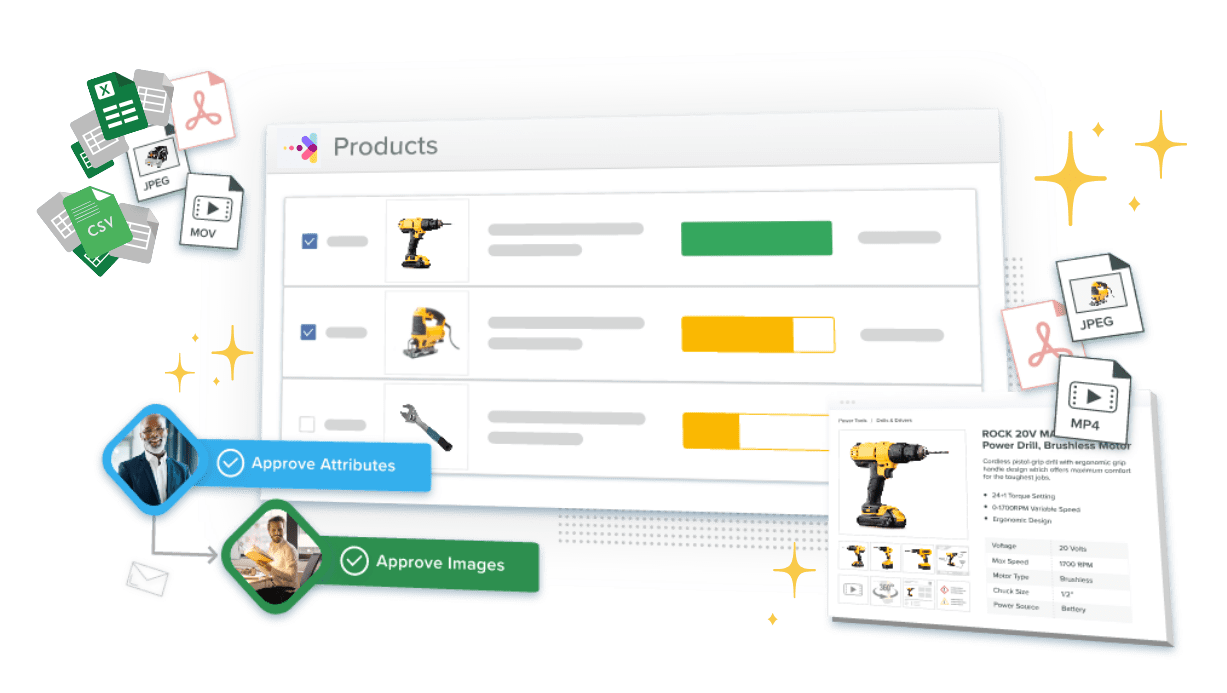
Table of Contents
Product classification for manufacturers is the systematic organization of SKUs into standardized taxonomies: UNSPSC, ETIM, eCl@ss, GS1 GPC, and marketplace browse nodes. Those codes are what let ERP systems exchange your data, marketplaces list your products, and procurement platforms find them. Managing classification inside a Product Information Management (PIM) platform automates attribute inheritance, cross-taxonomy mapping, and channel feed validation across large, complex catalogs.
From the four consumer product types to UNSPSC, ETIM, and marketplace taxonomies: a practical guide for manufacturers, distributors, and eCommerce teams managing large catalogs.
You list a product on Amazon and cannot work out the right browse node. Or a distributor files your industrial components under the wrong commodity code. Either way, you already know what bad classification costs.
Wrong codes mean your products miss the searches that matter. Your distributor’s procurement system cannot read your data. Buyers looking for exactly what you sell never see you.
Classification sits where marketing, operations, and data management meet. Get it right and you gain search visibility, smoother channel integrations, and cleaner inventory data in every system your products touch. Get it wrong and those problems multiply with every SKU you add.
This guide covers the consumer framework and the practical standards that manufacturers, distributors, and eCommerce teams actually work with. For the wider picture, see our complete product data management guide for manufacturers.
What Is Product Classification?
Product classification is the systematic assignment of products to standardized categories, codes, or taxonomies. The criteria vary: how buyers purchase an item, what it is used for, how it is specified, or which industry it belongs to.
Classification brings order to a big catalog. It lets trading partners swap data reliably. And it decides where your product shows up in search, in marketplace listings, and in procurement systems.
The key word is systematic. Classification should be consistent, governed, and repeatable, not a judgment call each team member makes differently.
It is also not the same as naming or describing a product. It is a structured assignment to a defined taxonomy, whether a consumer marketing framework, an industry standard code, or a marketplace category tree.
Three related terms get confused constantly. Here is how they differ.
This guide focuses on the classification layer. For the navigation side, see our guides to product categorization and product taxonomy, and our overview of what a PIM is for how these layers sit inside a governed content architecture.
Classification vs. Categorization: The Real Difference
The distinction gets clearest with a real product in a real manufacturing context.
Take a pressure-relief valve. In a PIM, that valve carries two parallel structures at once.
You need both. They do different jobs, sit in different PIM fields, and go to different places. Confuse them, and put a navigation category where a UNSPSC code belongs, and your products vanish from procurement searches. The product description can be flawless and it will not help. That gap is one reason accurate product information matters so much in B2B sales.
The 4 Types of Consumer Product Classification
The classic framework from marketing theory sorts products into four types by how buyers approach the purchase. It is used in both consumer and B2B strategy, and the type your product falls into shapes distribution, pricing, messaging, and customer experience.
1. Convenience Products
Bought often, with little effort and almost no comparison. Buyers know what they want and want it fast. These are usually non-durable goods, used up quickly, though some durable items follow the same pattern. They compete on availability and familiarity rather than differentiation, so the priority is wide distribution and consistent product data everywhere a buyer might look.
Example: dish soap. Chosen on habit and price with barely a pause. In B2B, consumable supplies behave the same way: office paper, cleaning products, standard fasteners, usually bought on contract or auto-replenishment. Inventory coverage matters more than elaborate marketing.
2. Shopping Products
These involve comparison before purchase. Buyers research, weigh specs, prices, and reviews, then decide. The cycle is longer, and they will spend time getting it right. Shopping products span durable goods like appliances and equipment, and non-durable goods bought on value.
Example: HVAC or industrial air filters. A facility manager compares efficiency ratings, dimensions, media types, lifespan, and price. This is exactly why complete specs matter. A buyer who cannot compare, because your data is missing or inconsistent, picks the competitor whose data is clean.
3. Specialty Products
These have unique characteristics or brand identity that buyers seek out deliberately, and they will go to real effort to get them. Price comes second to the match between product and need. Substitutes usually will not do. Almost always durable goods with distinctive quality markers or proprietary specs.
Example: luxury watches, precision-engineered components, specialized equipment with no direct substitute. In industrial markets the buyer goes to the approved vendor. Your job is being findable when they are ready.
4. Unsought Products
Things buyers do not think about until they suddenly need them. Nobody browses these. They are discovered in response to an event.
Example: insurance, fire suppression systems, emergency repair components. Effective marketing speaks to the triggering event and makes the product easy to find in that moment, which takes strong SEO, clear product data, and fast availability signals from distributors.
Classification Standards for Manufacturers and B2B Sellers
The four-type framework helps with marketing strategy. Day to day, manufacturers and distributors live somewhere else entirely.
Manage thousands of SKUs across dozens of trading partners and you need codes that machines can read. Procurement systems, distributor platforms, and marketplace APIs all have to process them. Six standards come up most often.
UNSPSC: United Nations Standard Products and Services Code
An 8-digit code that covers nearly every product and service. It nests four levels deep: segment, family, class, then commodity. Government buyers require it. So do healthcare supply chains and big purchasing platforms like SAP Ariba, Oracle, and Coupa. Sell to any of them without valid UNSPSC codes and your products never show up in contract searches.
ETIM: European Technical Information Model
The standard for electrical, electronic, and technical products. It runs across Europe, and it is spreading in electrical wholesale and building automation worldwide. Each ETIM class sets out its own technical features and the values you may use. That is what makes the data machine-readable between makers and distributors. For most European distributor catalogs, ETIM is the price of entry.
The current version is ETIM 10.0, released in December 2024. It added 119 new product classes and introduced grouped feature sections, bundling features into groups like material, electrical, and dimensions to make mapping cleaner across sectors. ETIM International releases major versions on roughly a two-year cycle. Because classes and permitted values shift with each release, manufacturers selling into ETIM-governed channels need a way to track which version their catalog conforms to, and to re-map affected attributes when a new release lands, rather than auditing thousands of SKUs by hand each cycle.
eCl@ss (ECLASS)
A cross-industry standard for classifying and describing products. It is used heavily in industrial manufacturing, process industries, and engineering, and it is strongest in German-speaking markets. Like ETIM, it pairs a hierarchy with a structured attribute model. Industrial procurement platforms and ERP systems in automotive, chemical, and engineering often require it. Our guide to how ERP, PIM, and DAM form a single source of truth covers how those systems exchange classified data.
GS1 GPC: Global Product Classification
GS1’s retail standard, used across packaged goods, grocery, and general merchandise. GPC codes are required for GDSN, the network Walmart, Target, Kroger, and other big retailers use to take in and check product data. Sell through major retailers and need GTIN compliance? Then GS1 GPC belongs in your stack.
NAICS and NAPCS
Two government statistical systems. NAICS sorts businesses by industry. NAPCS sorts the products and services those businesses sell. Neither shows up much in daily channel work, but both are required for some government reporting, export paperwork, and statistical filings.
HS Codes: Harmonized System
The global customs and tariff system, run by the World Customs Organization and used by nearly every country. Export anything and every shipment needs an HS code. Those codes also set tariff rates and duty. Get one wrong and you have a legal problem, not just an operational one.
The next revision was originally expected as “HS 2027,” but the WCO extended its review cycle by a year. The eighth edition, now named HS 2028, was accepted on 21 January 2026 and enters into force on 1 January 2028. It carries 299 sets of amendments, adding 428 new subheadings and removing 172. The heaviest changes cluster in three areas: public health, where new subheadings cover ambulances, PPE, ventilators, and diagnostic devices, and vaccines move into two new headings (30.07 and 30.08); environmental protection, where plastic waste is restructured to match Basel Convention requirements and single-use plastics gain their own classification; and the food-pharmaceutical boundary, where a new heading (21.07) finally settles long-running disputes over dietary supplements. Manufacturers in those sectors have a two-year window to audit current commodity codes against the new nomenclature.
Marketplace and Channel Classification Requirements
Industry standards are only half of it. Every major sales channel keeps its own taxonomy too. Put a product in the wrong category and the damage is immediate. You lose visibility, your content quality score drops, or the listing never gets approved at all.

Every channel has its own taxonomy. Maintaining correct Amazon browse nodes, Walmart taxonomy codes, Google product categories, and UNSPSC codes for thousands of SKUs across spreadsheets is unsustainable, and it is where errors start. For a deeper look at one channel, see how brands run Amazon listing operations at scale.
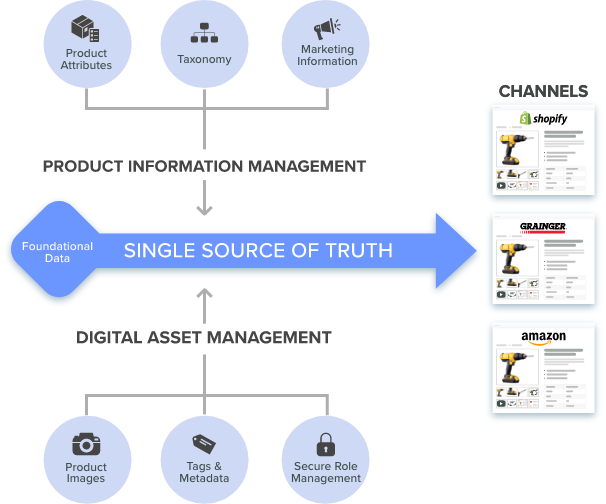
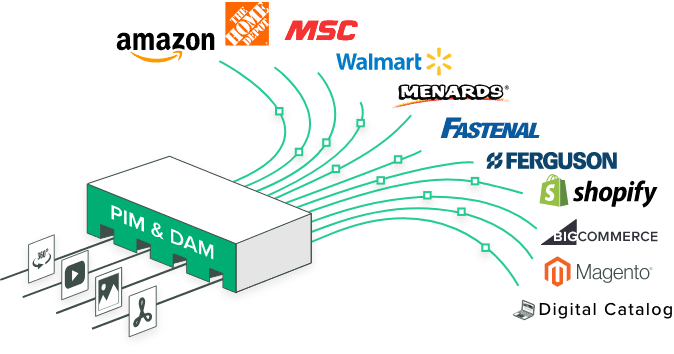
Catsy stores each product’s classification across several standards in parallel. One source of truth, every channel served. Your team assigns the attributes once in the PIM: UNSPSC code, Amazon browse node, Google product taxonomy, Walmart taxonomy. Catsy maps each into the correct channel format and syndicates automatically. When Amazon revises its browse node structure or Walmart adds taxonomy codes, you update the governed attribute in Catsy once, rather than in every channel portal separately.
How PIM Enforces Classification Rules at Scale
Classification only pays off if you enforce it. A framework that lives in a spreadsheet, or in one person’s head, will drift.
New products get classified differently from old ones. Seasonal additions skip the step entirely. The catalog turns inconsistent, and that inconsistency flows downstream to every channel you publish to. This is the core argument for using a PIM to make and keep your data clean.
That 42% ties straight back to classification. Marketing keeps one version. eCommerce keeps another. Operations keeps a third, in a different system and half-finished. No single record is authoritative, so no channel downstream can trust any of them.
The same gap has followed manufacturers into their AI work. Gartner predicts that through 2026, organizations will abandon 60% of AI projects unsupported by AI-ready data. Classification data is already structured, governed, and machine-readable. That makes it one of the easier places to start.
A PIM enforces classification through three mechanisms.
Attribute Inheritance for Complex Variant Matrixes
Large catalogs are rarely flat. Most manufacturers manage parent-child structures where one base product spins off dozens or hundreds of variants: sizes, finishes, voltages, packaging configurations. Classifying each variant by hand is where manual processes break first.
Attribute inheritance solves it. You set the codes once on the parent, and every child variant picks them up. The only exceptions are attributes that genuinely differ, such as an HS code that changes because a variant uses a different material. This cuts manual entry sharply. It also keeps things consistent: a child SKU cannot drift into a different UNSPSC segment just because someone typed it twice. Deciding which fields belong at which level is its own discipline, covered in our guide to parent vs. SKU attribute ownership.
Cross-Taxonomy Mapping
Most manufacturers do not classify against a single standard. One SKU might need a UNSPSC code for procurement buyers, an ETIM class for European distributors, an Amazon browse node for the marketplace, and an HS code for customs, all at once. Keeping those as separate spreadsheets synchronized by hand is where drift usually starts.
Cross-taxonomy mapping fixes that. Your internal code translates into each destination format automatically when you syndicate. One “motor” SKU gets its ETIM class and its Amazon B2B category at the same moment, both drawn from one record. When a taxonomy changes, you edit the mapping rule. You do not touch the products.
Managing Version Upgrades Without Data Corruption
Standards do not sit still. ETIM moves about every two years. HS codes follow the WCO cycle, now set for 2028. Amazon and Google change more often than either. Each release can rename, split, merge, or retire a code your catalog depends on. Done by hand, an upgrade means auditing every affected SKU and hoping nothing slips. In a governed PIM, the old and new code sets can run side by side for a while. Validation rules flag any product still on a dead code, so you re-map it on purpose instead of watching a channel feed break the day the standard changes.
AI and Automated Product Classification
Classifying a big catalog by hand is slow and uneven. An operator doing 500 products a day makes calls that a second operator would make another way. Over time the catalog drifts. AI helps at three levels.
Catsy’s AI-assisted classification suggests UNSPSC codes, marketplace browse nodes, and taxonomy assignments from product attributes and descriptions. Every suggestion carries a confidence score, so high-confidence assignments can be approved in bulk while lower-confidence ones route to a human reviewer. Validation rules still apply afterward, so even AI-suggested codes must pass your governed vocabulary requirements before reaching a channel.
A 5-Step Process to Classify Products at Scale
Most classification projects fail for one reason. Teams start classifying before the governance is in place. Here is the order that works.
For most manufacturers, a classification project using Catsy’s pre-loaded templates and AI-assisted tools runs 30 to 60 days from audit to first syndication, depending on catalog size and how many standards are in scope. The governance infrastructure then stays in place, so products added after the initial project follow the same workflow from day one.
2026 Taxonomy Governance Checklist
Those five steps get a catalog classified. Keeping it that way is the harder part. ETIM moves every two years, HS 2028 lands in January of that year, and marketplaces revise whenever they like. Use this as a recurring review.
Key Takeaways
Frequently Asked Questions
Which product classification standard should I use?
Choose based on your industry and sales channels. UNSPSC suits government procurement and ERP systems. ETIM supports electrical and technical products. eCl@ss is common in industrial manufacturing. GS1 GPC is used widely in retail and is required for GDSN. Amazon and Google each require their own taxonomies. Multi-channel manufacturers typically run several standards at once, managed through a PIM.
What are the 4 types of product classifications?
The four types are convenience products, shopping products, specialty products, and unsought products. They are defined by how buyers approach the purchase, and each calls for a different marketing, distribution, and inventory strategy.
What is the difference between product classification and product categorization?
Classification assigns standardized codes for system interoperability and data exchange, such as a UNSPSC code used by procurement platforms. Categorization organizes products into customer-facing groups for browsing and navigation, such as a breadcrumb on your website. Both are required, and they live in different attribute fields in a PIM.
How long does it take to classify a large product catalog?
With pre-loaded templates and AI-assisted classification, most manufacturers reach first syndication in 30 to 60 days, depending on catalog size and how many standards are in scope. The timeline depends far more on how many standards you need and how complete your existing attribute data is than on raw SKU count.
Can AI classify products accurately enough to trust?
For most of a catalog, yes, with review. Machine learning models trained on an existing classified catalog produce confidence-scored suggestions, so high-confidence assignments can be approved in bulk while ambiguous ones go to a human. Regulated categories, where a wrong code carries compliance consequences, should always keep human review in the loop. PIM validation rules apply to AI suggestions the same way they apply to manual entries.
When does HS 2028 take effect, and what changes?
HS 2028 was accepted on 21 January 2026 and enters into force on 1 January 2028. It carries 299 sets of amendments, adding 428 new subheadings and removing 172. The largest changes affect public health items, environmental categories including plastic waste and single-use plastics, and the food-pharmaceutical boundary, where a new heading covers dietary supplements.
References
Classify Your Entire Catalog at Scale
Catsy centralizes classification as governed, validated attributes, so your products carry the right codes for every channel, every standard, and every trading partner. One source of truth, zero classification drift. Book a demo to see it on your own catalog.