
AI Agents · PIM

What is the Best PIM with AI Agents?

A Comprehensive Comparison Guide

By Ceejay S Teku  ·  April 6, 2026
Catsy best PIM with AI agents
What You'll Learn
AI Integration Capabilities: how modern PIM systems leverage AI agents to automate data enrichment and translation
Agentic Commerce Readiness: why businesses need PIM systems that communicate with AI shopping assistants
ROI and Efficiency Gains: examples of companies reducing product content prep time from months to days
Essential Features: the critical capabilities that separate basic PIM from truly intelligent platforms
Implementation Strategy: how to evaluate and select a PIM system for the AI-driven commerce revolution

As digital commerce keeps evolving, more businesses are asking the same question: what is the best PIM with AI agents? Product data lives everywhere — across e-commerce platforms, marketplaces, ERP systems, and new sales channels that seem to appear overnight. Keeping product information accurate and consistent across multiple channels is no longer something your teams can manage by hand.

This is where modern product information management (PIM) systems step in. The best PIM software actively improves your product data using automation and intelligent workflows. When AI agents are built into a PIM platform, product data management becomes faster and far more scalable. Rather than reacting to data problems, businesses can stay ahead of them.

Understanding AI Agents in Product Information Management

Traditional PIM systems were built to centralize product data. They act as a single place to store product descriptions, technical specifications, digital assets, and other core product information. That alone brings big benefits — teams can centralize product data, reduce duplication, and improve data accuracy across multiple sales channels.

The problem is that traditional PIM software still relies heavily on manual effort. Someone has to clean the data, validate it, update product content, and manage workflows. As product catalogs grow and businesses expand into multiple regions and languages, that work becomes overwhelming.

AI agents change how PIM systems work. Instead of waiting for humans to fix issues, AI agents actively monitor product data and take action. They can validate data quality and detect errors, then suggest corrections automatically. They can generate product descriptions and translate content into multiple languages. All of your product information stays up to date across all sales channels.

Key Features That Define the Best AI-Powered PIM

Not all PIM solutions are created equal. The best PIM software with AI agents includes a clear set of core features designed to support scale, speed, and accuracy.

·Automated data enrichment: AI tools analyze existing product data, competitor listings, and digital shelf analytics to improve product content.
·Data validation: AI agents continuously check for missing attributes, incorrect values, and inconsistent formatting.
·Intelligent workflow management: AI can route tasks automatically, reduce bottlenecks, and support cross-functional collaboration.
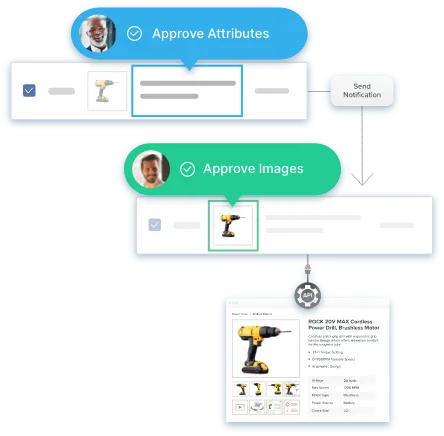
·Digital asset management: AI-powered DAM can tag images, verify quality, and ensure the right assets appear on the digital shelf.
·Built-in analytics and reporting: Teams can see which attributes drive conversions and where product data needs improvement.
·Cloud-native platform: Scales easily, supports API access, and integrates smoothly with ERP systems and ecommerce platforms.

Digital Asset Management in AI-Driven PIM Systems

Digital asset management plays a major role in product data management today. Product images and digital assets are just as important as product descriptions and technical specifications. If assets are outdated or mismatched, customer trust drops quickly.

In AI-driven PIM systems, digital asset management is fully integrated into the centralized platform. AI tools automatically tag product images, link them to the correct products, and validate that they meet quality standards. A unified platform that combines PIM and DAM gives teams a single source of truth.

Catsy best PIM with AI agents

How AI Agents Transform Product Data Management

Onboarding speed. AI-powered PIM solutions can ingest supplier data, extract product attributes, and validate technical specifications automatically. What once took weeks can now happen in days or hours.

Product content creation. AI agents generate product descriptions tailored to different sales channels and regions. Content can be localized into multiple languages while maintaining consistent product data and brand voice.

Continuous optimization. Instead of waiting for quarterly reviews, the system uses digital shelf analytics and performance insights to improve product content in real time.

Workflow management. AI agents help manage version control, track approvals, and enforce data validation rules. Problems are caught early, and improvements happen continuously.

Agentic Commerce and the Future of Product Discovery

Agentic commerce is changing how products are discovered and purchased. AI shopping assistants can now search product catalogs, compare options, and complete purchases on behalf of users. These systems rely on structured, accurate product data to function.

For businesses, this means product information management systems must be ready for machine consumption, not just human browsing. Product data must be complete, consistent, and machine readable. Missing attributes or outdated information can cause products to be skipped entirely by AI agents.

The best PIM with AI agents supports agentic commerce by providing structured product data, API access, and real-time updates. As more consumers rely on AI assistants, businesses that invest early in AI-ready PIM systems will have a clear advantage.

Choosing the Right PIM Solution for Your Business

Start by defining your business needs. Consider your product catalogs, number of sales channels, and regions you support. A PIM software comparison is essential — look closely at AI capabilities, not just feature lists. Ask how AI agents are actually used to improve data quality, product workflows, and operational efficiency.

Integration is another key factor. The best PIM software offers seamless integrations with ERP systems, ecommerce platforms, and third-party tools. Usability matters too — a user-friendly interface reduces the steep learning curve that often comes with enterprise software.

Book a demo with Catsy

Key Takeaways

The best PIM with AI agents turns product information management into a true strategic advantage.
AI-powered PIM systems improve your data quality while they reduce manual effort across your teams.
Faster, more automated workflows support shorter time to market for new and updated products.
Centralizing product data helps maintain consistency across multiple sales channels.
Streamlined operations make it easier to scale and adapt to agentic commerce.
Choosing a cloud-native PIM platform with strong AI capabilities ensures long-term flexibility.
Built-in analytics and seamless integrations help businesses meet today’s demands and prepare for what comes next.

Frequently Asked Questions

What makes a PIM system "AI-powered" instead of just automated?

The biggest difference is in how it thinks. Basic automation follows fixed rules that you set up one time. An AI-powered solution uses AI agents that can learn from your product data, spot patterns, and fix common issues — improving product content without manual effort.

Do I really need AI agents if I already have a PIM system?

If your catalog is growing or if you’re selling across multiple channels, then yes, it’s worth it. Traditional PIM systems are great at centralizing product data, but AI agents keep that data accurate without adding more manual work for your team.

How do AI agents actually improve data quality?

They constantly check your product data for missing attributes and errors. If something looks off, the system can flag it or correct it based on patterns it’s already learned. That leads to better data accuracy and fewer surprises on your digital shelf.

Will my team need technical skills to use an AI-powered PIM?

Nope. The best PIM software is built with a user-friendly interface and intuitive UI. The AI works in the background, so marketing teams and sales teams can focus on product content rather than wrestling with complex tools.

Can an AI-powered PIM help us launch products faster?

Absolutely. AI agents speed up onboarding by extracting supplier data, generating product descriptions, validating technical specifications, and managing workflows automatically. That can cut time to market from weeks or months down to days.

How does AI-powered PIM support agentic commerce and AI shopping assistants?

AI shopping assistants rely on structured product data — and that data should be accurate. A PIM with AI agents ensures that your product catalogs are consistent and easy for machines to read, helping your products get discovered and selected by AI buyers.

Is AI-powered PIM only for large enterprise brands?

Not at all. Mid-market brands benefit just as much, especially if they’re managing multiple sales channels or planning to expand globally. AI helps smaller teams work like much larger ones by reducing manual effort and improving operational efficiency.

Where to Next?

AI is no longer a future consideration for product information management. It is already reshaping how manufacturers and distributors enrich content, govern data quality, and scale across channels without adding headcount. Catsy’s connected PIM and DAM platform handles the complexity of large, multi-channel catalogs. When you are ready to go deeper, our guides below walk through the decisions that matter most before you commit to a platform.

Add AI Agents to Your Product Data Workflow

Catsy’s AI-powered PIM actively monitors, enriches, and distributes product data across every channel — turning your product information management from a maintenance task into a competitive advantage.

Book a Demo