

What Is Product Information Management?
Product information management (PIM) helps businesses centralize product data, then distribute that data across sales and marketing channels. As commerce becomes more digital, managing complete product data is foundational to operational success.
Why it matters: When product data is fragmented or unreliable, it impacts every aspect of your business. Launch timelines expand and customer expectations go unmet. Returns increase, and your teams spend time correcting preventable data errors instead of driving growth.
According to research published in MIT Sloan Management Review, companies lose an estimated 15 to 25 percent of revenue due to poor data quality (Thomas C. Redman, “Seizing Opportunity in Data Quality,” 2017). For organizations operating across multiple channels, the risk compounds quickly.
“Companies lose an estimated 15-25% of revenue due to poor data quality.” – MIT Sloan Management Review, 2017
The growing complexity of product data
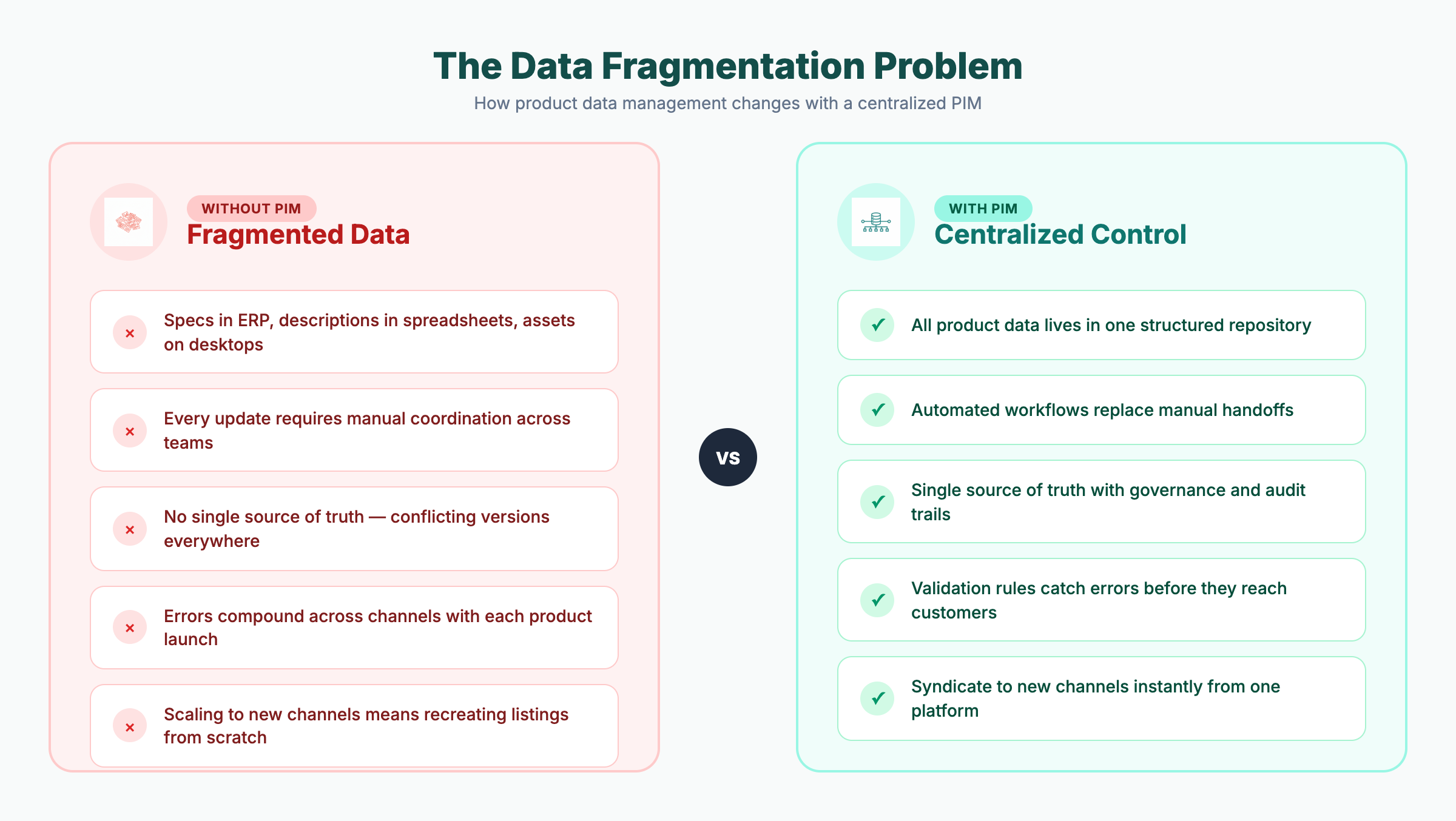
Launching a product today is far more complex than it was even a decade ago. Maybe your tech specs live in your ERP, but your marketing teams are updating descriptions elsewhere. Your pricing is in siloed spreadsheets while your digital assets are stored on random team members’ desktop folders.
Every update requires coordination, and every handoff introduces risk.
Now, multiply that effort across hundreds — or thousands — of SKUs and multiple suppliers. Compliance requirements are evolving, and your distribution channels are expanding. What was once manageable is now a messy web of data that requires manual processes and keeps inconsistent records. What a mess.
This is the operational reality for many e-commerce businesses and manufacturers, and it’s why data accuracy and operational efficiency are now executive-level concerns.
Manual data management was never designed for this environment.
What Is Product Information Management, Really?
Product information management (PIM) is both a business discipline and a category of software built to bring structure and governance to product data at scale.
At its core, a PIM system creates a centralized platform where your teams can collect and manage product data, then enrich and distribute it. Rather than chasing updates across disconnected tools, your teams operate from a single source of truth that supports each stage of the buying process, using PIM software to build and manage that centralized environment.
The benefits show up quickly. Automated workflows replace manual tasks, and data governance gets stronger. Your product content becomes easier to scale across your ecommerce platforms, mobile apps, and retail partners as well as your print catalogs and any emerging digital channels.
Just as importantly, PIM gives you the foundation you need to deliver consistent customer experiences. When your customers see the same, accurate product data wherever they shop, confidence increases and friction is reduced.
A practical way to think about PIM
Think of PIM as the operational hub for your product catalog.
Your PIM is where your product specs, tech data, pricing, and digital assets all live together in a structured home. Marketing teams layer in the emotional data — storytelling, SEO attributes, translations, certifications, and compliance documentation.
Once enriched, your product content flows directly to each of your chosen channels in formats tailored to each destination.
It’s useful to compare this with a content management system. Your CMS manages your website content, but a PIM prepares product data for every platform you sell on.
What makes a modern PIM platform effective
Industry analysts often describe PIM solutions as technology that keeps an approved and shareable version of product content. The goal is clear: create a single source of truth for multichannel commerce.
Four capabilities make that possible.
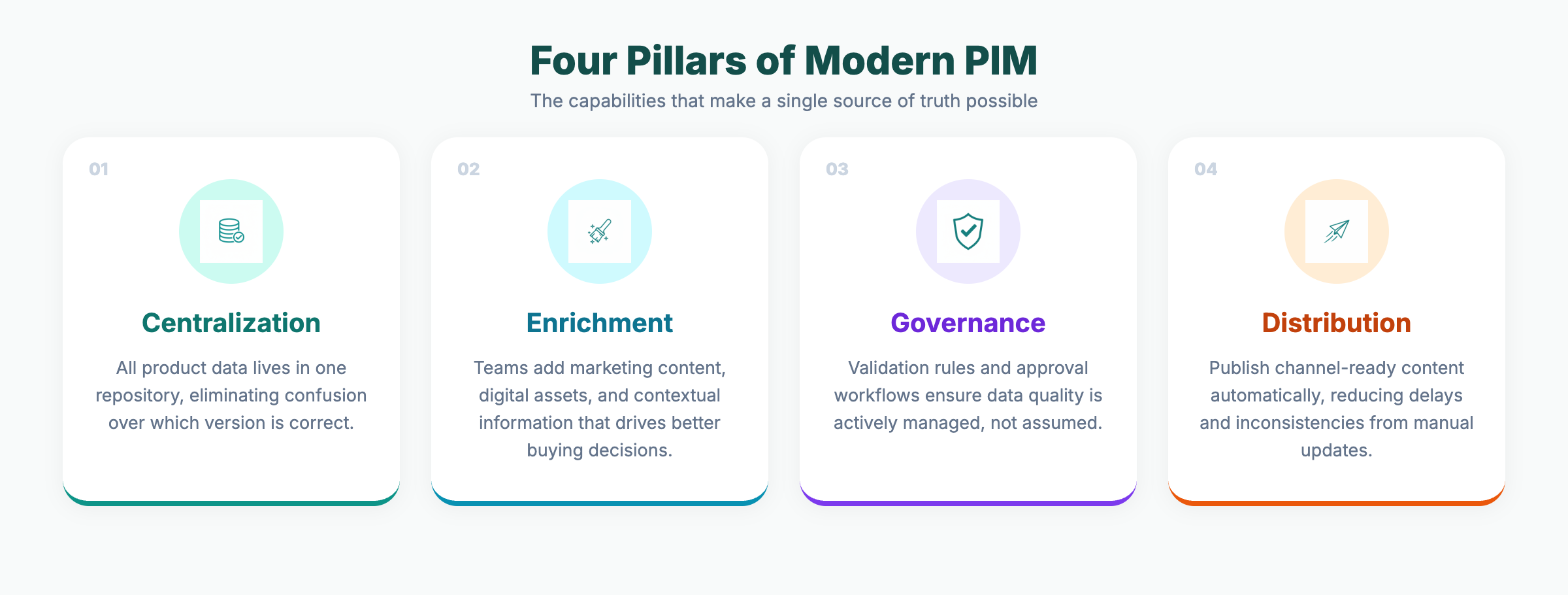
Centralization ensures that all of your product data lives in one repository, eliminating confusion over which version is correct.
Enrichment gives your teams the tools to add marketing content, digital assets, and contextual information that supports better buying decisions and improved customer satisfaction.
Governance introduces validation rules and approval workflows — it gives you accountability. Data quality improves because it’s actively managed, not assumed.
Distribution enables your organization to publish channel-ready content automatically, reducing the delays and inconsistencies that come with manual updates.
Understanding what PIM is… and what it’s not
PIM makes more sense when you see what it complements, not what it replaces.
A PIM platform serves as a centralized hub for product data management and governance, helping organizations maintain data quality at scale. It also operates as a publishing engine for multiple channels while supporting integrations across other systems.
Equally important is understanding what PIM is not. It is not simply a spreadsheet replacement or a substitute for enterprise resource planning. It is not a static catalog, and it is not limited to large enterprises.
Instead, PIM transforms raw product data into structured, enriched content that is ready for digital commerce.
Organizations often question whether digital asset management should exist separately from product data management. Platforms like Catsy address this by combining PIM and digital asset management within a single centralized environment.
Keeping product images aligned with product content reduces integration complexity and strengthens operational control, especially for visually driven brands.
What Centralized Product Data Does a PIM System Manage?
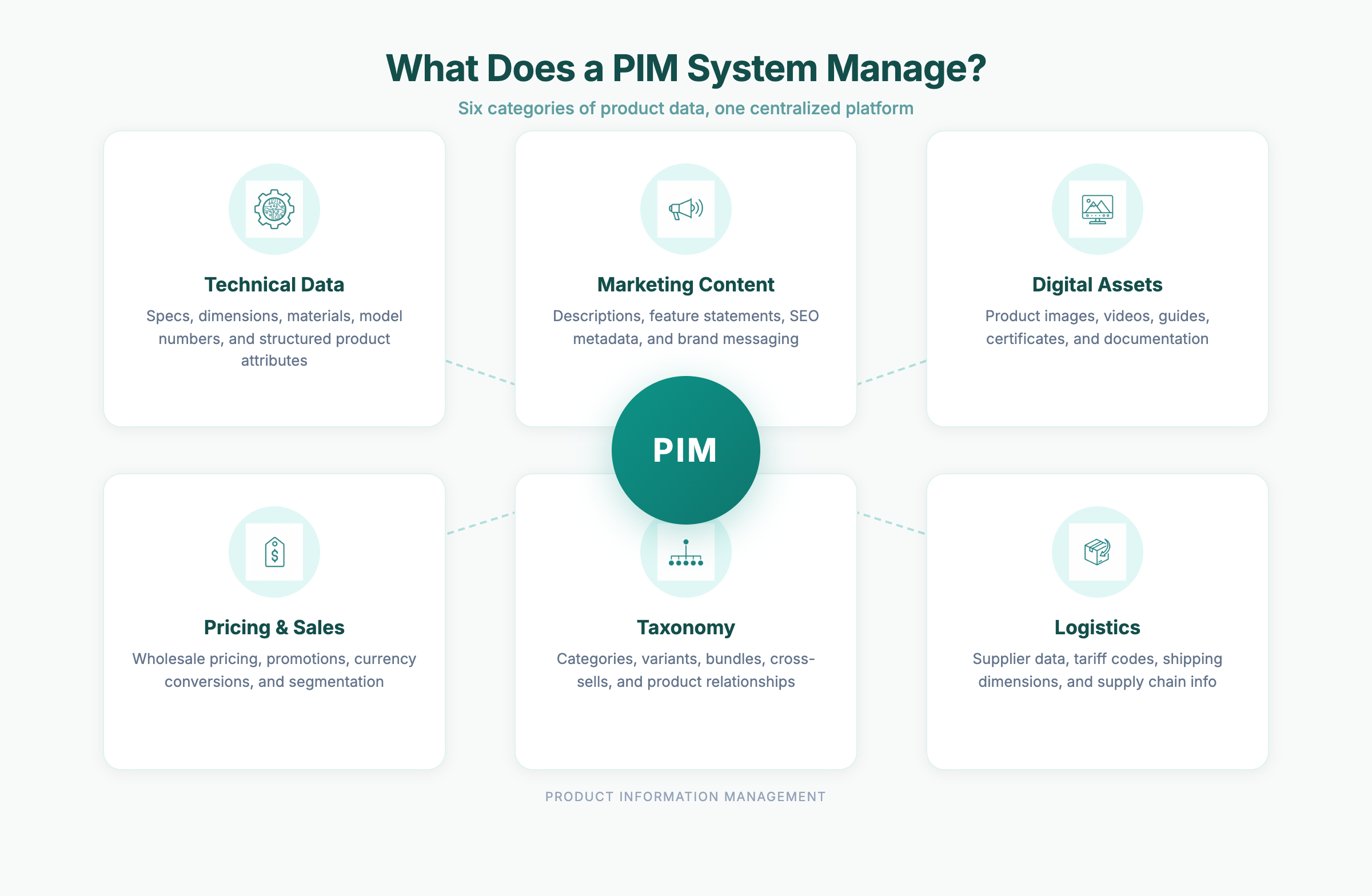
Today’s PIM platforms handle product names and SKUs, but they also centralize all of the information you need to market your products successfully.
Technical data forms the foundation. That includes product specifications, dimensions, materials, compatibility info, model numbers, and other structured attributes.
Marketing content is layered on top: optimized product descriptions, feature statements, brand messaging, and metadata designed to support digital marketing performance.
Digital assets are equally critical. Product images, videos, installation guides, certificates, CAD files, and documentation need to remain tightly connected to your product records to ensure consistency across channels.
Pricing and sales data often include wholesale pricing, promotional pricing, currency conversions, and pricing strategies tailored to different customer segments.
Taxonomy structures define your categories, variants, bundles, cross-sells, and product relationships that simplify navigation for your customers and improve the buying process.
Usage data such as care instructions, warranty details, and compatibility guidance reduces customer service friction while improving customer satisfaction .
Logistics information including supplier data and tariff codes helps align product content with supply chain management, especially when supported by streamlined product information workflows for e-commerce.
Consider a furniture manufacturer managing a single bed frame. The record may include multiple product images, an assembly video, packaging dimensions, safety certifications, material descriptions, and detailed specifications. Without centralization, maintaining accuracy becomes nearly impossible.
How a PIM System Works
Platforms may vary, but most PIM systems follow a structured lifecycle that transforms fragmented data into content that’s ready to reach your customers.
The process starts with aggregation. Data is imported from ERP systems, supplier feeds, spreadsheets, and other systems into one central repository.
Then, standardization. Incoming data is normalized to match a consistent model, and validation rules are applied. Incomplete records are flagged for improvement.
Classification comes next. Products are assigned to taxonomies and hierarchies that determine required attributes, maintaining catalog consistency.
Enrichment is where collaboration picks up speed. Marketing teams add content, attach digital assets, optimize for search, and prepare listings for marketing campaigns.
Governance ensures accountability through approval workflows, audit trails, and role-based permissions that protect data accuracy.
Distribution pushes approved content to your sales channels.
Finally, monitoring closes the loop. Teams track completeness scores, syndication errors, and performance metrics to continuously improve data quality.
This lifecycle is ongoing. As products evolve, the system adapts without introducing operational chaos.
Benefits of Product Information Management in Digital Commerce
When businesses implement PIM, they consistently report measurable gains across operations and revenue.
“Product launches reduced from 2-3 weeks to minutes.” — Leigh Country, Catsy customer
A centralized source of truth eliminates data silos and ensures every team member is working from the same, accurate data.
Time to market gets faster through automated workflows that replace manual effort. Catsy customer BAMA, a manufacturing company, reported a 70 percent faster time-to-market after implementing PIM.
Product data quality improves through validation rules and governance, giving teams greater confidence in the accuracy of their product records.
Customer experience strengthens when shoppers encounter detailed specs, high-quality imagery, and relevant product data that builds purchasing confidence and customer loyalty.
Conversion rates rise with richer product content. Salsify’s internal research (2023) found that enhanced product content increases conversion rates by an average of 15 percent, with some categories seeing gains up to 50 percent.
“Enhanced product content increases conversion rates by an average of 15%.” — Salsify, 2023
Returns decline when descriptions set accurate expectations. According to Akeneo’s 2025 B2C Survey of 1,800 consumers across eight countries, 40 percent of shoppers returned a product in the past year due to inaccurate product information. Better data means fewer returns.
Omnichannel expansion becomes far more manageable with PIM. Instead of recreating listings for each destination, teams can syndicate consistent branding to ecommerce sites, marketplaces, and every digital channel from a single source, following PIM strategies that support global scalability.
Operational efficiency may be the most immediate benefit. BAMA reported a 60 percent reduction in data manipulation time, allowing their team to focus on higher-value initiatives while also unlocking SEO gains driven by centralized, optimized product content.
“60% reduction in data manipulation time. 70% faster time-to-market.” — BAMA, Catsy customer
The result is compelling. Catsy customer Leigh Country achieved return on investment within 12 months of implementation.
Who Uses PIM?
Product information management systems are inherently cross-functional. PIM users span nearly every department.
Business users across the organization rely on PIM for different reasons. Product managers keep accurate records. Marketing teams gain access to enriched content that accelerates campaigns. Ecommerce managers streamline listings and updates across platforms, and sales teams get immediate access to tech specs and collateral.
Customer service teams operate more confidently when accurate product information is readily available. Data and analytics teams gain actionable insights into data quality and catalog performance.
Industry adoption is equally broad. Retailers and distributors manage large catalogs across multiple sales channels. Manufacturers maintain product specifications while syndicating content to partners. Consumer packaged goods companies support retailer requirements.
Apparel brands coordinate complex variant structures. Healthcare organizations track regulatory data. Automotive and electronics companies manage compatibility relationships.
Apparel brands coordinate complex variant structures. Healthcare organizations track regulatory data. Automotive and electronics companies manage compatibility relationships.
Any organization selling products across multiple channels or managing complex data can benefit, and many find that common myths about PIM implementation overstate the difficulty of getting started.
PIM vs. Other Enterprise Systems
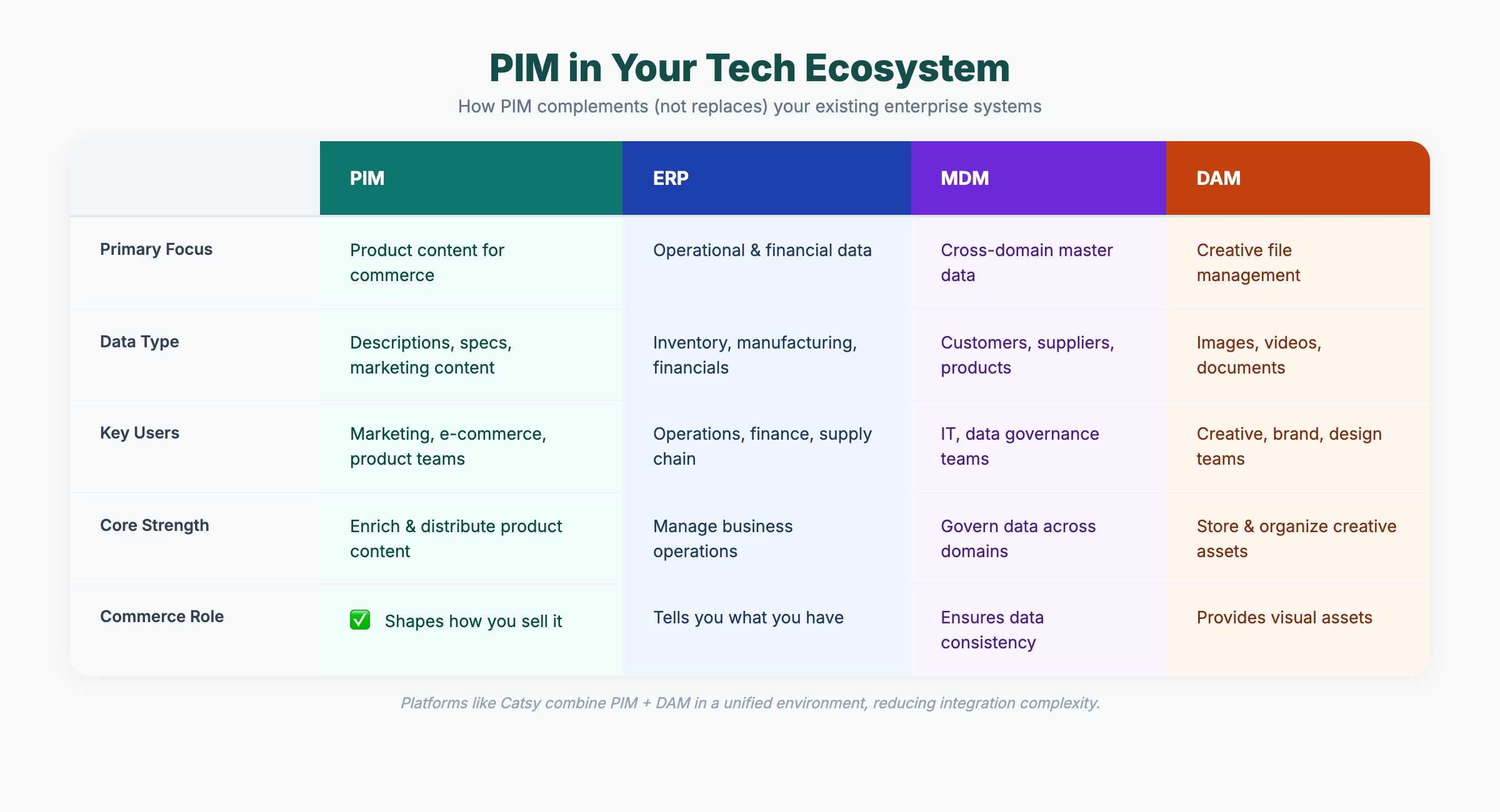
Editor’s note: I would recommend turning the table above into a native HTML CSS table rather than an image.
PIM is most powerful when it’s understood as part of a larger tech ecosystem.
Enterprise resource planning systems (ERPs) manage operational data like manufacturing processes and inventory. PIM manages marketing-ready product content. ERP tells you what you have; PIM shapes how you sell it.
Master data management platforms (MDMs) govern multiple enterprise domains like customers and suppliers. PIM focuses specifically on the product domain, with tools designed for e-commerce.
DAM platforms specialize in storing and governing creative files. PIM connects those assets directly to product records.
Rather than integrating separate platforms, some organizations adopt solutions like Catsy that manage both data and creative assets natively. A unified workflow reduces licensing overhead while ensuring that governance spans both imagery and product content.
Together, these systems create a seamless flow from design to sale.
When Do You Need a PIM System to Ensure Data Quality?
Your organization may not need PIM immediately, but there are signs that spreadsheets and manual workflows aren’t cutting it anymore.
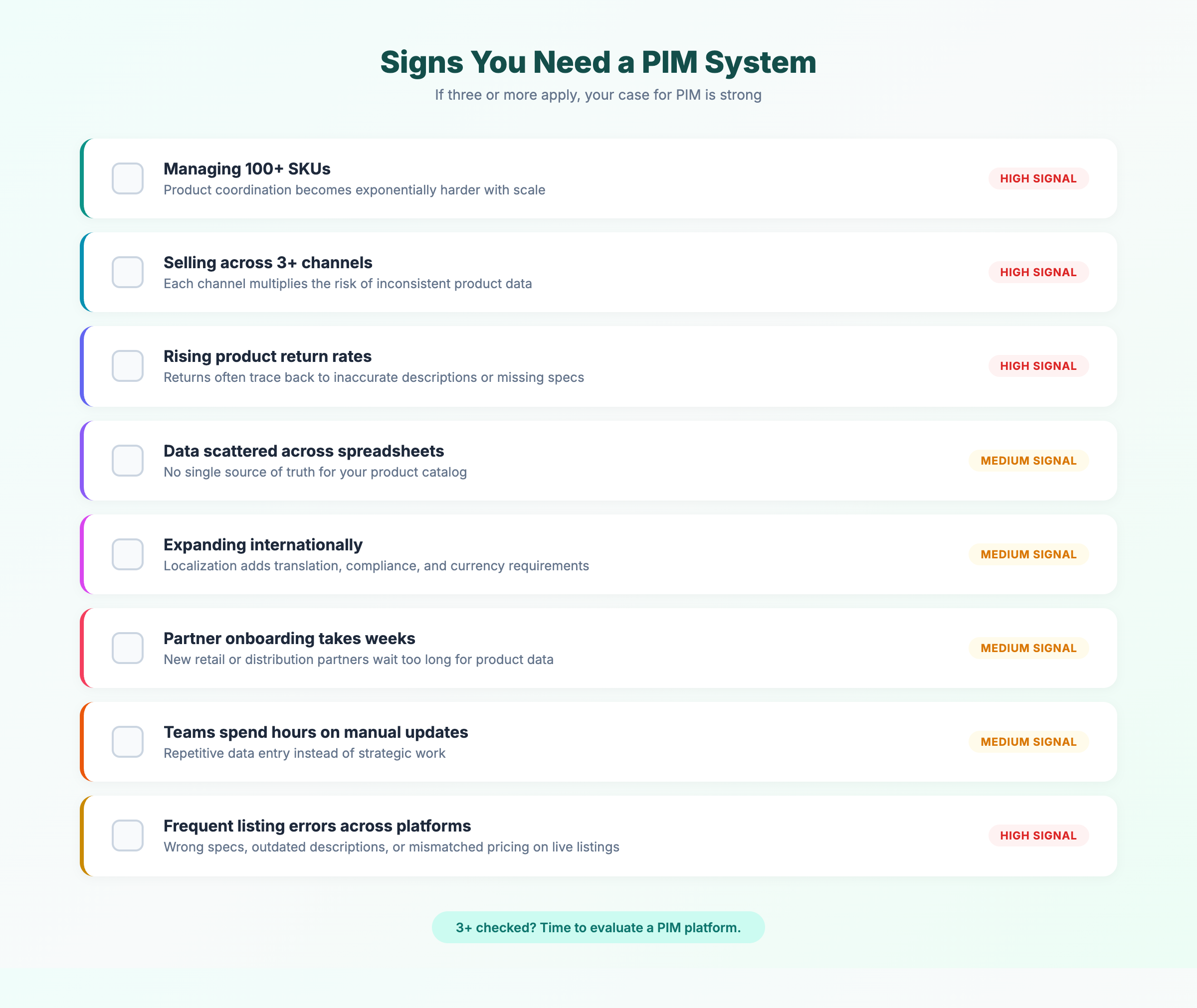
Companies that manage more than 100 SKUs often run into coordination challenges. Selling across three or more channels compounds the issue. Scattered data and rising error rates increase operational strain.
International expansion adds localization requirements. Growing return rates can point to inaccurate product info. If onboarding new partners takes weeks, or if your teams spend excessive time on manual updates, your case for PIM strengthens, especially for B2B brands scaling on platforms like BigCommerce with tightly integrated PIM.
Many Catsy customers arrive at this realization once they’re managing hundreds or thousands of products across numerous channels and recognize that their current processes are unsustainable.
As a guideline, organizations experiencing multiple symptoms simultaneously are likely ready to evaluate a PIM platform.
Use Cases Across Industries
The value of PIM is clearest in real-world applications.
Fashion brands that launch seasonal collections need to coordinate thousands of size and color variants. A centralized system for managing variants allows them to cut launch timelines dramatically while reducing listing errors.
Consumer packaged goods manufacturers sync data with major retailers that enforce strict validation standards. Structured data models and automated feeds shrink onboarding timelines considerably.
Electronics companies manage complex tech specs and compatibility data. Medical device manufacturers track regulatory documentation and unique device identifiers.
“70% faster product data turnaround across 500,000+ SKUs and 70+ retailers.” — BrandJump, Catsy customer
These scenarios represent just a portion of PIM’s cross-industry impact.
Choosing a PIM Solution
Selecting a PIM platform requires aligning technology capabilities with business needs.
Flexible data modeling is essential to accommodate variants, bundles, and evolving catalogs. Workflow and governance tools protect data quality. Enrichment features let teams create better content more efficiently.
Asset management capabilities help maintain consistency between data and digital assets. Syndication connectors streamline distribution while dashboards give visibility into completeness and performance.
The vendor landscape generally falls into four categories:
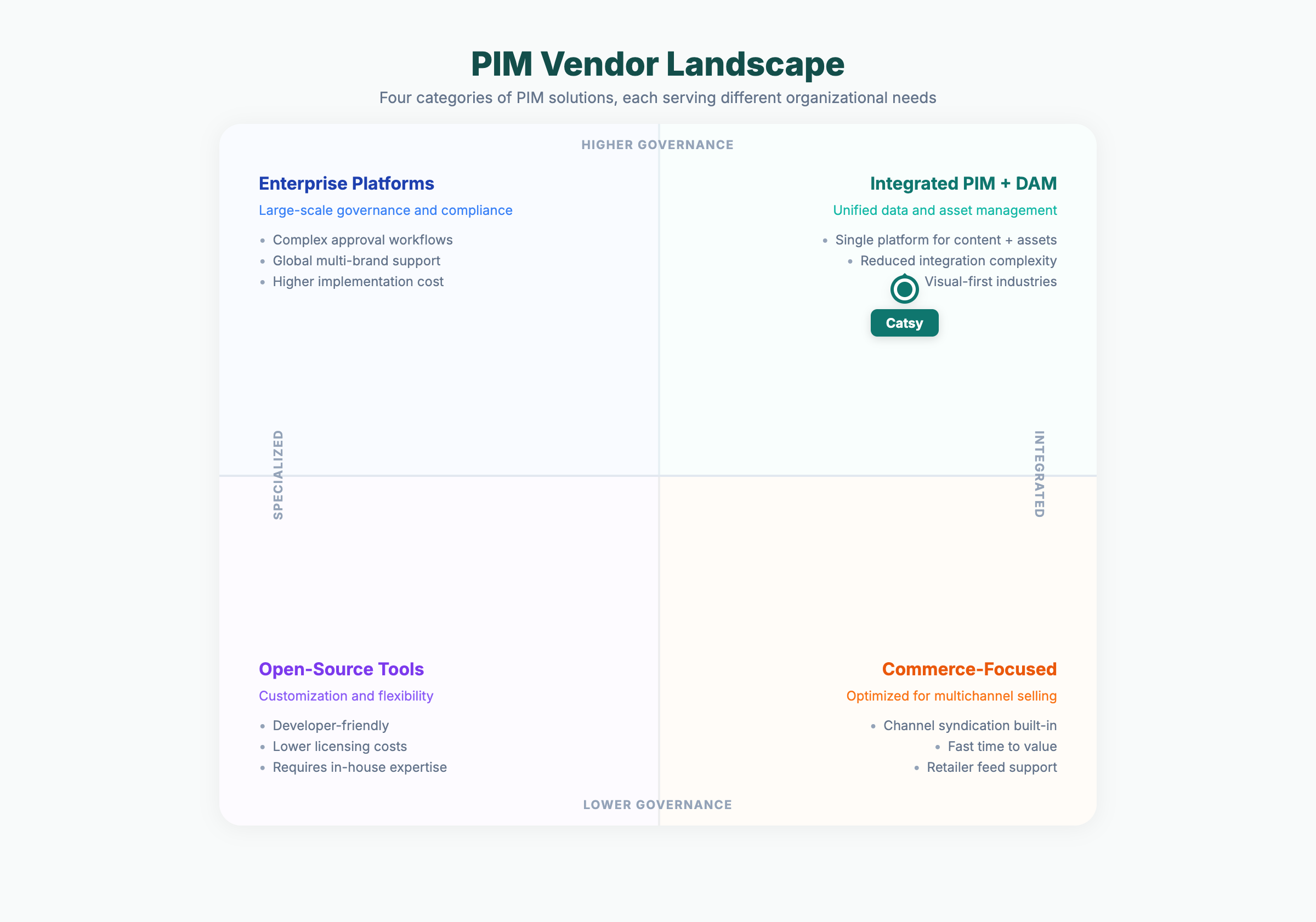
Enterprise platforms designed for large-scale governance
Commerce-focused solutions optimized for multichannel selling
Integrated PIM and DAM platforms like Catsy
Open-source tools that offer customization options
Catsy was designed specifically for visual-first industries where creative assets must remain in sync with content. It’s a strong fit for brands with high asset volumes.
Implementation expectations vary, but pilot deployments often take two to three months, with broader rollouts following a phased approach. Integrated platforms frequently shorten timelines by eliminating complex system integrations, particularly when robust APIs connect PIM and DAM with the rest of your stack.
Success ultimately depends on executive sponsorship, clearly defined governance roles, and disciplined change management.
Emerging Trends in PIM Software
PIM continues evolving alongside the broader commerce landscape.
Artificial intelligence is reshaping workflows by generating product descriptions, recommending content improvements, auto-tagging images, and identifying data gaps. Catsy applies AI capabilities to recognize product attributes from images, generate accessibility text, and surface opportunities to improve conversion through richer media.
Sustainability initiatives and digital product passports are expanding the scope of product data as organizations track materials, sourcing, and environmental impact.
Composable commerce architectures position PIM within flexible technology stacks that support web, mobile, voice, and future channels without requiring full replatforming.
Social commerce demands real-time synchronization between product catalogs and shoppable content.
Collectively, these shifts reinforce PIM’s role as core infrastructure for modern commerce strategies.
Final Thoughts and Next Step
Product information management transforms how organizations create, manage, and distribute product content. By centralizing product data, enforcing governance, enabling enrichment, and automating distribution, PIM software supports faster launches, stronger data accuracy, improved customer experiences, and measurable growth.
Whether you manage hundreds of products or hundreds of thousands, the right platform scales with your business and strengthens your ability to compete.
Organizations early in their evaluation may benefit from a readiness assessment. Those comparing vendors should consider a structured selection framework, while teams preparing for deployment often succeed with a phased implementation plan.
Curious whether Catsy aligns with your catalog and channel strategy? A short product catalog assessment can provide personalized recommendations, estimated timelines, and projected ROI, and you can review PIM software pricing options to understand which tier best fits your needs. You can also contact the Catsy team to schedule a brief consultation with a PIM specialist and explore your options.
The organizations gaining advantage in modern commerce are not simply collecting product data. They are activating it. With the right product information management system, you can do the same.