
Turning spreadsheets into a single source of truth
How a leading U.S. pump manufacturer eliminated manual data workflows and built a centralized product content platform with Catsy PIM and DAM.
Liberty Pumps is a leading U.S. manufacturer of wastewater and drainage pump systems. They serve residential and commercial markets through industrial distributors like Ferguson.
Liberty Pumps uses a product information management PIM system, Catsy, as a centralized repository for their product data. Catsy makes it easier to store data in just one place and to maintain that data consistently across all sales channels. It's a huge part of making digital commerce and product data syndication actually work across multiple channels.
Before Catsy, things were a whole lot messier. Their product data lived all across Epicor's ERP systems and in a mix of manually managed Excel files. These multiple systems created data silos and inconsistencies, and way too much need for manual entry. It slowed down distributor readiness and made fixing data accuracy a constant effort.
Once they implemented Catsy PIM software and DAM (digital asset management), everything started to come together. In just 12 weeks, they centralized their product data, linked their digital assets directly to SKUs, and they automated parts of their workflows. With this done, marketing teams can create product descriptions and marketing collateral with turbo speed — no more worrying about where to find the correct version of the data they need.
The result? Teams get a single source of truth for their product information. Better accuracy and stronger control over product data made Liberty Pumps more efficient and cut down on manual work.
Liberty Pumps designs and manufactures pumping products for the removal of groundwater and wastewater. They offer complete, pre-assembled sewage packages for residential and commercial settings, and they sell sump pumps, sewage pumps, grinder pumps, and effluent pumps.
In short, their data supports a catalog with hundreds of SKUs and many product families. This data is distributed through industrial suppliers across North America.
Before Catsy, product data was managed across three disconnected systems:
Teams were storing digital assets like images and spec sheets separately from their product data with no link to the SKUs. That meant that teams had to manage all of that product data and their digital assets across multiple systems. That led to data silos, and it made product data management much harder than it needed to be.
Before Catsy, the setup was reliant on Epicor ERP exports and manually maintained Excel files. With no real centralized repository, it was tricky to keep all of the product data aligned across sales channels. Maintaining accurate information was nearly impossible.
There wasn't really any metadata management in place, either, which was making it hard to organize product information and connect related digital assets. Over time, that led to data inconsistencies and lower data quality. Naturally, that meant more manual work for teams who were trying to keep everything synced.
Each and every product began in Epicor, but that was just the very beginning of a very long manual process. Teams were left to export product data and combine it with separate marketing and technical spreadsheets. Then, they'd have to reformat everything and run validation, only to send it back out across channels. There was no true single source of truth that was owning the final product record.
Marketing teams had to create product descriptions and feature fields by hand, so they were frequently repeating work across product families that had minor changes. Digital assets had to be manually matched to the right SKUs, and pricing details lived in disconnected spreadsheets — with no validation, of course. Without proper metadata management or centralized data management, keeping product data aligned across existing systems was a constant challenge.
And then there was the manual data entry that slowed everything down. Just the addition of one SKU could take between 20 and 46 minutes. Without a PIM to streamline those workflows, updates that should have just taken a few hours stretched into days. Data inconsistencies showed up between ERP systems and marketing files, and preparing distributor feeds for partners like Ferguson required heavy manual effort every time.
In the end, there wasn't really a system of record — just a bunch of files that were forced to act like one. That made it hard to keep data accurate and maintain consistent product data.
Liberty Pumps chose Catsy PIM and DAM with a pretty clear mission: get rid of the manual merging, create one version of the truth for product data, automate the repetitive content work, and make distributor syndication clean and repeatable. All of that, without ripping out Epicor.
So, rather than replacing their ERP they just built on top of it. Using a PIM like Catsy, they were able to reduce manual data entry and keep data consistent across each of their sales channels. It turned product data management from a cleanup job to something structured.
Their rollout was done in phases over 12 weeks. They were seeing progress the whole time — no need to wait to the end.
Success criteria: Eliminate manual ERP to spreadsheet workflows and significantly reduce manual data entry. Automate marketing content creation and improve data accuracy across the board. Link all digital assets directly to product records inside the PIM system. Launch at least one validated distributor channel at go-live, ensuring accurate product data across all sales channels.
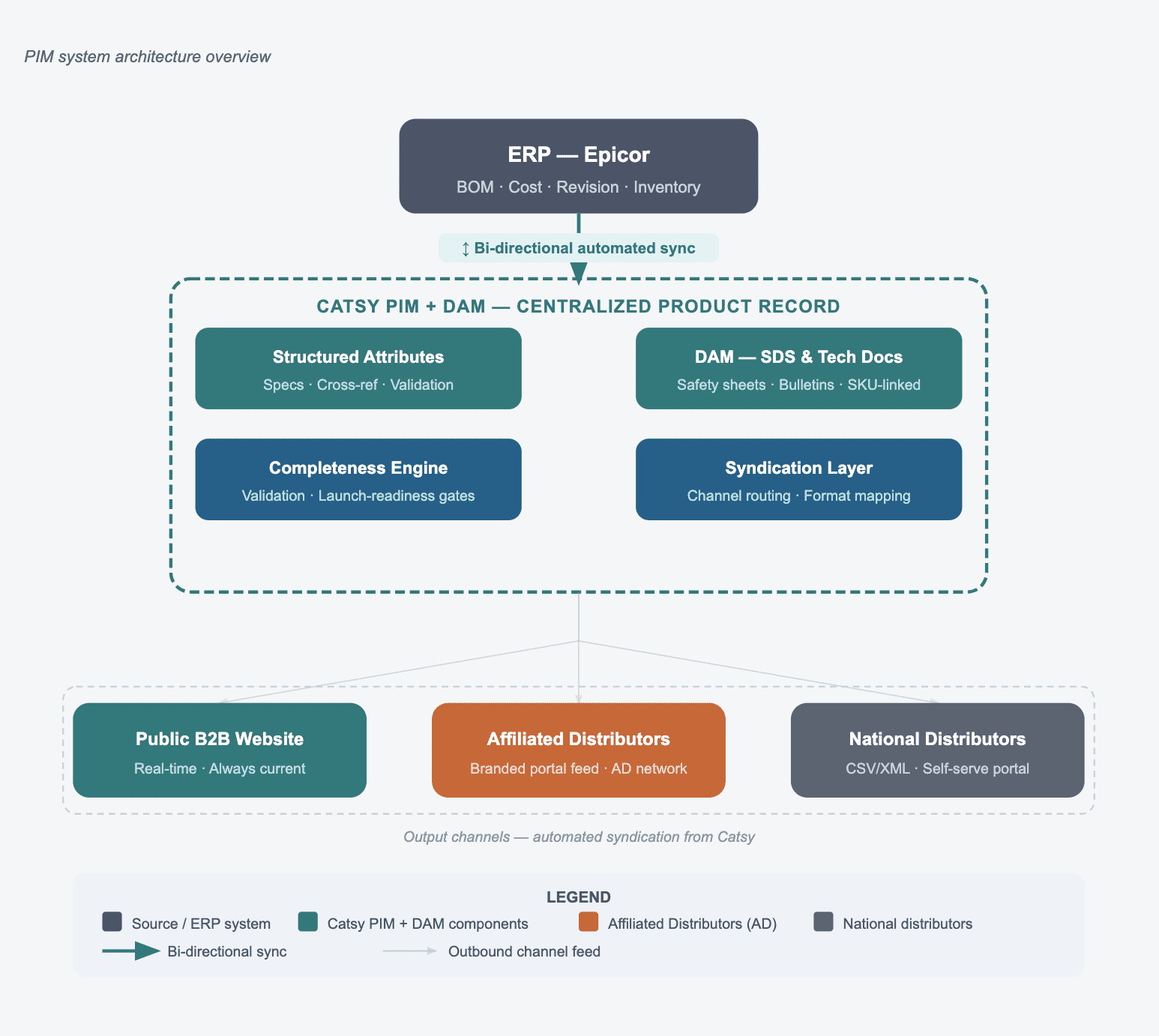
Catsy's PIM is the structured content layer between the Epicor ERP and Liberty Pumps distribution channels. Catsy helps to centralize the product data and organize product info to distribute it across multiple sales channels.
ERP data like pricing details and core product attributes flow into the PIM system on a scheduled basis. That keeps your product data aligned with ERP data without duplicating its functionality. Within Catsy, product records are enriched with product descriptions and tech specs that ERPs weren't built to manage.
Catsy's DAM got rid of one of the biggest bottlenecks in the team's old process. Digital assets like images, PDFs, manuals, and spec sheets are now directly linked to the product data according to SKU. That means when teams prepare for distributor pushes or product data syndication, the correct assets are already attached.
Rule-based automation inside the PIM system helps streamline workflows by generating marketing materials and product descriptions from existing product attributes. This reduces manual data entry and frees up marketing teams to focus on higher-value work. It also turns raw product data into actionable insights that support better decisions across manufacturing operations. Internal price list channels create a controlled space for managing pricing details, replacing disconnected spreadsheets with a validated system that improves data accuracy.
Distributor channels, starting with Ferguson, are configured to match required schemas across commerce systems and marketing channels. Built-in data validation guarantees that product data is complete and accurate before it's shared.
Internal price list management and collaboration between teams also improve how product data is handled. Engineers and marketing teams work together within the same PIM system, ensuring technical specifications are correct and product information stays aligned.
In the end, Catsy PIM provides a centralized repository and single source of truth for product data. It brings together product master data, supplier data, and related digital assets into one system.
"Catsy allows us to manage our data more efficiently and avoid costly errors when updating data manually. The integration with EPICOR is very convenient for getting our data and setting up our channels to distribute it. Catsy automates our databases and serves as one source of truth."— Kim, Digital Asset and Pricing Administrator, Liberty Pumps, Inc.
ERP integration is the foundation, not the ceiling. Liberty Pumps did not try to replace their ERP systems. Instead, they extended them. By treating Epicor as the source of transactional truth and the PIM system as the structured content layer, they removed the fragile manual handoff that caused data quality issues. This approach to product data management helps centralize product data while keeping enterprise resource planning focused on transactions. Choosing the right PIM software is key to making this work and to building a strong product information management PIM strategy.
Rule-based automation increases content capacity without adding headcount. When product data is structured correctly, marketing teams can generate product descriptions and feature content automatically. This reduces manual data entry, improves data accuracy, and helps manage complex product data across large catalogs. It is especially valuable for manufacturers working with repeating product families across multiple sales channels.
Asset linkage is essential for distribution readiness. When digital assets are disconnected, teams waste time trying to match files to product records. With digital asset management built into a PIM system, related digital assets are linked directly to SKUs inside a centralized repository. This improves data quality, ensures accurate product data, and supports reliable product data syndication across multiple channels.
A phased approach delivers value faster. Liberty Pumps structured their implementation in stages, starting with data consolidation, then automation, and finally channel configuration. This made it easier to manage product data and improve operational efficiency without waiting for everything to be perfect. Each phase strengthened the overall product information management system and reduced risk.
Distributor syndication requires structure, validation, and formatting. A strong PIM solution adds this layer by handling field mapping, validation rules, and asset connections before product data is shared. This ensures consistent product data and accurate information across multiple sales channels and commerce systems.
Liberty Pumps completely changed its product information operations in 12 weeks, cutting out manual workflows and automating content creation — just by putting a PIM system in place that every team and each channel can rely on. They created a true single source of truth across their entire system.
For manufacturers who are dealing with complex product catalogs across ERP systems and internal teams, Catsy is the layer that connects everything. It makes it easier to manage complex data — especially at scale — and to eliminate data silos. This naturally improves data accuracy and keeps consistent data flowing across each and every sales channel.
With the right PIM software in place, workflows become more predictable and easier to manage. Product data syndication turns into a repeatable process instead of a manual task, and accurate information moves cleanly across commerce systems and distribution networks. The result is stronger operational efficiency, better data quality, and a more reliable customer experience across every channel.
Ready to build your single source of truth?
Request a demo at catsy.com/demo| Workflow area | Before Catsy | After Catsy |
|---|---|---|
| Product data source | Multiple — Epicor exports + separate marketing spreadsheets maintained by different teams | Single — Catsy PIM, continuously synced from Epicor via scheduled import; supplier data integrated for procurement and compliance |
| ERP-to-content workflow | Manual export, merge, reformat, and validate every time an update occurred | Automated scheduled import; product records in Catsy stay aligned with Epicor continuously |
| Marketing content creation | Written manually per product; duplicated effort across product families; error-prone | Generated automatically using attribute-based rules; consistent across all product families; product descriptions are standardized and centrally managed |
| Digital asset management | Stored separately from product records; manually associated with SKUs when preparing files | Linked directly to product records in Catsy DAM; automatically included in exports |
| Price list management | Disconnected spreadsheets; no centralized validation; inconsistency risk | Centralized in structured Catsy channels with validation before distribution; pricing details consolidated and validated |
| Distributor feed preparation | Manual assembly per distributor; time-intensive; inconsistent formatting | Schema-configured channel exports; validated automatically; repeatable on demand; marketing channels managed for consistent syndication |
| Data accuracy risk | High — manual hand-offs between systems created inconsistency between ERP and marketing data | Low — single validated record in Catsy; all changes flow from one controlled source |